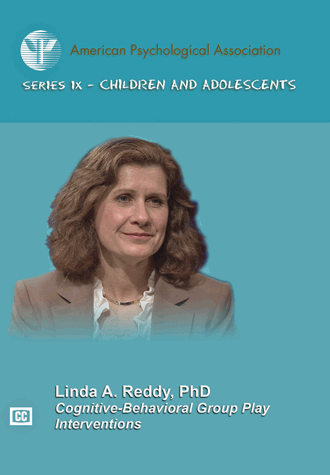
Cognitive-Behavioral Group Play Interventions
ISBN: 978-1-4338-1732-8Streaming options
In this video, Dr. Linda A. Reddy demonstrates evidence-based approaches to implementing cognitive–behavioral group play interventions with children who are 4–10 years old. Often times, children with neurocognitive and behavioral issues such as ADHD, have trouble interacting with other children and adults.
The cognitive–behavioral approach shown here uses group play interventions to help children develop prosocial skills such as sharing, asking for and offering help. Dr. Reddy's group-play interventions include a multimodal approach that integrates cognitive–behavioral interventions and skill-intensive opportunities for learning through teaching modalities, as well as structured group therapy interventions.
In this video, Dr. Reddy demonstrates cognitive–behavioral group play interventions with four elementary-aged school children through several exercises in developmentally appropriate games.
Prosocial skills are broadly defined to include social skills, self control, emotional regulation, anxiety/stress management, mastery, goal setting, and anger management skills.
Six principles guided the development of group play interventions:
- well-defined and -designed
- based on empirically-supported principles
- guided by developmental theory
- developmentally appropriate
- skill intensive
- easy to adopt and implement in school and/or clinic settings
Prior to participating in group play interventions, it is critically important for practitioners to teach children specific prosocial skills to successful participation in group play interventions.
Group play skill sequences are a step-by-step behavior approach to teach children prosocial skills through modeling, feedback, and role playing with adults and peers are presented. Group play skill sequences are designed to prepare (prime) children before they participate in group play interventions.
Linda Reddy, PhD, is a professor in the school psychology doctoral program at Rutgers University. She is the former founder/director of the Child/Adolescent ADHD Clinic and director of the Center for Psychological Services at Fairleigh Dickinson University.
Her research interests include the assessment and treatment of children with ADHD-related disorders, group play interventions, classroom assessment and professional development, and test development and validation.
She has published more than 70 articles and book chapters and six books on assessment and interventions for children with special needs. Most recent books include: Group Play Interventions for Children: Strategies for Teaching Prosocial Skills, Empirically Based Play Interventions for Children, Second Edition, and Neuropsychological Assessment and Interventions for Youth: An Evidence-Based Approach to Emotional and Behavioral Disorders.
Dr. Reddy has received more than 42 million dollars in federal and private foundation grants for her work.
She is a Fellow of APA and a member of the APA Board of Professional Affairs. She is the president of APA Division 16 (School Psychology).
Dr. Reddy is also a licensed psychologist in New Jersey, New York, and Pennsylvania and is a nationally certified school psychologist. Dr. Reddy consults with schools/agencies and conducts school/community workshops nationwide.
- Bhoomika, Rastogi Kar. (2013). Cognition and brain development: Converging evidence from various methodologies. Washington, DC: American Psychological Association.
- DuPaul, George J., & Kern, Lee. (2011). Young children with ADHD: Early identification and intervention. Washington, DC: American Psychological Association.
- Monastra, Vincent J. (2014). Parenting children with ADHD: 10 lessons that medicine cannot teach, 2nd ed. Washington, DC: American Psychological Association.
- Reddy, Linda A., Weismann, Adam S., & Hale, James B., (Eds.). (2013). Neuropsychological assessment and intervention for youth: An evidence-based approach to emotional and behavioral disorders. Washington, DC: American Psychological Association.
APA Videos
- Filial Play Therapy
Risë VanFleet - Integrative Family Therapy
Jay Lebow - Parenting Young Children
Edward R. Christophersen - Play Therapy With a 6-Year-Old
Jane Annuziata - Psychotherapy of Children With Conduct Disorders Using Games and Stories
Richard A. Gardner - Treating Adolescents With ADHD
Robert J. Resnick - Working With Children With ADHD
Vincent J. Monastra
APA Books
- Empirically Based Play Interventions for Children, Second Edition
Edited by Linda A. Reddy, Tara M. Files-Hall, and Charles E. Schaefer - Group Play Interventions for Children: Strategies for Teaching Prosocial Skills
Linda A. Reddy - Play Therapy for Preschool Children
Charles E. Schaefer - Psychosocial Treatments for Child and Adolescent Disorders: Empirically Based Strategies for Clinical Practice, Second Edition
Edited by Euthymia D. Hibbs and Peter S. Jensen