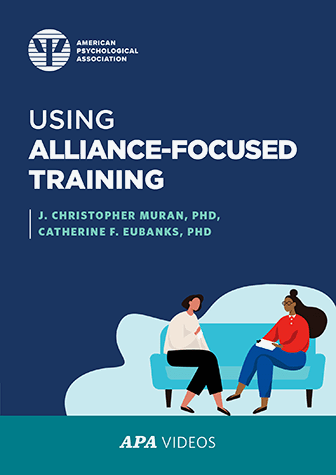
Using Alliance-Focused Training
ISBN: 978-1-4338-4236-8In Using Alliance Focused Training, Dr. Muran and Dr. Catherine Eubanks work with four colleagues, Dr. Sarah Bloch-Elkouby, Dr. Benjamin Johnson, Dr. Lauren Lipner, and Dr. Adelya Urmanche to demonstrate alliance focused training, an empirically supported, transtheoretical model to increase the effectiveness of therapy. Evidence shows that a core component of successful therapy is the alliance between the therapist and patient. Central to maintaining this therapeutic alliance is the ability to foresee and work through ruptures, which involve either pulling away from or confrontations with the therapist. Leaving ruptures unaddressed leads to poor treatment outcome.
In this video, the guest experts lead three separate alliance-focused training sessions in which one of the four colleagues present a case and a particular patient interaction or dynamic that has proven challenging. After each presentation, the guest experts and their colleagues work together to discuss the case, offer feedback, and suggest experiential exercises to improve skills in rupture repair. These demonstrations are framed by a discussion with Dr. Muran and Dr. Eubanks and their colleagues about the alliance-focused training protocol and its use in improving therapeutic outcomes.
Alliance-focused training (AFT) is a model that integrates principles from intersubjective, cognitive, and emotion-focused therapies and is founded on experiential learning (thus sharing an orientation akin to deliberate practice). This video demonstrates how to help therapists negotiate challenging interpersonal process—ruptures in the working alliance—with their patients, and in particular how to regulate their emotional experiences in the context of ruptures. Ruptures are common occurrences in therapy and can be described as movements against (confrontation ruptures) or away from (withdrawal ruptures) another person or the work of therapy. Ruptures have been empirically shown to be risk factors for poor treatment outcome as well as presenting rich opportunities for positive change.
In this video, the use of mindfulness and experiential exercises, including two-chair work, are illustrated and discussed as important training strategies. The principle of metacommunication, that is, communication about the communication process in a collaborative, immediate, and granular way, is also highlighted as an effective means towards emotion regulation and mutual recognition between therapist and patient. The effect of AFT has been empirically demonstrated in research supported by the National Institute of Mental Health.
J. Christoper Muran, PhD, is dean and professor at the Gordon F. Derner School of Psychology, Adelphi University. He completed postdoctoral training in cognitive therapy (University of Toronto) and psychoanalysis (New York University). He is a fellow of APA (Divisions 12 and 29) and on its Advisory Steering Committee for the Development of Clinical Practice Guidelines. He is past president of the Society for Psychotherapy Research (SPR) and past editor of its journal Psychotherapy Research. Since 1990, Dr. Muran has been principal investigator of the psychotherapy research program at Mount Sinai Beth Israel, which has been funded by grant awards from the National Institute of Mental Health.
Dr. Muran has received distinguished career awards from APA, the National Register and SPR. He has published and presented extensively on change processes and the alliance, including Alliance-Focused Training: An Evidence-Based Guide to Negotiating Rupture (2025 with colleagues), Therapist Performance Under Pressure: Negotiating Emotion, Difference and Rupture (2020 with Catherine Eubanks), The Therapeutic Alliance: An Evidence-Based Guide to Practice (2010 with Jacques Barber), Dialogues on Difference: Diversity Studies of the Therapeutic Relationship (2007), Self-Relations in the Psychotherapy Process (2001), and Negotiating the Therapeutic Alliance (2000 with Jeremy Safran). He previously coproduced Rupture and Repair in Psychotherapy (2020 with Catherine Eubanks) for the APA Psychotherapy Video Series.
Catherine F. Eubanks, PhD, is professor at the Gordon F. Derner School of Psychology, Adelphi University. She completed her doctoral training at Stony Brook and a postdoctoral fellowship at Mount Sinai Beth Israel, where she subsequently served as coinvestigator of its Psychotherapy Research Program. She is a fellow of APA (Division 29) and received early career awards from APA and the Society for Psychotherapy Research (SPR). She has served as president of the Society for the Exploration of Psychotherapy Integration (SEPI) and as executive officer of the North American chapter of SPR. She is currently managing editor of Psychotherapy Research.
Dr. Eubanks has published and presented extensively on change principles and alliance rupture repair and developed the Rupture Resolution Rating System (3RS with J. C. Muran and J. D. Safran). She is coauthor of Therapist Performance Under Pressure: Negotiating Emotion, Difference and Rupture (2020 with J. C. Muran) and the forthcoming Alliance-Focused Training: And Evidence-Based Guide to Negotiating Ruptures (2025 with J. C. Muran, L. W. Samstag, and J. Macdonald). She has coedited a number of books, including Rupture and Repair in Psychotherapy: A Critical Process for Change (2023 with L. W. Samstag and J.C. Muran). She previously coproduced Rupture and Repair in Psychotherapy (2020 with J. C. Muran) for the APA Psychotherapy Video Series.
APA Videos of Related Interest
Rupture and Repair in Psychotherapy
J. Christopher Muran and Catherine F. Eubanks
Client Contributions in Psychotherapy
Jairo N. Fuertes, Kathryn Kline, Amy Greaves, and Heidi M Levitt
Emotion-Focused Therapy Deliberate Practice
Rhonda N. Goldman
Client-Directed Outcome-Focused Psychotherapy
Scott D. Miller
Emotion-Focused Therapy Supervision
Leslie S. Greenberg
Relational Psychodynamic Psychotherapy Supervision
Joan E. Sarnat
Critical Events in Psychotherapy Supervision
Nicholas Ladany
APA Books of Related Interest
Alliance-Focused Training: An Evidence-Based Guide to Negotiating Ruptures in Therapy
J. Christopher Muran, Catherine F. Eubanks, Lisa Wallner Samstag, and James Macdonald
Rupture and Repair in Psychotherapy: A Critical Process for Change
Catherine F. Eubanks, Lisa Wallner Samstag, and J. Christopher Muran
Therapist Performance Under Pressure: Negotiating Emotion, Difference, and Rupture
J. Christopher Muran, and Catherine F. Eubanks
Becoming Better Psychotherapists: Advancing Training and Supervision
Louis Castonguay and Clara E. Hill
Clinical Supervision: A Competency-Based Approach, Second Edition
Carol A. Falender and Edward P. Shafranske
The Real Relationship in Psychotherapy: The Hidden Foundation of Change
Charles J. Gelso
The Other Side of Psychotherapy: Understanding Clients’ Experiences and Contributions in Treatment
Jairo N. Fuentes
Suggested Resources
Muran, J. C., Eubanks, C. F., Samstag, L. W., & Macdonald, J. (2025). Alliance-focused training: An evidence-based guide to negotiating rupture in therapy. American Psychological Association.
Eubanks, C. F., Samstag, L. W., & Muran, J. C., Eds. (2023). Rupture and repair in psychotherapy: A critical process for change. American Psychological Association.
Muran, J. C. & Eubanks, C. F. (2020). Therapist performance under pressure: Negotiating emotion, difference and rupture. American Psychological Association
Muran, J. C., Safran, J. D., Eubanks, C. F., & Gorman, B. S. (2018). The effect of an alliance-focused training on cognitive-behavioral therapy for personality disorders. Journal of Consulting & Clinical Psychology, 86, 384-397.
Muran, J. C., & Barber, J. P., Eds. (2010). The therapeutic alliance: An evidence-based guide to practice. Guilford Press.
Safran, J. D., & Muran, J. C. (2000). Negotiating the therapeutic alliance: A relational treatment guide. Guilford Press.