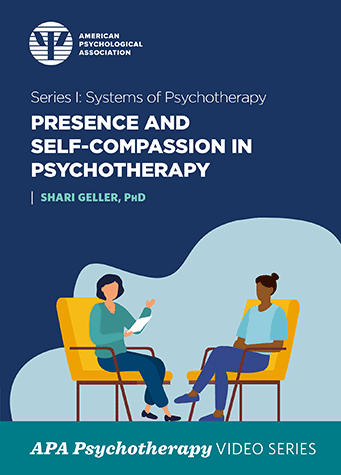
Presence and Self-Compassion in Psychotherapy
ISBN: 978-1-4338-4908-4In Presence and Self-Compassion in Psychotherapy, Shari Geller, PhD, explores the transformative role of self-compassion in psychotherapy. Drawing on research and her extensive clinical experience, Dr. Geller illustrates how self-compassion helps individuals respond to painful thoughts and emotions with kindness, warmth, and care, fostering resilience, emotional well-being, and healthier relationships.
Dr. Geller works with a client who struggles with people-pleasing and the pressure to be the perfect partner, friend, and colleague. As the client grapples with self-criticism and unrealistic expectations, Dr. Geller guides her through exercises that draw on the memory of her late grandmother, a figure who embodied compassion, warmth, and unconditional care. By connecting with this internalized source of support, the client begins to access a more accepting and nurturing relationship with herself. Hosted by Rayna Markin, PhD, this insightful demonstration offers clinicians practical examples of how self-compassion can deepen therapeutic work, strengthen emotional resilience, and support meaningful change.
This therapeutic approach integrates self-compassion and therapeutic presence as foundational elements of effective psychotherapy. Self-compassion involves responding to personal suffering, difficult emotions, and self-critical thoughts with kindness, understanding, and care rather than judgment. Research has shown that self-compassion supports emotional resilience, psychological well-being, healthier relationships, and reduced anxiety and depression. It also benefits therapists, helping them manage the emotional demands of clinical work while reducing burnout and enhancing professional well-being.
Central to this approach is therapeutic presence, a way of being in therapy that involves bringing one's full self into the therapeutic relationship while remaining grounded, open, and deeply attuned to the client's moment-to-moment experience. This quality of presence fosters safety, trust, and connection, strengthening the therapeutic alliance and creating conditions that support healing and growth.
The framework emphasizes three interconnected levels of practice. First, self-compassion strengthens therapeutic presence by helping therapists navigate their own emotional reactions and challenges with kindness, allowing them to remain engaged and available to clients. Second, self-compassion is conveyed through the therapeutic alliance. As therapists consistently respond with warmth, validation, and acceptance, clients begin to internalize these qualities and develop a more compassionate relationship with themselves. Third, self-compassion can be incorporated through practical interventions such as reflective inquiries, experiential exercises, and regulation-focused practices that help clients respond more skillfully to distress.
Because self-compassion is both transtheoretical and transdiagnostic, it can be integrated across therapeutic orientations and client concerns. Ultimately, this approach views self-compassion as the foundation for therapeutic presence, meaningful therapeutic relationships, and effective interventions, supporting healing, resilience, and sustainable clinical practice.
Shari Geller, PhD is a clinical psychologist, author, educator, and certified mindful self-compassion (MSC) teacher dedicated to making therapeutic presence a core component of psychotherapy training worldwide. She coauthored Therapeutic Presence: A Mindful Approach to Effective Therapeutic Relationships (2nd edition, 2022) with Leslie Greenberg and wrote A Practical Guide for Cultivating Therapeutic Presence (2017), which provides practical tools for therapists. She also co-edited Grounding Psychotherapy in Self-Compassion (2025), a key resource on self-compassion in clinical practice.
As codirector of the Centre for MindBody Health in Toronto, Geller provides therapy, supervision, and training in emotion-focused therapy (EFT), mindfulness, and self-compassion for individuals and couples. She teaches at York University and serves as an adjunct professor at the University of Toronto. Geller is actively involved in professional organizations, co-develops the SCIP certificate program, and integrates music, mindfulness, and rhythm through her Therapeutic Rhythm and Mindfulness Program. Her lifelong meditation practice, love of nature, and dogs support her commitment to presence.
Videos
Presence in Psychotherapy
Shari Geller, PhD
Generating Self-Compassion in Emotion-Focused Therapy
Ladislav Timulak, PhD
Mindful Therapy
Lorne Ladner, PhD
Mindfulness for Anxiety
Ronald D. Siegel, PsyD
Working With Emotion in Emotion-Focused Therapy
Leslie S. Greenberg, PhD accompanied by Michael A. Tompkins, PhD, and Norka T. Malberg, PsyD
Positive and Transpersonal Approaches to Therapy
Roger Walsh, MD, PhD, DHL
Books
Therapeutic Presence: A Mindful Approach to Effective Therapeutic Relationships
Shari M. Geller and Leslie Greenberg
A Practical Guide to Cultivating Therapeutic Presence
Shari M. Geller
The Art and Science of Mindfulness: Integrating Mindfulness Into the Helping Professions, Third Edition
Shauna L. Shapiro, Linda E. Carlson, and Broderick A. Sawyer
Empathic Engagement in Clinical Practice
Douglas Flemons
Mindfulness-Based Practices in Therapy: A Cultural Humility Approach
Don E. Davis, Cirleen DeBlaere, Joshua N. Hook, and Jesse Owen
Person-Centered Psychotherapies, Second Edition
David J. Cain and David Murphy
Other Suggested Resources
Tyano Ronen, G., & Geller, S. M. (Eds.). (March 2025). Grounding psychotherapy in self-compassion. Guilford Publications.
Geller, S. M. (2025). Exploring the interplay between therapeutic presence and self-compassion in psychotherapy. In G. Tyano Ronen & S. M. Geller (Eds.), Grounding psychotherapy in self-compassion. Guilford Publications.
Geller, S. M., & Graziani, C. (2024). Therapeutic presence: An essential way of being. In M. Cooper, M. O'Hara, S. Stephen, Y. Gololob & G. Di Malta (Eds.), Handbook of person-centred psychotherapy and counselling (3rd ed). Palgrave Macmillan.
Geller, S. M. (2020). Cultivating therapeutic presence: Strengthening your clinical heart, mind and practice. Transformance: The AEDP Journal.
Geller, S. M., & Porges, S. W. (2014). Therapeutic presence: Neurophysiological mechanisms mediating feeling safe in therapeutic relationships. Journal of Psychotherapy Integration, 24(3), 178192.