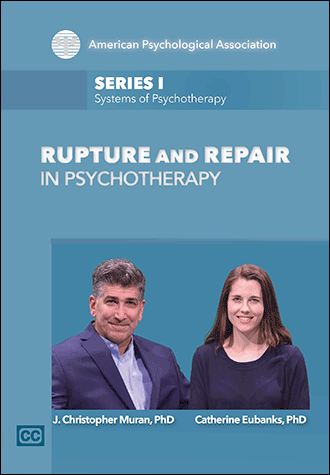
Rupture and Repair in Psychotherapy
ISBN: 978-1-4338-3258-1Available formats
Streaming options
In Rupture and Repair in Psychotherapy, Dr. Chris Muran and Dr. Catherine Eubanks discuss the common challenge of alliance rupture and how to work through this phenomenon to a positive therapeutic outcome.
Sometimes dramatic, sometimes not, alliance ruptures are defined as increased tension or conflict between the respective wants or needs of the therapist and the patient, and can include disagreement on the tasks of therapy and a strain in the patient–therapist emotional bond.
In this video, Drs. Muran and Eubanks look at examples of ruptures and discuss how to repair them, including advice to therapists on how to regulate their own emotions and respond constructively to alliance ruptures. The guest experts suggest a pragmatic, integrative approach to working with ruptures in psychotherapy, one that can be adopted by therapists of any orientation.
This video will prove beneficial to clinical students as well as psychotherapists at any point in their practice.
The clients in the demonstrations in this video are portrayed by actors.
Alliance rupture repair has received considerable conceptual and empirical attention as an important change process in psychotherapy, across theoretical models. This video provides multiple brief demonstrations (with commentaries) of rupture repair, involving two different therapists and three different patients (six demonstrations altogether).
The alliance-focused approach on display is based on an integration of principles derived from various psychotherapy models, including cognitive, emotion-focused, interpersonal and intersubjective, as well as psychotherapy and communication research, and the cognitive and emotion sciences. The video introduces ruptures in terms of confrontations (movements against the other) and withdrawals (movements away from self or other) and demonstrates how to repair ruptures by inviting patients to explore them to increase awareness of oneself in relation to another and the possibility of providing a new relational experience.
The principle of metacommunication (that is, communication about the communication process in a collaborative, immediate, and granular way) is highlighted as an effective means towards emotion regulation and mutual recognition. Renegotiating how therapists and patients work together is also considered.
J. Christopher Muran, PhD, is associate dean and full professor at the Gordon F. Derner School of Psychology, Adelphi University, where he has served as training director for its doctoral program in clinical psychology (2009–present). He completed postdoctoral training in cognitive therapy (University of Toronto) and psychoanalysis (New York University).
He is a fellow of APA (Divisions 12 [Society of Clinical Psychology] and 29 [Society for the Advancement of Psychotherapy]) and on its Advisory Steering Committee for the Development of Clinical Practice Guidelines.
He is past president of the Society for Psychotherapy Research and past editor of its journal Psychotherapy Research; he is also on the editorial boards for the Journal of Consulting and Clinical Psychology and Clinical Psychology: Science & Practice.
Since 1990, Dr. Muran has directed the Psychotherapy Research Program at Beth Israel Medical Center (now Mount Sinai Beth Israel), which has been funded by grant awards from the National Institute of Mental Health. He was chief psychologist at Beth Israel for 15 years (1994–2009) and is on faculty at Icahn School of Medicine at Mount Sinai.
Dr. Muran has received several awards for his research and teaching; he has published more than 130 papers and nine books on change processes and the therapeutic relationship, including Therapist Performance Under Pressure: Negotiating Emotion, Difference and Rupture (2020; with Catherine Eubanks), Practice-Oriented Research (2016; with Louis Castonguay), Transforming Negative Reactions to Clients (2013; with Abraham Wolfe and Marvin Goldfried), The Therapeutic Alliance (2010; with Jacques Barber), Dialogues on Difference (2007), Self-Relations in the Psychotherapy Process (2001), and Negotiating the Therapeutic Alliance (2000; with Jeremy Safran).
Catherine F. Eubanks, PhD, is associate professor of clinical psychology at the Ferkauf Graduate School of Psychology of Yeshiva University. She also serves as associate director of the Mount Sinai-Beth Israel Brief Psychotherapy Research Program.
Dr. Eubanks received the Early Career Award from APF/Division 29 in 2018, the Outstanding Early Career Achievement Award from the Society for Psychotherapy Research in 2015, and the Dissertation Award from the Society for the Exploration of Psychotherapy Integration in 2007. She served as president of the Society for the Exploration of Psychotherapy Integration (SEPI) in 2019, and served as executive officer of the North American chapter of the Society for Psychotherapy Research from 2013–2018.
Dr. Eubanks has previously served as an associate editor for Psychotherapy Research and is currently an associate editor for the Journal of Consulting and Clinical Psychology. She also serves on the editorial boards of Psychotherapy Research and the Journal of Psychotherapy Integration.
She developed the Rupture Resolution Rating System (3RS; with Chris Muran and Jeremy Safran) and is coauthor (with Chris Muran) of Therapist Performance Under Pressure: Negotiating Emotion, Difference and Rupture (2020).
Muran, J. C. & Eubanks, C. F. (2020). Therapist performance under pressure: Negotiating emotion, difference, and rupture. Washington, DC: American Psychological Association.
Muran, J. C., Safran, J. D., Eubanks, C. F., & Gorman, B. S. (2018). The effect of an alliance-focused training on cognitive-behavioral therapy for personality disorders. Journal of Consulting and Clinical Psychology, 86, 384–397. (Awarded Most Valuable Paper on Innovations in Psychotherapy for 2018 by Journal of Contemporary Psychotherapy)
APA Videos
- Engaging Men in Psychotherapy
APA Psychotherapy Stimulus Series
Matt Englar-Carlson - Relational Psychotherapy
Jeremy D. Safran - Responding Therapeutically to Anger
APA Psychotherapy Stimulus Series - Responding Therapeutically to Negative Reactions
APA Psychotherapy Stimulus Series - Therapist–Client Boundary Challenges
APA Psychotherapy Stimulus Series - The Therapy Relationship
Charles J. Gelso
APA Books
- Developing the Therapeutic Relationship: Integrating Case Studies, Research, and Practice
Edited by Orya Tishby and Hadas Wiseman - The Real Relationship in Psychotherapy: The Hidden Foundation of Change
Charles J. Gelso - Therapist Performance Under Pressure: Negotiating Emotion, Difference, and Rupture
J. Christopher Muran and Catherine F. Eubanks - Transforming Negative Reactions to Clients: From Frustration to Compassion
Edited by Abraham W. Wolf, Marvin R. Goldfried, and J. Christopher Muran