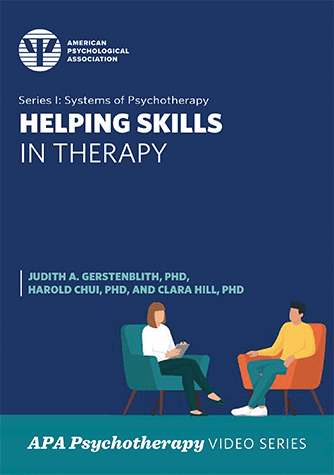
Helping Skills in Therapy
ISBN: 978-1-4338-4456-0Clara Hill’s helping skills model consists of three main goals—exploration, insight, and action—in which helpers guide clients in exploring their thoughts and feelings, discovering the origins and consequences of maladaptive thoughts and behaviors, and creating positive long‑term change. In this video, two therapists—or helpers—Judith A. Gerstenblith, PhD, and Harold Chui, PhD, work with several clients on each goal of the helping skills model, showcasing the approach in a structured and instructive way. The clients share a variety of concerns while Drs. Gerstenblith and Chui use the model to work with clients on their deeper anxieties and pressure points, providing them with fresh solutions to begin the process of change in their personal lives.
Guided by a discussion with the founder of the model, Clara Hill, PhD, and host Katherine Helm, PhD, Helping Skills in Therapy is an exciting counterpart to the newest edition of the book cowritten by Drs. Hill, Gerstenblith, and Chui Helping Skills: Facilitating Exploration, Insight, and Action, 6th edition (2024).
The helping skills model integrates exploration, insight, and action skills with theory, cultural considerations, and clinical awareness. Exploration skills are based on the theoretical foundation of client-centered and humanistic theories, insight skills are based on the theoretical foundation of psychodynamic and existential theories, and action skills are based on the theoretical foundation of cognitive and cognitive-behavioral theories.
The goal of exploration is to help clients tune in to their internal experience through talking about and reflecting on their thoughts and feelings related to their concerns. Exploration skills include questions/probes for thoughts and feelings, restatements, reflections of feelings, and disclosures of feelings.
The goal of insight is to foster awareness and insight into the client’s relational patterns; understand reasons underlying their thoughts, feelings, and behaviors; and co-construct meaning of their experiences. Insight skills include challenges, questions/probes for insight, interpretations, immediacy, and disclosures of insight.
The goal of action is to explore the idea of changing by determining if the client wants to change, considering the changes they might want to pursue, strategizing about how to change, and working through potential barriers to change. Action skills include questions/probes for action, information, feedback, process advisement, direct guidance, and disclosures of strategies.
The helping skills process is collaborative, and varies greatly according to the individual client and their particular needs in each moment of the therapeutic process. We highlight the importance of building and maintaining a strong therapeutic relationship, attending to cultural factors, noticing and working with transference and countertransference, attuning to timing and responsiveness, observing client’s behavior and reactions, reflecting in and outside of sessions to increase awareness, and proactively seeking supervision, consultation, and training.
Broadly speaking, her research and clinical interests involve meaning-making through relational healing. She studies psychotherapy process and outcome, therapist interventions and training, the role of attachment and differentiation in the therapeutic relationship, the ways in which therapists work with existential themes (e.g., dreams, meaning in life, religion/spirituality, death) in psychotherapy, and the development of culturally-embedded strengths and holistic flourishing in psychotherapy. She also focuses on supporting helping professionals, including therapists, in addressing burnout and cultivating well-being, as well as supporting the spiritual formation of religious leaders. As part of this work, she cofacilitates empirically-based personal and professional formation groups designed for mental health professionals, chaplains, and clergy.
Dr. Gerstenblith was chosen as the University of Maryland College of Behavioral and Social Sciences Emerging Scholar and received the College of Behavioral and Social Sciences Excellence in Teaching Award, the American Psychological Association Division 29 Student Excellence in Teaching/Mentorship Award, the Milton Dean Havron Social Sciences Award, and the Society for Psychotherapy Research Postdoc/Early Career Award.
At the start of the COVID-19 pandemic, Dr. Gerstenblith helped to found RUACH: Emotional and Spiritual Support, a network of mental health professionals, chaplains, and clergy providing free and accessible care. She serves as a mentor through Division 29 of the American Psychology Association and has taught courses in Helping Skills and The Psychology of Interpersonal Relationships to undergraduate psychology students. Dr. Gerstenblith is passionate about improving psychotherapy through research, teaching, supervision, and mentorship.
Harold Chui, PhD, is an associate professor in the Department of Educational Psychology at The Chinese University of Hong Kong (CUHK). He received his doctorate in counseling psychology at the University of Maryland, College Park and completed a postdoctoral fellowship at the Gordon F. Derner School of Psychology in Adelphi University, New York. He was a recipient of the Bergin and Garfield Emerging Scholar Award from the Society of Psychotherapy Research (SPR) and the Young Researcher Award (2018 and 2023) from CUHK.
Dr. Chui’s research focuses on psychotherapy process and outcome, psychotherapy training and supervision, multicultural issues in counseling, and school mental health. He is an associate editor of Psychotherapy and editorial board member of Journal of Counseling Psychology and Psychotherapy Research. Dr. Chui is dedicated to advancing psychotherapy research in underrepresented populations and contexts. He currently serves as president of the SPR—Asian area affiliate and cochair of the Diversity, Equity, Inclusion and Fairness Committee at SPR. Dr. Chui teaches courses on Helping Skills and Personal Growth for beginning counselors and strives to promote the application of helping skills in diverse settings and everyday life.
Clara E. Hill has been the president of the society for Psychotherapy Research and of the Society for the Advancement of Psychotherapy, Editor of the Journal of Counseling Psychology, and coeditor of Psychotherapy Research. Awards include the Distinguished Research Career Award from the Society for Psychotherapy Research, the Distinguished Psychologist Award from the Society for the Advancement of Psychotherapy, and the Leona Tyler Award from the Society of Counseling Psychology. Her major research interests are therapist skills, psychotherapy process and outcome, training and supervising therapists, dream work, meaning in life, and qualitative research.
She has published 18 books, including Working with Dreams in Psychotherapy, Dream Work in Therapy, Helping Skills,Essentials of Consensual Qualitative Research, Meaning in Life, and Psychotherapy Skills and Methods that Work. She has also published more than 265 articles in academic journals and 90 chapters in books. She has recently published a debut novel about dreams and psychotherapy, The Owl and the Dreamcatcher.
APA Videos
Helping Skills in Practice: A Three-Stage Model
Clara Hill, PhD
Meaning in Life: A Case Study
Clara Hill, PhD
Dream Work in Practice
Clara Hill, PhD
Person-Centered Therapy Over Time
David J. Cain, PhD, ABPP
The Therapy Relationship
Charles J. Gelso, PhD
Psychoanalytic Therapy
Nancy McWilliams, PhD
APA Books
Helping skills: Facilitating exploration, insight, and action (6th ed)
Clara Hill, Harold Chui, and Judy Gerstenblith
Meaning in life: A therapist’s guide
Clara Hill
Case formulation in emotion-focused therapy: Co-creating clinical maps for change
Rhonda Goldman and Leslie Greenberg
Case formulation in existential–humanistic therapy
Louis Hoffman and Heatherlyn P. Cleare-Hoffman
Relational spirituality in psychotherapy: Healing suffering and promoting growth
Steven J. Sandage, David Rupert, George Stavros, and Nancy Gieseler Devor
Psychoanalytic theory and cultural competence in psychotherapy
Pratyusha Tummala-Narra
Other Suggested Resources
Ahn, L. H., Hill, C. E., Gerstenblith, J. A., Hillman, J. W., Anderson, T., Mui, V., See, A., &. Kivlighan, D. M. Jr. (2023). "Helping skills training: Outcomes and trainer effects." Journal of Counseling Psychology, 70(4), 396–402. https://doi.org/10.1037/cou0000667
Gelso, C. J. (2018). The therapeutic relationship in psychotherapy practice: An integrative perspective. Routledge.
Hill, C. E., Anderson, T., Kline, K., McClintock, A., Cranston, S., McCarrick, S., Petrarca, A., Himawan, L., Pérez-Rojas, A. E., Bhatia, A., Gupta, S., & Gregor, M. (2016). "Helping skills training for undergraduate students: Who should we select and train?" The Counseling Psychologist, 44(1), 50–77. https://doi.org/10.1177/0011000015613142
Hill, C. E., Anderson, T., Gerstenblith, J. A., Kline, K. V., Gooch, C. V., & Melnick, A. (2020). "A follow-up of undergraduate students five years after helping skills training." Journal of Counseling Psychology, 67(6), 697– 705. https://doi.org/10.1037/cou0000428
Hill, C. E., & Norcross, J. C. (2023). Psychotherapy skills and methods that work. Oxford University Press.
Hill, C. E., Lystrup, A., Kline, K., Gebru, N. M., Birchler, J., Palmer, G., Robinson, J., Um, M., Griffin, S., Lipsky, E., Knox, E., & Pinto-Coelho, K. (2013). "Aspiring to become a therapist: Personal strengths and challenges, influences, motivations, and expectations of future psychotherapists." Counselling Psychology Quarterly, 26, 267-293. doi:10.1080/09515070.2013.825763
Hill, C. E., Roffman, M., Stahl, J., Friedman, S., Hummel, A., & Wallace, C. (2008). "Helping skills training for undergraduates: Outcomes and predictors of outcomes." Journal of Counseling Psychology, 55, 359-370.
Hill, C. E., Spangler, P. T., Chui, H., & Jackson, J. (2014). "Training undergraduate students to use insight skills: Rationale, methods, and analyses." The Counseling Psychologist, 42(6), 702-728. https://doi.org/10.1177/0011000014542598
Hill, C. E., Spangler, P. T., Jackson, J., & Chui, H. (2014). "Training undergraduate students to use insight skills: Integrating results across three studies." The Counseling Psychologist, 42(6), 800-820. https://doi.org/10.1177/0011000014542602
Holmes, J., & Slade, A. (2018). Attachment in therapeutic practice. SAGE Publications.
Knox, S., & Hill, C. E. (2021). "Training and supervision in psychotherapy: What we know and what we need to know." In M. Barkham, W. Lutz, & L. G. Castonguay (Eds.), Bergin and Garfield’s Handbook of psychotherapy and behavior change (50th anniversary ed., pp. 327-349). New York, NY: Wiley.
McWilliams, N. (2004). Psychoanalytic psychotherapy: A practitioner’s guide. Guilford Press.