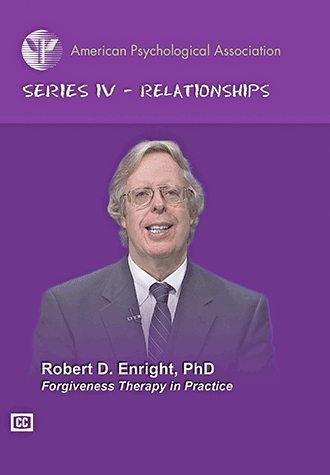
Forgiveness Therapy in Practice
ISBN: 978-1-4338-2126-4Forgiveness is the process of uncovering and letting go of anger at someone who has caused pain. This process can be the path to healing in many situations, as anger is frequently at the core of a client's issues and may be the center of a number of disorders.
The forgiveness therapy model is flexible enough to be integrated into any therapeutic approach. Fostering forgiveness in therapy involves uncovering the depth of the client's anger, obtaining commitment to forgive, and working on being able to forgive. The final phase of this therapy is the discovery of meaning in what has been suffered, finding a new purpose in life, and exploring one's own faults and the need to be forgiven by others.
In this video program, Dr. Enright demonstrates his approach to forgiveness therapy with a female client who feels hurt by her mother.
In forgiveness therapy, there are four basic phases to the treatment.
First, the uncovering phase seeks to explore not only the anger but also the depth of it. Often a client comes to therapy with a much deeper anger than he or she has been aware. Injustices are explored here as well as the complications to one's life from the interplay of injustice and anger, which can include sadness, altered life conditions such as changing jobs or partner-separation, and the subtle development of a pessimistic worldview (thinking, for example, that all bosses are only out for themselves if the client was dismissed from a career).
The second phase, called the commitment to forgive, includes understanding what forgiveness is and is not. Forgiveness is a moral virtue (as are justice, patience, and kindness, as examples) in which an unjustly treated person offers the cessation of resentment toward the injurer along with a positive, merciful response to him or her such as compassion, understanding, and as a later development, even love. To forgive is not to condone, forget, or reconcile because none of these are moral virtues. One can forgive without reconciling, for example, if the offending person continues with hurtful actions without remorse or any sense of altering that pattern of behavior.
The third phase is where the client engages in the work of forgiveness. This starts with cognitive exercises.
The therapist asks the client/patient to understand the offending other's childhood with a focus on the injustice that this person may have received from others. This cognitive perspective continues through the offending person's adolescence and adulthood, again with an emphasis on the injustices that he or she has suffered. The point is to help the client, not to condone what happened, but to better understand the struggles that the offending person has had in life.
Next, the cognitive exercises focus on the difficulties for the offending person at the time of the offense, for the same reason: to see an emotionally-wounded person rather than someone who is evil incarnate.
After this, the psychotherapist helps the client/patient to take what is called the "cosmic perspective," seeing the inherent worth of all people, including the offending person.
The cognitive exercises are followed by the exploration of compassion in the client/patient as he or she sees a suffering person who acted unjustly. This can help the client/patient to bear the pain of what happened so that he or she does not throw that pain back at the offending one, avoiding a cycle of revenge between the two.
The fourth phase includes the discovery of meaning in what has been suffered, finding a new purpose in life once equipped with the process of forgiveness, and an exploration of one's own faults and the need to be forgiven by others.
These activities are then usually followed by emotional relief in that anger, anxiety, and depression diminish and a sense of hope and enhanced self-esteem increase. Three decades of research on the Process Model of Forgiveness shows strong empirical support for emotional healing in the client/patient who follows this psychotherapeutic process.
Robert D. Enright, PhD, received his doctorate in educational psychology from the University of Minnesota in 1976.
He is a licensed psychologist and a professor of education psychology at the University of Wisconsin–Madison, a position he has held since 1978. He is a founding board member of the International Forgiveness Institute, Inc. which develops forgiveness education materials for schools.
His recent work is within conflict regions, such as Belfast, Northern Ireland, assisting teachers to deliver forgiveness instruction to students. He has been a leader in the scientific study of forgiveness and its effects since 1985. Time magazine referred him as "the forgiveness trailblazer."
He is the author of more than 130 publications, including seven books. He and his colleagues have developed and tested a pathway to forgiveness that has helped incest survivors, people in drug rehabilitation, in hospice, in shelters for abused women, and in a cardiac unit of a hospital, among others. His forgiveness work has appeared in many national and international newspapers, magazines, and radio and television programs.
- Enright, R. D., & Fitzgibbons, R. (2015). Forgiveness therapy. Washington, DC: American Psychological Association.
- Enright, R. D., (2001). Forgiveness is a choice. Washington, DC: American Psychological Association.
- Enright, R. D. (2012). The forgiving life. Washington, DC: American Psychological Association.
APA Videos
- Case Formulation in Emotion-Focused Therapy: Addressing Unfinished Business
Rhonda N. Goldman - Emotion Focused Therapy for Trauma
Sandra C. Paivio - Emotionally Focused Couple Therapy for Clients Dealing With Infidelity
Sue Johnson - Emotion-Focused Therapy Over Time
Leslie S. Greenberg - Forgiveness
Robert D. Enright and Richard P. Fitzgibbons - Narrative Processes in Emotion-Focused Therapy for Trauma
Lynne Angus and Sandra C. Paivio - Working With Anger
Lorne Korman
APA Books
- The Forgiving Life: A Pathway to Overcoming Resentment and Creating a Legacy of Love
Robert D. Enright - Road Rage: Assessment and Treatment of the Angry, Aggressive Driver
Tara E. Galovski, Loretta S. Malta, and Edward B. Blanchard
Magination Press Books
- Rising Above the Storm Clouds: What It's Like to Forgive
Robert D. Enright