Emotion-Focused Therapy
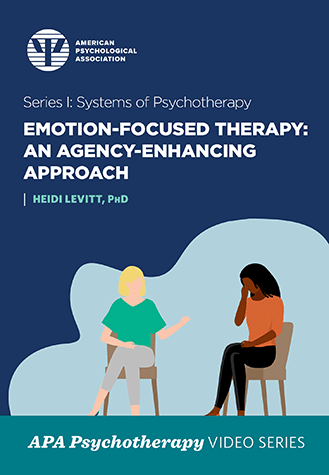
Emotion Focused Therapy: An Agency-Enhancing Approach demonstrates how therapists can foster client empowerment while reducing therapist-driven authority. In this video, Heidi Levitt, PhD, presents agency-enhancing therapy, an approach that can be integrated across psychotherapy orientations to help clients build confidence in their ability to process emotions and navigate life’s challenges. Grounded in five core values, including client-driven interventions, reflective silence, holistic pattern exploration, reduced power dynamics, and client-led goal setting, the approach is demonstrated within emotion-focused therapy. Through excerpts from a therapy session, viewers see how therapists can support emotional processing, encourage client meaning-making, and respond collaboratively to emerging insights. The video concludes with a conversation between Dr. Levitt and Jessica Smedley, PhD, exploring how agency-enhancing practices can strengthen therapeutic responsiveness, client agency, and meaningful emotional change across a range of therapeutic approaches.
Agency-enhancing therapy is an approach that can be integrated into any style of psychotherapy to help clients build confidence in their ability to understand, process, and navigate life’s challenges. Rather than positioning the therapist as the expert with all the answers, this approach empowers clients to become active agents in their own growth and healing. At its core, agency-enhancing therapy is guided by five key principles: encouraging client-led interventions, creating space for meaningful reflection and insight, exploring patterns across emotional, cognitive, interpersonal, and cultural dimensions, addressing power dynamics within the therapeutic relationship, and supporting clients in directing their own goals and development.
These principles are applied within emotion-focused therapy (EFT), a humanistic approach that helps clients transform difficult emotions into healthier, more adaptive experiences. By combining EFT’s emphasis on emotional processing with feminist-multicultural values that reduce power imbalances and center client perspectives, the agency-enhancing approach promotes deeper collaboration, self-healing, and personal empowerment.
Heidi M. Levitt, PhD, is a professor in the Clinical Psychology program within the Department of Psychology at The University of Massachusetts Boston. She trains therapists to conduct an agency-enhancing approach to emotion-focused therapy that combines feminist-multicultural and humanistic principles. She is a licensed psychologist. Her integrative approach to psychotherapy is rooted in humanistic, constructivist, and feminist-multicultural orientations and draws on psychodynamic conceptualizations and cognitive-behavioral interventions.
APA videos
Issues of Agency
Eileen M. Russell, PhD
Client Contributions in Psychotherapy
Jairo N. Fuertes, PhD, ABPP, LMHC, Kathryn Kline, PhD, Amy Greaves, PhD, Heidi M. Levitt, PhD
Emotion and Culture in Psychotherapy
Shigeru Iwakabe, PhD
Emotion-Focused Therapy in Practice: Working With Grief and Abandonment
Jeanne C. Watson, PhD, CPsych
Case Formulation in Emotion-Focused Therapy: Addressing Unfinished Business
Rhonda N. Goldman, PhD
Strengths and Flourishing in Psychotherapy
Steven J. Sandage, Sarah Crabtree, Todd Farchione, Heidi M. Levitt, Y. Joel Wong, and Jesse Owen
APA books
Essentials of Critical-Constructivist Grounded Theory Research
Heidi M. Levitt
Feedback-Informed Treatment in Clinical Practice: Reaching for Excellence
David S. Prescott, MA, CCC, Cynthia L. Maeschalck, and Scott D. Miller
Cultural Humility: Engaging Diverse Identities in Therapy, Second Edition
Joshua N. Hook, Don Davis, Jesse Owen, and Cirleen DeBlaere
Multicultural Therapy: A Practice Imperative
Melba J. T. Vasquez and Josephine D. Johnson
Working With Narrative in Emotion-Focused Therapy: Changing Stories, Healing Lives
Lynne Angus and Leslie S. Greenberg
The Responsive Psychotherapist: Attuning to Clients in the Moment
Jeanne C. Watson and Hadas Wiseman
Suggested Resources
Elliott, R., Watson, J. C., Goldman, R. N., & Greenberg, L. S. (2025). Learning emotion-focused therapy: A comprehensive guide, 2nd ed. American Psychological Association.
Greaves, A., Levitt, H. M., Fuertes, J. Goodyear, R., Cruz Oliveira, J. T. T, Hand, A. B., & Sera, H. (2025). Prioritizing the central role of clients: Identifying and working with clients' capacities and contributions in psychotherapy. Counselling Psychology Quarterly. Advance online publication. https://doi.org/10.1080/09515070.2025.2572567
Levitt, H. M. (2026). The Shift to Agency-Enhancing Therapy from Theoretical Orientation-Focused Therapy: A Transtheoretical Integration of Key Findings on Clients Experiences and Contributions. In the Autobiographical Reflections Series in the Journal of Contemporary Psychotherapy. Advance online publication. https://doi.org/10.1007/s10879-026-09717-w
Levitt, H. M., Pomerville, A. & Surace, F. I. (2016). A qualitative meta-analysis examining clients' experiences of psychotherapy: A new agenda. Psychological Bulletin, 142(8), 801-830. https://dx.doi.org/10.1037/bul0000057
Levitt, H. M., & Whelton, W. J. (2024). On the need to reconcile cultural and professional power in psychotherapy: Humanistic principles that are foundational for feminist multicultural practice. The Humanistic Psychologist, 52(2), 137-162. https://doi.org/10.1037/hum0000327
Levitt, H. M., Whelton, W. J., & Iwakabe, S. (2019). Integrating Feminist-Multicultural Perspectives into Emotion-Focused Therapy. In L. Greenberg & R. Goldman's Clinical Handbook of Emotion-Focused Therapy (pp. 425-444). Washington, DC: American Psychological Association. ISBN: 978-1-4338-2977-2