Mindfulness for Insomnia
ISBN: 978-1-4338-2376-3Available formats
Streaming options
Insomnia occurs when individuals who frequently suffer from chronic sleep disturbance try harder to sleep or develop an anxious response when they are unable to sleep. Mindfulness-based therapy for insomnia, or MBTI, combines mindfulness principles and practices with behavioral techniques to treat this common issue.
MBTI teaches clients with insomnia how to use meditation practices to cultivate mindful awareness and change how they may be thinking about their insomnia symptoms. Practicing mindfulness meditation helps clients see their thoughts and desires as dynamic mental events and helps avoid becoming fixated on achieving specific outcomes or goals. This process, called metacognitive shifting, is one of the keys to reducing the symptoms of chronic insomnia.
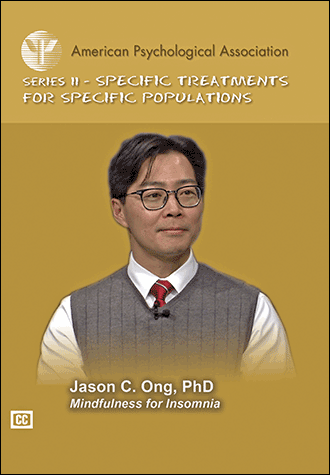
In this video, Dr. Jason C. Ong works with a group of young male clients who are all suffering from various sleep issues. In this demonstration, Dr. Ong teaches behavioral strategies within a mindfulness framework to help the group learn how to cope with periods of wakefulness at night.
Mindfulness-based therapy for insomnia (MBTI) is a group intervention that uses mindfulness principles and practices with behavioral approaches for the treatment of insomnia. Mindfulness meditation is a practice that focuses on present-moment awareness without judgment.
By practicing mindfulness meditation, thoughts and desires are seen as dynamic mental events rather than a fixation on achieving specific outcomes or goals. This process is called metacognitive shifting and is one of the keys to reducing the symptoms of chronic insomnia.
Individuals who suffer from chronic sleep disturbance frequently try harder to sleep or develop an anxious response when they are unable to sleep. These responses perpetuate a vicious cycle of insomnia. MBTI teaches clients with insomnia how to use meditation practices to cultivate mindful awareness and shift metacognitions related to insomnia symptoms.
Following the tradition of other mindfulness-based interventions, both formal meditations and informal meditations are taught and a period of discussion is provided for clients to process their experiences. In addition, MBTI teaches behavioral strategies that are delivered within a mindfulness framework. These strategies provide specific instructions for scheduling a "sleep window" and recommendations on how clients can cope during periods of wakefulness at night.
Overall, MBTI teaches clients with insomnia to reduce the effort put into making sleep happen and allow their mind and body to regulate sleep and wakefulness more consistently.
Research on MBTI has demonstrated evidence for efficacy on improving sleep parameters and reducing pre-sleep arousal. Furthermore, it appears to be particularly helpful for those who endorse cognitive features related to the sleep disturbance, such as anxiety about sleep, racing thoughts in bed, or feeling consumed by the sleep problem.
Dr. Jason Ong is an associate professor of behavioral sciences and director of the Behavioral Sleep Medicine Training Program at Rush University Medical Center. He received his PhD from Virginia Commonwealth University and completed a fellowship in behavioral sleep medicine at Stanford University. His primary research and clinical interests involve behavioral and mindfulness-based interventions for insomnia and other sleep disorders. Secondary research interests include the impact of sleep disturbance on chronic conditions.
Dr. Ong has secured more than 3 million dollars in research grants from the National Institutes of Health and the American Sleep Medicine Foundation. His work has been published in JAMA Internal Medicine, SLEEP, Behavior Research and Therapy, and Journal of Clinical Psychology.
- Ong, J. & Sholtes, D. (2010). A mindfulness-based approach to the treatment of insomnia. Journal of Clinical Psychology: In Session, 66, 1175–1184.
- Ong, J. C. & Manber, R. (2010). Mindfulness-based therapy for insomnia. In M. L. Perlis (Ed). Behavioral sleep medicine treatments (pp. 133–141). London, UK: Elsevier.
- Ong, J. C., Manber, R., Segal, Z., Xia, Y., Shapiro, S. L., & Wyatt, J. K. (2014). A randomized controlled trial of mindfulness meditation for chronic insomnia. Sleep, 37, 1553–1563.
- Ong, J. C., Ulmer, C. S., & Manber, R. (2012). Improving sleep with mindfulness and acceptance: A metacognitive model of insomnia. Behaviour Research and Therapy, 50, 651–660.
APA Videos
- Mindful Therapy
Lorne Ladner - Mindfulness for Addiction Problems
G. Alan Marlatt - Mindfulness for Anxiety
Ronald D. Siegel - Mindfulness for Well-Being
Rezvan Ameli - Mindfulness-Based Cognitive Therapy for Depression
Zindel V. Segal - Positive and Transpersonal Approaches to Therapy
Roger Walsh - Presence in Psychotherapy
Shari M. Geller
APA Books
- 25 Lessons in Mindfulness: Now Time for Healthy Living
Rezvan Ameli - Activities for Teaching Positive Psychology: A Guide for Instructors
Edited by Jeffrey J. Froh and Acacia C. Parks - The Art and Science of Mindfulness: Integrating Mindfulness Into Psychology and the Helping Professions
Shauna L. Shapiro and Linda E. Carlson - Mindfulness-Based Therapy for Insomnia
Jason C. Ong - Spiritually Oriented Psychotherapy for Trauma
Edited by Donald F. Walker, Christine A. Courtois, and Jamie D. Aten