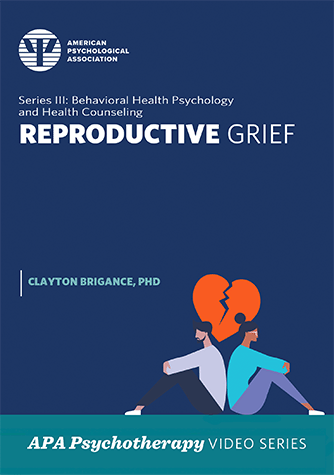
Reproductive Grief
ISBN: 978-1-4338-4974-9Available formats
Streaming options
Reproductive Grief addresses a challenge many couples face but rarely feel prepared for: the relational strain of infertility, pregnancy loss, and unexpected disruptions to family building. These experiences often bring not only personal grief, but disconnection, miscommunication, and a shared sense of uncertainty that can quietly erode a couple's bond.
In this video, Clayton Brigance, PhD, presents a relationship-centered approach designed to help couples move through reproductive grief together rather than alone. Drawing from Gottman Method Couple Therapy and relational mindfulness, the video explores how partners can rebuild emotional safety, navigate conflict intensified by stress and loss, and reconnect around meaning, intimacy, and shared hope. The format blends psychoeducation with practical insights drawn from real therapy sessions, offering a clear sense of how these interventions unfold without revealing personal details. Structured communication tools, grounding strategies, and mindful pauses during conflict are highlighted as ways couples can strengthen their connection even in painful moments.
Hosted by Breon Rose, PhD, Reproductive Grief allows viewers will come away with a renewed understanding of reproductive grief as a relational experience-and a hopeful sense that deeper connection, resilience, and shared meaning are possible, even in the midst of ongoing uncertainty.
The approach to reproductive grief showcased in this video is anchored in the Four Pillars of Connection—a framework that helps couples cultivate mindful attunement, navigate heightened and decisional conflict, process disrupted visions of parenthood, and sustain emotional and physical closeness under chronic strain. The approach emphasizes mindfulness as a shared, relational practice, illustrating how present-moment awareness, emotional regulation, empathy, and coregulation can be woven into couple interactions to support connection and resilience during reproductive loss.
Interventions combine core Gottman tools—such as structured communication, conflict regulation, and strengthening friendship and shared meaning—with mindfulness-based practices including mindful listening, emotional labeling, grounding, and intentional pauses during conflict. Healing is framed not as symptom reduction alone, but as the deepening of emotional connection, relational flexibility, and shared resilience in the face of ongoing reproductive uncertainty.
Clay Brigance, PhD, LPC, is the founder and clinical director of Shiloh Counseling, a private practice specializing in couples therapy and reproductive mental health. He is licensed in Missouri, Florida, and Colorado, and is a Certified Gottman Method Couples Therapist. Dr. Brigances clinical work focuses on supporting couples navigating infertility, pregnancy loss, and complex family-building journeys.
Dr. Brigance is an active member of the American Psychological Association (Divisions 43 and 56) and serves on the Healthcare Taskforce for the Institute of Reproductive Grief Care. He is a frequent presenter at national conferences and professional trainings, and has been featured in APAs webinar series. His forthcoming book, Couple Therapy for Reproductive Grief, expands on his integrative model for working with couples in this population. In addition to his clinical and scholarly work, Dr. Brigance cohosts the podcast Love and Infertility, which provides accessible, evidence-informed support for couples.
Other suggested resources
Brigance, C. (2027). Couple therapy for reproductive grief. American Psychological Association.
Jaffe, J. (2024). Reproductive trauma: Psychotherapy with infertility and pregnancy loss clients. American Psychological Association.
Gottman, J. M., & Gottman, N. (2011). The seven principles for making marriage work: A practical guide from the country's foremost relationship expert. Harmony Books.
Gottman, J. M., & Gottman, J. S. (2024). Fight right: How successful couples turn conflict into connection. Harmony Books.
Greenberg, L. S. (2011). Emotion-focused therapy. American Psychological Association.