skip to main content

How to date in a distanced world

Psychologists offer insights on the pros and cons of dating during a pandemic.

APA Style leaf logo Cite This Article in APA Style
Huff, C. (2020, August 11). How to date in a distanced world. https://www.apa.org/topics/covid-19/date-distanced-world

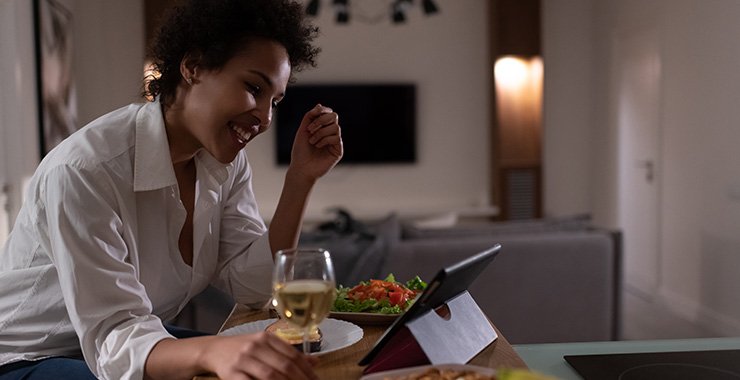
Woman in an online date using tablet

Finding that simpatico person has never been easy, but in these days of COVID-19 contagion fears, it’s even more complicated. 

“I’m finding that the people that are struggling the most are people who have been dating for a long time, and they have been single for a while,” says Jordana Jacobs, PhD, a New York City-based clinical psychologist. “And they’re almost throwing up their hands, saying, ‘And now this? Are you kidding me?’”

Still, even a public health crisis won’t squelch the human need to connect with others emotionally and physically, which may even be stronger now than ever before, psychologists say. The process of meeting someone special may progress differently, but one advantage is that some of the superficial layers of dating can be shed along the way, says Goali Saedi Bocci, PhD, a clinical psychologist in Portland, Oregon.

“We’re all in a more vulnerable space,” Saedi Bocci says. “Many of us are feeling more isolated and so we’re more willing to open up, and we’re more willing to put ourselves out there.”

Similarly, Jacobs tells her patients who don’t want to put their future plans on hold that this pandemic stretch may be surprisingly optimal for meeting a life partner. 

“People are much more seriously looking for true committed partnership,” says Jacobs, whose research has focused on how accepting one’s mortality enables one to love more fullyopens in new window. Those searching for commitment, she says, might “find it much faster now than they would have otherwise.”

How can those searching for that special someone best navigate dating in a physically distanced world? Psychologists recommend strategies to help patients sort through the emotional and practical logistics:


Appreciate the benefits of virtual connections

Some of Saedi Bocci’s clients were in the early stages of getting to know someone and had gone on a few dates when the shelter-in-place orders hit this spring. That lull is paying off in some ways, she tells them, “because it forces them to put the brakes on the relationship, in terms of jumping the gun when it comes to physical intimacy.” 

Jacobs agrees that a longer phase of virtual flirting allows time to see if emotional intimacy is developing without one’s perspective getting skewed by attraction. “[When we meet] in person, we can very easily become intoxicated, literally and metaphorically,” she says, noting that dates often involve drinking in restaurants or bars. “We’re animals. We want physical connection.”

Brainstorm creative dates

With video technology, dates can still take place over coffee or dinner, just a screen’s distance apart, Saedi Bocci says. Order food from the same place, she suggests, so the dinner feels more communal. One of her patients wanted to watch “Sleepless in Seattle” with her date, so Saedi Bocci suggested syncing their screens with the help of Netflix Party.

Keely Kolmes, PsyD, a psychologist who practices in the San Francisco area, points to some creative suggestionsopens in new window that change up the typical date, such as virtually comparing the contents of your respective refrigerators. Or ask your date to walk through their home and shine the screen on five items that are meaningful for some reason, says Kolmes, who uses the pronouns they/them. “Find ways to make it novel and to find out more about someone in a way that you might not if you met them for dinner at a restaurant.”

Acknowledge limitations

Getting to know someone via video is a far more reliable and multifaceted way to connect than by relying on text, email, or even the phone, says Chuck Hill, PhD, a professor of social psychology at Whittier College in California. “A very high percentage of our nonverbal communication is through the face—the smiles, the eyebrows, the eyes.” 

Even so, video misses out on the gestures, body positioning, and other more subtle flirting and communication signals, Hill says. “When you are looking at a talking head, you lose the rest of the body.”

Seemingly strong online connections also may not later translate, Kolmes notes. “The biggest drawback [of virtual dating] is there’s just a lot of chemistry that’s very sensual and pheromonal. You can get attached to somebody and find that they just don’t smell right or that their mannerisms off-screen are off-putting.”

Create trust

In any relationship, individuals must build trust, Hill says. “We think in terms of the development of trust as an incremental exchange,” he says. “The trust builds up over a period of time typically.” If anything, developing that mutual trust is even more crucial in these pandemic days, Hill says. Before meeting in person, people must believe that they’re getting a complete picture of their date’s exposure to others, as well as whether they agree on how physically distanced any in-person date will be.

To some extent, these are similar to conversations and trust building around safe sex, but they must start sooner in a relationship, even before meeting face to face, Hill says. People recognize that a commitment as mundane as sharing a meal carries a risk, since a date may have the virus and not realize it, he says. “Not only are you putting yourself at risk, you are potentially putting other people at risk.”

Think through in-person logistics

Kolmes describes how some patients take advantage of the outdoors, meeting up for a picnic with masks or learning more about each other over long walks or hikes. “There are some people who expect to be doing a lot of walks and talks for a long time,” they say.

Psychologists can help clients think through date planning in advance, Jacobs says. Discussing how the date will look, and how much distancing (or not) each person prefers, presents the opportunity for both parties to explore issues that involve boundaries, safety, and mutual respect, Jacobs says. “See how you can work through this together,” she says, “especially since there are bound to be differences here. It’s unlikely that two people feel exactly the same way.”

Once two people decide to become more intimate, Saedi Bocci says, they may create their own dating bubble, agreeing to practice social distancing except with each other. Kolmes and Jacobs have some patients who got tested for COVID-19 first before crossing that six-foot divide, and sometimes on an ongoing basis. “I think it’s going to be the new norm,” Jacobs says.

Practice self-compassion

As with the prepandemic world, sometimes people will regret going further physically than they’d initially planned. In their work with patients, Kolmes seeks to normalize the natural feelings that led to a situation that a client may later lament: “Let’s think about what led you to do that. You’ve been lonely. There’s this longing for a safe person and hope and optimism.”

That situation can open the door to a deeper conversation, Kolmes says. “Has that been an issue before the virus? Have there been other times in your life where you feel like you have been impulsive and regretted it later?”

Everyone these days is to some extent a pandemic virgin, trying to move forward with their lives as safely as possible, and psychologists can help their patients learn self-compassion, Jacobs says. 

“Have compassion for yourself at this time, particularly when we are longing for connection and longing for touch,” she says. “Even with the safest or best intentions, you may touch somebody when you weren’t planning on it.”

Recommended Reading

You may also like