skip to main content

New guidance for protecting research participants

Ensuring safety during the COVID-19 pandemic means reducing building occupancy, spreading out in labs, and more.

APA Style leaf logo Cite This Article in APA Style
Clay, R. A. (2020, July 6). New guidance for protecting research participants. https://www.apa.org/topics/covid-19/protecting-research-participants

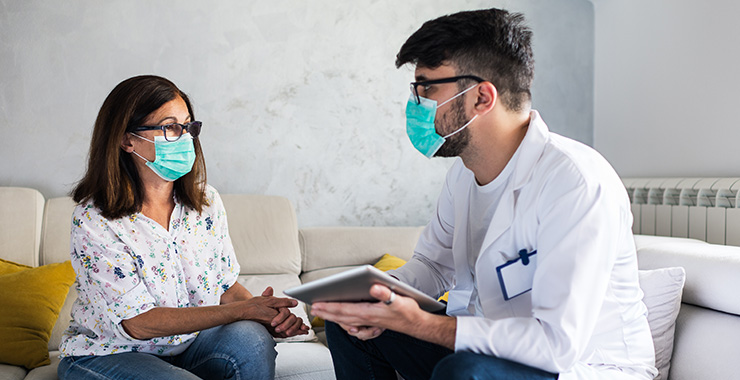
Doctor and patient sitting down wearing face masks

As the nation’s psychology labs begin to reboot their research, physical distancing, masks, and disinfecting are just the beginning of the safeguards psychologists are putting in place to keep research participants—and themselves—safe.

We spoke with five researchers who conduct research with both human and nonhuman animals. They recommend that researchers do the following:
Seek institutional guidance on new protocols

Individual institutions are issuing guidance for researchers that takes into account local infection rates and other factors. For instance, your institution may require COVID-19 tests or temperature checks before researchers and participants are allowed to enter a building, or may require a self-assessment questionnaire that asks about symptoms and potential exposure. Ask your institution for such guidance; also inquire about protocols for disinfecting labs and shared spaces, including who will perform these tasks and how often. And be sure to check with your institutional review board to see if it has issued guidance on how to modify protocols.

Think through every step

Researchers also must think about how to reduce risks at every point of their own research process, says Barbara Stanley, PhD, a professor of medical psychology in psychiatry at Columbia University Vagelos College of Physicians and Surgeons. Stanley conducts research on suicidal behavior and related topics. If the room where you usually meet with participants is too small to allow distancing, for example, you will have to seek out a bigger space. You also might assign a staff member to meet participants at the door of the building to prevent overcrowding in elevators, and limit exposure by bringing participants straight to the lab.

Adopt new protocols for welcoming participants

Even something as basic as how you greet participants will have to change, says Marguerita Lightfoot, PhD, a professor of medicine at the University of California, San Francisco, School of Medicine. Ordinarily, Lightfoot would welcome participants with a handshake and smile; now handshakes are taboo and smiles are hidden by masks. “We’ve been talking about things like virtual fist bumps or good old-fashioned waves as a way to make a connection,” she says. “And we’ll have to make nonverbal communication verbal, saying things like, ‘We’re glad you’re here’ and ‘Your contribution is valuable.’”

Consider risks outside the lab, too

In hard-hit urban areas like Houston or New York City, the biggest challenge is not safety in the lab but safety in getting to and from it, says Stanley. To avoid the risks of riding public transportation, Stanley is arranging car service for research participants. Another option is to find out what buses are least crowded and educate participants about where to sit and other measures to take to reduce exposure.

Reduce density

Making sure there are never a lot of people—whether researchers, participants, students or administrative staff—at one place at one time is key. Sharing Google calendars to reserve time slots is one option. At the University of California, San Francisco, researchers and other staff will contact an administrative staffer before they plan to head to the lab, says Lightfoot. If too many people want to come in at the same time—with “too many” defined as more than 25% of normal occupancy—the staffer asks people to adjust their schedules. If no one can shift, a supervisor will decide whose work should be prioritized. Another option is to consider stretching participant appointments out to seven days a week to minimize the number of people in the building at one time.

Revise your consent forms, if needed

Make sure that participants can make informed choices about what they’re comfortable doing by reworking your informed consent documents, says Bethany A. Teachman, PhD, a psychology professor at the University of Virginia. Detail the potential risks as well as the measures you are taking to protect participants. And make sure participants understand they can withdraw from the study at any point. “We know there’s a white lab coat effect,” Teachman says. “We need to reduce the likelihood that people feel any sense of coercion.”

Protect nonhuman research subjects

To protect any animals involved in the research as well as the staff who interact with them, psychologist James Rowlett, PhD, a professor of psychiatry and human behavior at the University of Mississippi Medical Center, requires masks and other personal protective equipment, limits who has access to the animals, and restricts the number of people going into the colonies of rhesus macaques he studies. Because lab situations can differ, he also recommends that researchers be sure to be in contact with the university’s Institutional Animal Care and Use Committee and the attending veterinarian.

Get creative

Think about new ways you could achieve your research goals while still protecting participants’ safety, Teachman says. You could conduct testing or other research protocols outside rather than in a lab, for instance. You could use a one-way mirror that lets you still see and communicate with participants in another room. Teachman, who studies social anxiety, plans to deliver sensors and other equipment to participants’ homes, then interact with the participants over Zoom. And of course, many research topics could continue to be studied at a distance via the internet instead of face-to-face, says Leah Light, PhD, a professor emerita of psychology at Pitzer College who chairs APA’s Committee on Human Research.

Recommended Reading

Related

You may also like