skip to main content

How COVID-19 impacts people with disabilities

Research shows people with disabilities are at risk for mental health problems.

APA Style leaf logo Cite This Article in APA Style
American Psychological Association. (2020, May 6). How COVID-19 impacts people with disabilities. https://www.apa.org/topics/covid-19/research-disabilities

How COVID-19 impacts people with disabilities

Emerging research on COVID-19 shows that the coronavirus pandemic has increased psychological distress both in the general population and among high-risk groups. Behaviors such as physical distancing, as well as their social and economic impacts, are worsening mental health consequences. Research on the psychological impact of mass trauma (e.g., natural disasters, flu outbreaks) suggests that the pandemic might particularly harm the mental health of marginalized populations who have less access to socioeconomic resources and supportive social networks (e.g., Goldmann & Galea, 2014).

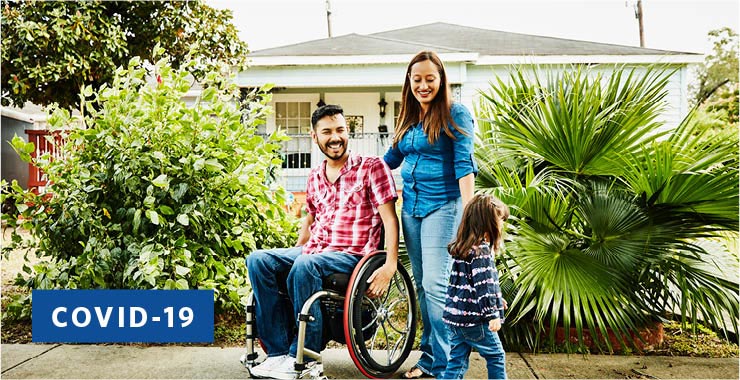
There are unique stressors and challenges that could worsen mental health for people with disabilities during the COVID-19 crisis. Research on past pandemics shows that disabled people find it harder to access critical medical supplies which can become even more challenging as resources become scarce (Campbell, Gilyard, Sinclair, Sternberg, & Kailes, 2009). Some people with disabilities report higher levels of social isolation than their nondisabled counterparts (O'Sullivan & Bourgin, 2010). They may experience intensified feelings of loneliness in response to physical distancing measures. Social isolation and loneliness have been associated with increases in heart disease, dementia and other health problems according to the National Academies of Science, Engineering, and Medicineopens in new window. Furthermore, policies around rationing of medical care can intensify discriminatory attitudes towards disabled individuals during times of crisis (Priestley & Hemingway, 2006). This can understandably worsen your anxiety about getting sick and needing to seek medical care.

As the virus continues to spread, data is critical to informing the public health response. While adequate research on the specific impact of COVID-19 on the disability community is not yet available, several studies are underway or in planning phase. Data is needed on rates of infections, hospitalizations, outcomes and deaths disaggregated by disability, age, race and income, among other factors, so we can understand the impact of COVID-19 on multiple vulnerable groups.

Federal and local agencies will need to coordinate and use that data to better serve the disability community.  
Who is at risk?

It is important not to conflate health status with disability. Many people with disabilities are healthy. However, some have underlying or secondary aspects of their disability, like suppressed immune systems or respiratory concerns, that COVID-19 could worsen. Some have underlying acute health conditions, such as skin breakdown or urinary tract infection, which increase risk of severe symptoms associated with COVID-19. Being classified as “high risk” in the current pandemic can cause additional stress and fears.

The social gradient of risk may influence policies and decision-making related to access to care or treatments. Medical discrimination is always a dangerous reality for many people with disabilities in need of healthcare. Many disabled adults (60% report being “very concerned” in a recent survey - National Disability Institute, 2020 ) and disability rights organizations are anxious about how these policies may prevent them from getting equitable and fair treatment. Make sure you and your family know your rights. You should also know your risks and take appropriate precautions if you have an underlying condition. If in doubt, consult your treating physician.

References

Brooks, J. M., Iwanaga, K., Chan, F., Lee, B., Chen, X., Wu, J.-R., Walker, R., & Fortuna, K. L. (2020). Psychometric validation of the Job Satisfaction of Persons with Disabilities Scale in a sample of peer support specialists. Psychiatric Rehabilitation Journal. Advance online publication. https://doi.org/10.1037/prj0000411opens in new window

Campbell, V. A., Gilyard, J. A., Sinclair, L., Sternberg, T., & Kailes, J. I. (2009). Preparing for and responding to pandemic influenza: Implications for people with disabilities. American Journal of Public Health, 99, S294-S300, https://doi.org/10.2105/AJPH.2009.162677opens in new window

Galea, S., Merchant, R. M., Lurie N. (2020). The mental health consequences of COVID-19 and physical distancing: The need for prevention and early intervention. JAMA Intern Med. Published online April 10, 2020. https://doi.org/10.1001/jamainternmed.2020.1562opens in new window 

Goldmann, E., & Galea, S. (2014). Mental health consequences of disasters, Annual Review of Public Health, 35, 169-183 https://doi.org/10.1146/annurev-publhealth-032013-182435opens in new window

Lai, J., Ma, S., Wang, Y, et al. (2020). Factors associated with mental health outcomes among health care workers exposed to coronavirus disease 2019. JAMA Network Open. 3(3):e203976. doi:10.1001/jamanetworkopen.2020.3976 https://jamanetwork.com/journals/jamanetworkopen/fullarticle/2763229opens in new window

National Academies of Science, Engineering, and Medicine. (2020). Social isolation and loneliness in older adults: Opportunities for the health care system. Washington, DC: National Academies Press. https://doi.org/10.17226/25663opens in new window

O'Sullivan, T., & Bourgoin, M. (2010). Vulnerability in an influenza pandemic: Looking beyond medical risk. White Paper funded by Public Health Agency of Canada https://pdfs.semanticscholar.org/3fea/b020bbd580beee0ae83a05f2945286f61e2e.pdf?_ga=2.32448446.1610832451.1588091465-2065395916.1588091465opens in new window

Priestley, M., & Hemingway, L. (2007) Disability and disaster recovery, Journal of Social Work in Disability & Rehabilitation, 5:3-4, 23-42, DOI: 10.1300/J198v05n03_02opens in new window

Qi, F., Qian, S., Zhang, S., & Zhang, Z. (2020) Single cell RNA sequencing of 13 human tissues identify cell types and receptors of human coronaviruses. Biochemical and Biophysical Research Communications. DOI: 10.1101/2020.02.16.951913 [published ahead of print]

Wang W, Xu Y, Gao R, et al. (2020). Detection of SARS-CoV-2 in different types of clinical specimens. JAMA. Published online March 11, 2020. doi:10.1001/jama.2020.3786

Recommended Reading

You may also like