

Background
As of November 2023, the Map Movement Projectopens in new window reported seven states that banned transgender people from using restrooms and facilities consistent with their gender identity in K-12 schools. One additional state, North Dakota, extended the ban to some government-owned buildings, and one more state, Florida, extended the ban to colleges and government buildings. Such laws have documented negative impact on the mental health of transgender people (Horne, S. G., McGinley, M., Yel, N., & Maroney, M. R., 2022).
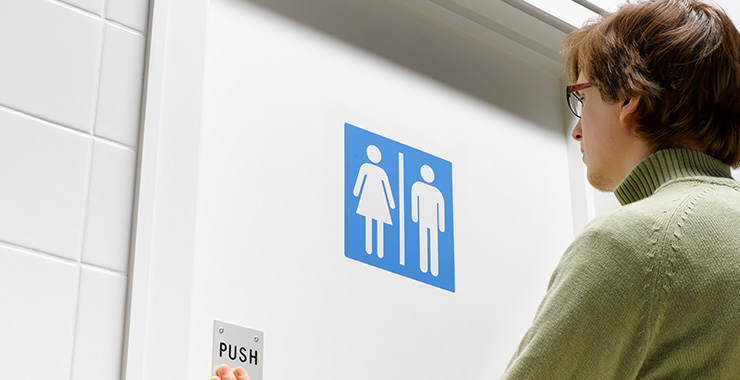
All-gender public restrooms can be used by anyone. In the U.S., all-gender restroom ordinances require a city, state, or municipality to designate single-stall public restrooms as all-gender. These public restrooms are commonly referred as “gender-inclusive,” “gender-neutral,” “mixed-sex,” or “unisex.” In addition to benefiting the transgender community, these laws can also benefit others, including people with disabilities, older adults, and parents of small children (American Psychological Association, 2019).
Gender-segregated restrooms can be unsafe and inaccessible to transgender people, since transgender people risk physical and verbal victimization in whichever gender-segregated restroom they enter (National Center for Transgender Equality, 2015). Those who oppose all-gender restrooms often cite concern that transgender people will attack or sexually harass cisgender people—particularly that transgender girls and women will victimize cisgender girls and women (Sanders & Striker, 2016). Since there is a much greater incidence of cisgender people attacking transgender people in bathrooms, the supposed controversy regarding all-gender restrooms has been labeled by activists and academics as a moral panic (Sanders & Striker, 2016).
Suggested discussion points
- Many transgender, nonbinary, and gender non-conforming people report being “gender-policed” (Detloff, 2006; Payne & Smith, 2016) when using public bathrooms with gender designated signage. Gender-inclusive bathrooms make it safer for them to use public restrooms (Chaney & Sanchez, 2017).
- According to the 2015 U.S. Transgender Survey, which had 27,715 respondents, transgender individuals reported incidents of verbal harassment (12% of respondents), physical assault (1%), or sexual assault (1%) when accessing a restroom, while 9% of survey respondents reported that they were denied access to a restroom in the past year (National Center for Transgender Equality, 2015).
- Gender-inclusive restrooms are also helpful for people whose family member—such as a child, person with a disability, or older adult—requires assistance from parents or caregivers of a different sex or gender (American Psychological Association, 2019).
- Single-use restrooms are crucial to people with paruresis (“shy bladder syndrome”) or parcopresis (“shy bowel syndrome”) who cannot comfortably use multi-stall restrooms (Knowles, & Skues, 2016). Gender-neutral signage also reduces long wait lines commonly associated with female-designated restrooms.
- For these reasons and many others, we are asking you to oppose (bathroom use bans) / support or co-sponsor (bills to establish universal design bathrooms). Please contact us if you have any questions, and we look forward to working with your office on this.
Are you a psychologist or a representative of a state, provincial, or territorial psychology association who has written a letter to your state legislative representative or representatives, provided testimony at a committee hearing, or participated in direct advocacy individually or with organized community advocacy efforts? If so, would you be willing to share either copies of letters or testimony, or videos of testimony, for consideration to be added here as examples to inform and inspire others to take similar action? If so, please send via email.
References
American Psychological Association. (2019). Resolution on Support of Universal Design and Accessibility in Education, Training and Practice. https://www.apa.org/about/policy/universal-design-accessibility-education
Chaney, K. E. & Sanchez, D. T. (2017). Gender- Inclusive Bathrooms Signal Fairness Across Identity Dimensions. Social Psychological and Personality Science, 9(2), 245- 253. https://doi.org/10.1177/1948550617737601
Detloff, M. (2006). Gender Please, Without the Gender Police, Journal of Lesbian Studies, 10(1-2), 87-105. https://doi: 10.1300/J155v10n01_05
Horne, S. G., McGinley, M., Yel, N., & Maroney, M. R. (2022). The stench of bathroom bills and anti-transgender legislation: Anxiety and depression among transgender, nonbinary, and cisgender LGBQ people during a state referendum. Journal of Counseling Psychology, 69(1), 1–13. https://doi.org/10.1037/cou0000558opens in new window)
Knowles, S. R. & Skues, J. (2016). Development and validation of the Shy Bladder and Bowel Scale (SBBS). Cognitive Behaviour Therapy, 45(4), 324-338. https://doi.org/10.1080/16506073.2016.1178800
Payne, E. & Smith M. J. (2016). Gender Policing. In: Rodriguez N., Martino W., Ingrey J., Brockenbrough E. (eds) Critical Concepts in Queer Studies and Education. Queer Studies and Education. Palgrave Macmillan, New York. https://doi.org/10.1057/978-1-137-55425-3_14opens in new window
National Center for Transgender Equality. (2015). 2015 U.S. Transgender Survey Executive Summary. https://transequality.org/sites/default/files/docs/usts/USTS-Executive-Summary-Dec17.pdfopens in new window
Sanders, J. & Striker, S. (2016). Stalled: Gender-neutral public bathrooms. The South Atlantic Quarterly, 115(4). https://doi.org/10.1215/00382876-3656191opens in new window
APA Resources
-
Transgender, Gender Identity and Gender Expression Non-discrimination (PDF, 70KBopens in new window)
Adopted by the APA Council of Representatives on August 13-14, 2008. -
Trans Resource Guide: A Guide for Supporting Trans and Gender Diverse Students (PDF, 309KB)opens in new window
This guide provides a safe learning environment for trans and gender diverse students who continue to be marginalized in many aspects of their lives.