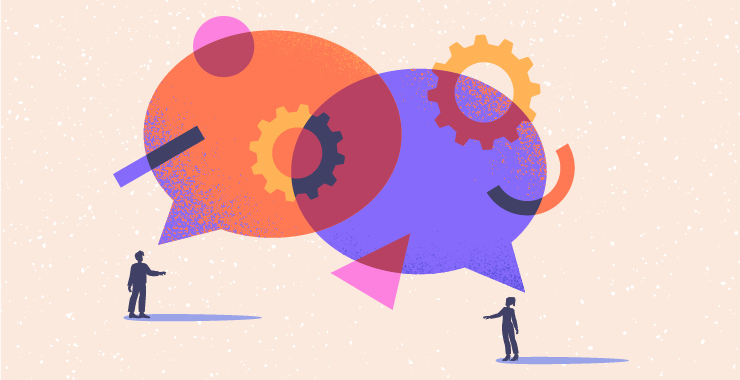
Conversations hold immense power. They help us form new connections and deepen existing ones. They can change minds, align brains, save lives—even prevent disaster on a global scale.
Yet this powerful tool for connecting with others is also one of the hardest to study. In every conversation, word choice, word order, timing, structure, and nonverbal cues can all vary in infinite ways, so what makes these interactions “click” has long remained a mystery.
“Conversation is this ancient technology for aligning our brains so that we can be on the same page,” said Thalia Wheatley, PhD, a professor of psychological and brain sciences at Dartmouth College who studies how we connect during conversations. “It’s the most ubiquitous social behavior that we do, yet we don’t really know much about it.”
That’s all starting to change, with artificial intelligence and advanced neuroimaging unlocking new insights about how we interact. Already, psychological research is offering valuable tips that can help deepen our relationships, resolve political conflicts, and even help people at risk for suicide. On a smaller scale, high-quality conversations can give us a welcome boost in our day-to-day lives.
[Related: The science of why friendships keep us healthy]
“Our well-being is determined largely by the quality of our social relationships, which are shaped by our conversations. Going a little deeper can help people create connections that leave them feeling happier,” said Michael Kardas, PhD, assistant professor of management and human resources at the University of Wisconsin–Madison, who studies deep conversations.