skip to main content

Improving online group therapy with virtual reality

Affordable VR headsets can help patients overcome the barriers of remote communication

APA Style leaf logo Cite This Article in APA Style
Stringer, H. (2025, May 12). Improving online group therapy with virtual reality. https://www.apa.org/topics/psychotherapy/virtual-reality-group-therapy

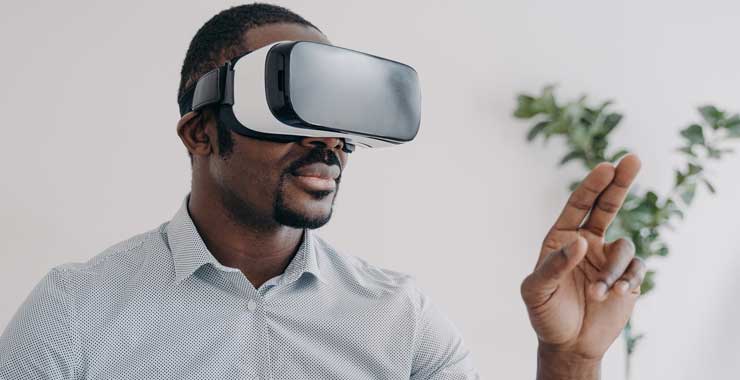
Man playing video game in office using oculus rift headset

Since the pandemic, online group therapy has proliferated and increased access to mental health treatment, but clinical researchers agree that looking at faces on a two-dimensional screen can hamper important aspects of human interaction. The lack of true eye contact, difficulty taking turns to speak, and heightened self-awareness can create barriers as group members try to connect.

Virtual reality (VR) has the potential to address these limitations, and high-quality VR headsets have become more affordable in the last few years. Psychologist Ayoub Bouguettaya, PhD, a research fellow at Cedars-Sinai Medical Center in Los Angeles, recently published a review paper about using extended reality to enhance effectiveness and group identification in remote group therapy for anxiety disorders (JMIR Formative Research, 2024opens in new window). APA asked him to explain how psychologists can bring these immersive experiences to the clinical setting to better help patients.


How can VR improve the effectiveness of online group therapy?

Remote group therapy on a 2D screen typically requires a structured style of talking that lacks spontaneity and feels more like an interview. I talk and then you talk, but this is not normally how people communicate. This does not allow people to agree with one another or interrupt, which can feel artificial. People have a tendency to look at someone’s body language and accurately predict when they want to say something, but it is difficult to do this when staring at a screen full of faces.

In a VR group session, users can move their heads to make eye contact and see body language, such as hand gestures, head tilting, and nodding. Research findings suggest that hand gestures help people focus on what others are saying and increase comprehension. Two-dimensional group therapy has also been shown to reduce creativity because communicators must narrow their cognitive focus to look at a screen. But VR gives users the freedom to look around a 3D room and more naturally generate ideas during interactions.

So how does VR group therapy work exactly?

Each member of a group can put on their 3D headset from anywhere and design their own customized environment for the group session. One participant may have the meeting take place in a diner, while another sees other members in a library or a Dungeons and Dragons fantasy setting.

To me, one of the most exciting parts of this technology is the ability to help people with anxiety disorders. For example, if group members suffer from arachnophobia (extreme fear of spiders), the therapist could add a spider to the environment to help participants work together to overcome this fear. They could touch the spider and learn how to practice mindfulness.

The therapist could also add a 3D brain model to the virtual room and click on different parts to help members visualize which areas of the brain are activated by the fear and how mindfulness exercises can rewire the brain. This is much more immersive than showing a plastic brain model or a video about the brain on a 2D screen.

How can therapists introduce VR group therapy to patients?

It’s important for psychologists to try VR technology for themselves first. Meta’s Quest headset is about $200, and it tracks head, arm, hand, and some upper body movements. We have strong evidence that group therapy is transformative for treating anxiety and phobias, and I guarantee that there will be patients who will be better served by virtual reality than other strategies.

There’s a 2019 study that looked at how often psychologists use VRopens in new window: Most had never used it and were skeptical of its use. Even if the research is extremely positive for a new modality of treatment in medicine, it typically takes many years for changes to be absorbed into practice. We have had telehealth for almost 40 years now, but it took a global pandemic to make it commonplace.

My hope is that we can speed up this timeline if psychologists are willing to overcome the psychological barriers to trying something new. Psychologists can start by booking an appointment with a tech retailer as a test run. When introducing the technology to patients, assure them that they have complete control over the headset. Show them how to turn it off and explain what data is being collected. Discussing the benefits is also crucial, including the research and how enjoyable people have found these tools.

What is your latest VR research exploring?

We’re looking at providing group therapy in combination with support groups and simply modifying how the groups meet—via Zoom, in person, or VR. We believe, and we hope, that VR groups will provide most of the benefits of in-person therapy without the drawbacks of Zoom. We also believe that the tools for exposure therapy in VR will enhance the clinical recovery of patients with social phobias.

I’m also piloting a project that provides VR headsets to clinical psychologists who work with children who have ADHD. I’m exploring what the challenges and possibilities are, and if there are improvements to social functioning for the children. Dropout rates are high with video calls for this population, but it’s fun to put on a headset to meet with a therapist in a virtual classroom for attention training. VR may increase retention, and as a result, improve treatment outcomes.

My hope is that researchers will continue to study how this technology could help specific patient groups. In the history of humankind, we’ve never been able to control a patient’s reality like this to encourage healing, empathy, and connection.

Recommended Reading

Speaking of Psychology

Subscribe to APA’s audio podcast series highlighting some of the most important and relevant psychological research being conducted today.

Subscribe to Speaking of Psychology and download via:

Appleopens in new window
Apple podcast logo

Spotifyopens in new window
Spotify logo

You may also like