The youth mental health crisis endures, according to CDC data released in Augustopens in new window. In 2023, 40% of all students, and 53% of girls, experienced persistent feelings of sadness or hopelessness. Nearly 1 in 5 students reported being bullied at school, while 13% missed school because of safety concerns.
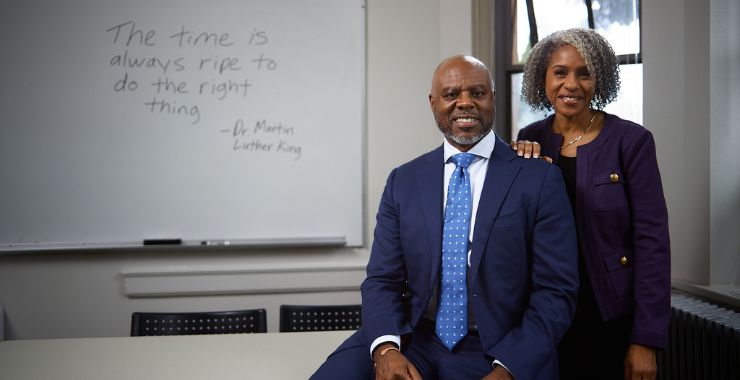
For Janine Jones, PhD, and Brent Jones, PhD, those numbers represent the faces of the children they work with day in and day out. Janine Jones is a licensed psychologist and professor of school psychology at the University of Washington in Seattle. Her research focuses on providing culturally responsive interventions in school-related settings, particularly for students of color. Her husband, Brent Jones, is the superintendent of Seattle Public Schools, a system that serves a diverse population of 49,226 preschool through 12th grade students and 6,486 staff members, across 104 schools. They spoke with APA about the mental health challenges facing schools and how to tackle them.
What are schools’ biggest challenges right now in terms of mental health?
Brent Jones: There are limited resources and high demand for services, and that’s a challenge many urban school districts are faced with. There’s also a great diversity of psychological challenges. One big challenge for us is identifying mental health issues early. We’re reliant mainly on teacher observations and on our students’ self-reporting. But we don’t have robust ways to identify problems early, which compounds the challenge. Often there might have been interventions or solutions that could have helped, if we had been able to start them earlier.
Janine Jones: One of the challenges is related to the lack of personnel to meet the demand. Although school psychologists are trained to provide mental health services, they’re often relegated into roles related to special education qualification and compliance. School psychologists are prepared to screen students to identify mental health issues early, for example. But because there’s such a shortage of school psychologists, and the demand is so high for mental health services, we just can’t keep up.
[Related: There’s a strong push for more school psychologists]
Some critics say schools aren’t doing enough. How would you respond?
Brent: Our bottom line as a school system is teaching and learning. From the superintendent to the classroom, we’re all teachers. Yet we also must deal with food insecurity, digital insecurity, housing insecurity, safety insecurity—all of these important things. Mental health gets caught up in the mix of all those necessary, but unfunded, mandates. We end up stretched so thinly that we can’t respond adequately to all the needs. We must figure out ways to provide more on-demand, real-time services for our students. Because the longer these things go unaddressed, the harder they are to treat.
Can community partners help address the demand?
Brent: We absolutely need to rely on community partners. We have experts in schools that can provide services, but we as a school district aren’t necessarily experts in mental health support. We tend to have a one-size-fits-all model, but there’s a wide diversity of needs. Community-based organizations that work with schools regularly can help scale up services to meet those more specialized needs.
Janine: There is beauty in being able to work with specialists who can step in, address a specific need, and step out. And it’s great when they can serve kids in the school environment, rather than an outpatient model where families must take kids from one place to another to receive services. At the same time, it’s not helpful when they’re pulling kids from a classroom where they’re supposed to be learning. The most effective model is a school-based health center. Not only is that model less disruptive, but having regular providers assigned to the school setting means students are building relationships with them, and they’re much more likely to turn to them for help when they need it. It’s a great model—when it’s funded well enough to work.
Are there initiatives or innovations that you’d like to see implemented in more schools?
Janine: There is such great promise in the multi-tiered systems of support (MTSS) model. In that model, tier-one services are available to everyone, regardless of need. That includes screening for mental health conditions and risks. Those that have a higher level of risk for a mental health need or disorder get tier-two interventions, which may be things like social support groups or other group interventions. Then in tier three, clinicians provide one-on-one intervention services to students with the greatest needs. A model like this with universal screening means we’re more likely to recognize that there’s a need for services and to provide supports much earlier. But it’s extremely difficult to implement this system in schools.
Brent: I agree that the MTSS model has great promise. But funding is always a challenge. It takes a lot of resources, a lot of coordination and intentionality. We need to think about approaching this in a holistic way. That also means we need to engage families and communities in our mental health initiatives. It can be difficult, due to logistical and communication barriers. But we need to make sure that our efforts are culturally responsive, that families feel we’re welcoming and accommodating their needs.
Where is more research needed?
Brent: More work on predictive modeling will be helpful. Data on student mental health is often fragmented and hard to interpret. We don’t have strong, timely data systems that allow us to look at the trends. That hinders our ability to scale up, so we’re having to almost customize services each and every time. We’re not using data in a way that allows us to be proactive; it’s very much reactive. I’m hoping that artificial intelligence might be an opportunity for us to build some coherence into our approach.
Janine: My first reaction to that question is that the body of research is there. The biggest problems are with implementation. Most of the researchers aren’t connected well enough to the systems to understand how to implement things and scale them up. Those types of partnerships are absolutely necessary so we can actually apply best practices. Looking at the research on trauma-informed practices in schools, for example, the people I know who are having the greatest impact are embedded in school districts. When that happens, implementation becomes part of everyday practice; it’s built into the curriculum. All of us working together is really the only way to make sure we’re making a difference long-term.

If you were to switch jobs with one another, how would you apply the knowledge from your own field to your new role?
Brent: [If I stepped into the role of school psychologist], I’d want to know: What are the three or four things that work most of the time? And how do we invest in those highest-impact services and shore them up so that we are catching most of our students in need, across cultures, across race, across income?
Janine: As a superintendent I would be trying to come from a space of helping everybody in the system understand their individual responsibility. When you’re working in such a large system, with so many priorities, everybody has their own agenda. I’d want to figure out a common denominator to help every person in the system feel a sense of accountability and a sense of empowerment to make things better.
Despite the challenges, what makes you hopeful?
Brent: What makes me hopeful is the narrative and awareness around mental health issues being destigmatized. Many more of our students are coming forward when they have challenges, and that gives us the opportunity to do what we need to do to support them in more relevant and meaningful ways. That’s a big deal, especially for students who have historically not performed well because of a lack of responsiveness from the system.
Janine: I love that answer, because it was the same answer that immediately came to my mind. I’m so excited about how much things have changed, particularly with communities of color. My work focuses on culturally responsive practices, and at the beginning of my career, I had to kind of sneak that content in. Some families saw mental health services as things that weren’t appropriate for them. Now they’re beginning to open up and seek support. So, I’m 100% aligned in Dr. Jones’ hope.