skip to main content

The game-changer: Helping athletes slow down and play in the moment

In his work for London’s Brentford Football Club, Michael Caulfield works with players on their mental well-being and performance
APA Style leaf logo Cite This Article in APA Style
Abrams, Z. (2025, May 7). The game-changer: Helping athletes slow down and play in the moment. https://www.apa.org/topics/sport-rehabilitation/athlete-well-being-performance

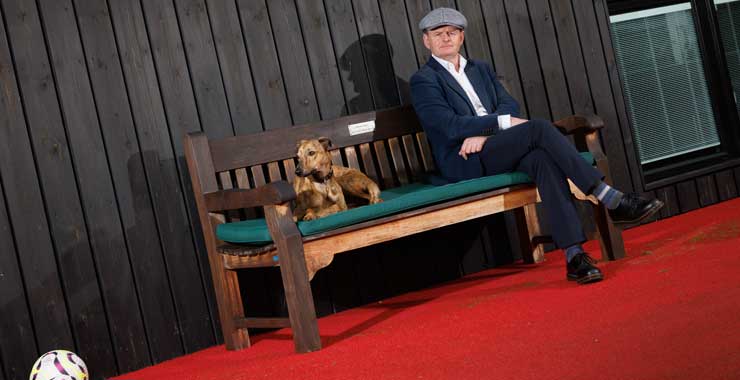
Sports psychologist Michael Caulfield on his bench

Michael Caulfield, a qualified sport psychologist based in Oxford, England, credits his dog and professional sidekick, Paisley, with helping shape his philosophy at work.

“We live in a world where people measure everything from their heart rate and sleep to their exercise and diet. We’ve got so much information,” says Caulfield, who consults for Brentford Football Club, a London-based soccer team in England’s top league. “Dogs don’t measure anything; they just bother about the next meal or walk because they live for that moment. In sport, we’re at a terrible risk of forgetting that. We’re so obsessed about the next challenge, the next goal, the next measurement, that we forget to live.”

Those insights determine how Caulfield and Paisley spend much of their time at Brentford’s training ground: walking around outside. He’s also found that the best conversations about well-being don’t happen across a desk, so he installed four benches around the club’s grounds where players or staff can “sit and talk or just sit.”

“I’ve created time—and that is literally my ‘innovation.’ Everything else was getting faster and faster, so I went slower and slower,” said Caulfield. “Often, I’m asked by a head coach or manager: Michael, what have you been up to today? Sometimes, I say: Less than you!”

Caulfield earned his master of science in sport psychology after 15 years as chief executive of Great Britain’s Professional Jockeys Association (PJA). He has since worked with teams and individuals who play soccer, rugby, darts, and more, but spends most of his time these days working with the players at Brentford on their mental well-being and performance, where he does far more listening than talking. We asked Caulfield to discuss his informal approach to sport psychology in a world where structure and measurement can be tough to avoid.

Rather than sitting behind a desk, you often sit or walk around the Brentford grounds with Paisley. Sometimes players join you. What inspired this approach?

I used to do the former, but I abandoned that—partly by choice and partly by request. In the end, players were tired of the nearly 24-hour surveillance that exists now in sport, and they wanted to dip out of that.

I started by buying one bench and now I’m up to four. Luckily, I had a beautiful, young puppy at the time, and he came with me. All of a sudden, the dynamic of the conversation and the topics discussed completely changed. And then, as one player said to me recently: “You’ve mentioned psychology, but it feels like you do absolutely no psychology with us. But you do, don’t you?” And I smiled.

It doesn’t have to be presented as psychology. We’ve reached a stage where many people in sport and performance psychology are trying to fix everything. I might prompt and urge and guide, but I never try to fix anything. Most important, I let them learn about themselves.

Before you trained in sport psychology, you helped improve athlete well-being through your work at the PJA. How have attitudes toward mental health in sport changed since then?

Everything has changed, especially the approach to mental well-being and psychology. When I started in 1988 at the Professional Jockeys Association, we had no budget, no research—we had nothing, really. In a way, that was our greatest strength, because we had to find clever ways to help.

The demands of that job, which is to ride a horse at 40 miles an hour every day, put a huge mental toll on people, in addition to the physical toll. It’s a sport where you had to be seen as tough. You couldn’t show weakness to anyone. I had to convince an entire industry and an entire group of athletes that actually, understanding yourself is not a weakness—it is a huge strength. In hindsight, I’d like to think I helped a sport to start talking and understanding the other side of its challenges, beyond the physical pressures.

Nearly 30 years later, every support mechanism is now in place, and the world is a bit more complex than it was then. We need to be careful about putting everything in the mental health bucket, because having a dip is a big difference to being mentally unwell or sick.

I had to convince an entire industry and an entire group of athletes that actually, understanding yourself is not a weakness—it is a huge strength.

How do you demonstrate the importance of your work in a world that’s so focused on measurable results?

We’re addicted to measurement. We’re addicted to outcomes. I’m more interested in the opposite—trust, timing, conversation, silence. I often say to people who employ me: You do realize, I’m not going to give you a set of results at the end of this. The look on their face is one of terror.

We live in a world where people measure everything from their heart rate and sleep to their exercise and diet. We’ve got so much information. I look back to that wonderful dog of mine, and dogs don’t measure anything. They just bother about the next meal or walk, because they live for that moment.

In sport, we’re at a terrible risk of forgetting that. We’re so obsessed about the next challenge, the next goal, the next measurement, that we forget to live. The “flow state” is becoming more and more elusive because we’re not bothered about the sheer and utter joy of doing things. We’re bothered about the output, but there’s more to life than output.

I’m not advocating an unprofessional, ill-disciplined, chaotic, data-free world, but I want to start a debate about leaning back the other way.

What approaches have you found most effective in supporting players and staff?

I try to connect with all sorts of people in sport. If I know 50 people at a club, I probably connect in 50 different ways. But one thing I use consistently—in this crazy, fast-paced world in which we live—is the power of the pen. Pen and paper are still majestic. I use it to connect with people and I encourage even the best in the world to do the same: to draw and map things out, to drop notes to people, to keep track of themselves. When you write something down and look at it, still to this day, it’s far more powerful than a screen.

You’ve worked with athletes across many sports and contexts. What differs between them and what is universal?

The common denominators are fear of failure, doubt, and handling setbacks. Even Michael Jordan and Roger Federer admitted publicly that they, at times, had moments of doubt.

As for what differs, I regard my work with each sport and organization a bit like going from a Catholic church to a mosque to a Hindu temple. You worship differently in each space. Whenever I go to a different environment, I try to immerse myself and respect their culture and beliefs. There’s nothing worse than imposing your own beliefs on someone.

How did starting your sport psychology career in your 40s help you add a personal touch to your work?

By the time I went to university, I had this huge lifetime of experience to influence my study. I was probably very annoying, but I challenged the way I was being taught. It was very much a fixing-type attitude: These are the facts. This is the research. This is what happens next. I’m thinking: Well, I know from 15 years running an organization that that’s not the real world. There’s only so much you can learn from theory—then you have to use your own instincts and experience.

I’ve still yet to see anything in my life that compares to private, honest, trusting conversation. That’s why I very rarely hold a meeting indoors. By luck, because of my dog, I’ve found that all the best conversations take place away from a meeting room.

The feedback I get from the people I work with is: “Thank you for letting us breathe a bit.” I was walking around the training ground last week, and I saw one of our players sitting quietly on my bench, eyes closed, in the afternoon sun. I just watched him. He sat there on his own for about 10 minutes and then went inside. The plaque on the bench says: “Michael’s bench: Just sit and talk, or just sit.” And he was just sitting.

Recommended Reading

Speaking of Psychology

Subscribe to APA’s audio podcast series highlighting some of the most important and relevant psychological research being conducted today.

Subscribe to Speaking of Psychology and download via:

Appleopens in new window
Apple podcast logo

Spotifyopens in new window
Spotify logo

You may also like