DeAngelis, T. (2023, January 5). Damar Hamlin’s collapse offers mental health lessons in trauma, vulnerability for NFL players and fans. https://www.apa.org/topics/sport-rehabilitation/damar-hamlin-collapse
As millions watched the January 2, 2023, Monday Night Football game between the Cincinnati Bengals and the Buffalo Bills, an unprecedented tragedy happened: Bills safety Damar Hamlin, 24, collapsed on the field after tackling Bengals wide receiver Tee Higgins.
The probable cause was a heart arrhythmia, or cardiac arrest, sparked by the impact of the collision. As of January 5, 2023, Hamlin was awake and improving but remained in critical condition at the University of Cincinnati Medical Center.
The incident was devastating, with players, coaches, and fans on both sides crying, hugging, and praying on the field and at the hospital.
“There’s no playbook for managing real-time drama and emotions associated with [the] immediate life-threatening event that occurred on Monday night,” Troy Vincent, vice president of football operations for the National Football League (NFL), said in media reports.;
Many experts agree that both teams played a huge role in recognizing Hamlin’s humanity by creating a cone of privacy around him while he was being administered CPR on the field.
Experts also say that the NFL made the right decision to suspend the game. In doing so, the league not only honored Hamlin but respected the mental health needs of the players, family, and fans. Still, seeing such a young and healthy player inexplicably collapse on national TV was traumatic for many.
[Related: How to cope with traumatic stress]
Psychologists say science offers lessons to pro players, youth players, and fans on how to recover from feelings of grief, helplessness, and vulnerability.
Pro players need to process their feelings
Today, a culture of mental health and wellness is more embedded in professional football and other sports than ever before, with mental health clinicians on every NFL team and more elite athletes sharing their mental health struggles with the public.
That reality was evident on the Cincinnati field that night, said William D. Parham, PhD, ABPP, director of the Mental Health and Wellness Program for the National Basketball Players Association. “The strength I saw that night was not in the football game itself, but in the vulnerability of the men who saw their brother go down,” he said. “The vulnerability, the strength, the priority of life over football—that was the strength that everybody saw.”
That said, many professional players retain a tendency to compartmentalize their feelings thanks to an ongoing performance ethic, said sport psychologist Sam Maniar, PhD, founder of the Center for Peak Performance and a consultant to the Cleveland Browns.
“We know that if you don’t process these emotions, they are going to fester and build up and bubble to the surface in ways we don’t want them to,” he said. For the players who watched Hamlin collapse, those feelings are likely to be extremely intense, with some players wondering if they played a part in the tragedy or why it happened to Hamlin and not to them, for example.
A first helpful step is to educate players on the range of emotional reactions they may be experiencing as a way to normalize those feelings, Maniar said. The National Center for PTSDopens in new window, for example, cites feeling distant or detached, feeling jumpy or easily startled, and avoiding people, places, and things related to the event as some common reactions. Others include worry, anxiety, fear, sadness, anger, numbness, and guilt.
After that, it’s important to encourage them to process their feelings in whatever healthy ways they are comfortable with, whether that’s talking with a therapist, teammates, or loved ones, or engaging in journaling, art, music, exercise, or meditation. “The key is toprocess how they’re feelingopens in new window—their fears, their concerns, their worries,” he said.
Outreach to fellow players is also important, Parham said, including those in the “strong and silent” category. “Outreach should be both to those who are obviously in need, but also to those who don’t appear to be in need,” he said.
All this work can help when players return to the field, but it can also help to put those feelings on hold during actual play, Maniar added. “They can use compartmentalization in a positive way to go in and play the game, but then to continue to process their feelings in healthy ways after the game,” he said.
Strategize with youth players on how to stay safe
Youth players are also affected by an event like this, said Maniar, who works with two high schools in the Cleveland area. They, too, may experience various trauma-based emotions and reactions, particularly if they have experienced similar traumas in the past such as the sudden death of a loved one. A common question is, “Could this happen to me?” he said.
As with professional athletes, it helps to educate kids about potential emotional reactions and to allow them to process their concerns and fears. Avoid too much interference or judgment, he added: “Too often, with kids in particular, we do a lot of telling and not enough listening.”
[Related: Evidence-based practices for childhood grief and trauma]
Also important is helping young athletes strategize about how to stay as safe as possible. Again, as with professional athletes, they need to feel confident when they head back out onto the field, Maniar said. “Part of that is learning to put their fears aside and go out there and just play the game that they enjoy.”
Fans should vent their feelings, then step away
Football fans—both those who attended the January 2 game and those who watched it on TV—are also affected by a crisis like this, said Tyler Bradstreet, PhD, director of clinical and sport psychology at Texas Tech Athletics. Being in the arena itself that night probably triggered more intense reactions than watching it on TV because the incident was that much more real.
But TV viewers—and simply those who read or heard about the event—were affected by such an event, as well. Research shows that repeated viewing of traumatic eventsopens in new window such as the 9/11 attacks and the Oklahoma City bombing can exacerbate people’s stress reactions. And now, social media channels enable ongoing conversations about it. “Even if you weren’t there, we were all indirectly exposed numerous times to this tragic situation,” he said.
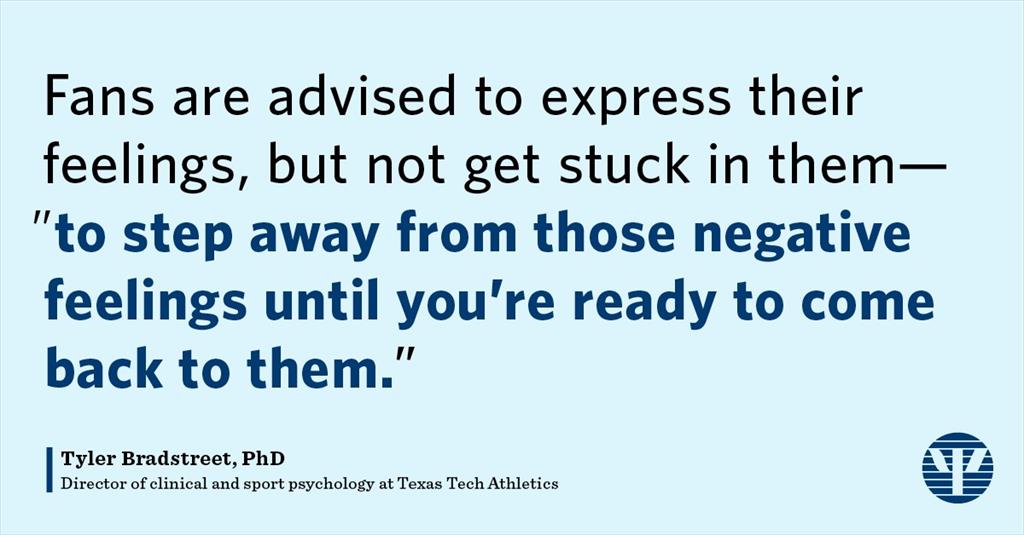
To help, Bradstreet advises fans to vent their feelings with appropriate friends and others, but not get stuck in them—“to step away from those negative feelings until you’re ready to come back to them.” And if the event does trigger past trauma, it may be a good idea to get trauma-related counseling, he said.
Also important is underscoring positive outcomes and coping strategies that can emerge from an event like this, said Manier—such as the many heartfelt public expressions of common humanity, care, concern, and solidarity, regardless of team or other affiliation. As one example of this, a charity that Hamlin established for children in 2020 leapt from donations of about $2,500 to more than $6.5 million in two days.
APA President Thema Bryant, PhD, who has studied collective trauma and how to heal from it, added that self-careopens in new window and community connectionopens in new window are vitally important following any traumatic event, including this one. Besides limiting media consumption, she advises healthy coping strategies such as eating nutritious meals, getting exercise, choosing spaces and people you can be yourself with, engaging in spiritual practices, and volunteering, among others.
“The people around you may cope in different ways—some will want to talk about it a lot and some don’t want to talk at all,” she said. “Allow yourself and your loved ones to express themselves and be themselves, as long as they are not engaging in destructive behaviors.”