


Foreword
In October 2021, the American Psychological Association issued a formal apology to communities of color for its role in promoting, perpetuating, and failing to challenge racism, racial discrimination, and human hierarchy in the United States. In the apology, APA acknowledged that the organization failed in its role leading the discipline of psychology, was complicit in contributing to systemic inequities, and hurt many through racism, racial discrimination, and denigration of people of color, thereby falling short on its mission to benefit society and improve lives. APA accepted responsibility for and owned the actions and inactions of APA itself, the discipline of psychology, and individual psychologists who stood as leaders for the organization and field.
At the direction of APA’s Council of Representatives, APA’s CEO offers this set of organizational priorities to Council for its consideration. This document details the strategic and collaborative processes APA underwent to develop these priorities, with the ultimate goal of advancing racial equity in the field of psychology and our broader society. If approved by Council, these priorities will guide this work going forward. Throughout this process, it has become clear that equity, diversity, and inclusion must live in the fabric of the organization in order to advance APA’s mission. We are committed to that vision
Background
EDI framework
In June 2018, APA began developing an Equity, Diversity, and Inclusion (EDI) Framework (PDF, 1.2MB)opens in new window to guide the association’s future EDI planning, as well as the work of the Chief Diversity Officer (CDO). The creation of the EDI Framework consisted of multiple rounds of input from staff, elected and appointed leaders, and experts across the association’s membership. The evolving EDI framework draws on APA’s 2005 diversity policy, its 2007 diversity plans and reports, and best practices from the field of organizational EDI. APA’s EDI framework reflects the view that equity, diversity, and inclusion are vital to the progress of our association, the field of psychology, and society. The Framework provides the foundation for the next phase of EDI strategic planning, including the development of a road map consistent of iterative goals and metrics. APA is committed to engaging in an inclusive and transparent process that systematically and comprehensively advances EDI, our strategic priorities, and the association’s vision and mission.
Definitional resolution on dismantling systemic racism
The first phase of EDI strategic planning is focused on dismantling systemic racism. In February 2021, APA’s Council of Representatives adopted a resolution on Harnessing Psychology to Combat Racism: Adopting a Uniform Definition and Understanding (PDF, 95KBopens in new window). This definitional resolution on racism provided guidance to psychologists and APA to consider four levels of racism—internalized, interpersonal, institutional, and structural—in an effort to counter racism among individuals and across societal systems. The resolution also mandated that the APA “undertake an analysis of psychology’s history, with the goal of understanding the harms that marginalized racial groups have experienced and the actions necessary to create a more equitable, diverse, and inclusive association, discipline, and society going forward.”
Historical chronology
APA sought a historical review of how psychology and APA have harmed people of color since the formal institutionalization of U.S. psychology in the late 1800s. The goal of the review was to document the long history of harms done to these communities, and to provide a resource that could inform APA’s work on an apology.
Apology and commitment to dismantling racism
Building on this earlier resolution, and taking into account the documented historical harms, on October 29, 2021, the APA Council of Representatives passed a trio of resolutions focused on the dismantling of racism, including:
- Apology for the Role of the American Psychological Association in Promoting, Perpetuating, and Failing to Challenge Racism, Discrimination, and Human Hierarchy in the United States (PDF, 120KB)opens in new window focuses on acknowledging and apologizing for the roles of psychology and APA in promoting, perpetuating, and failing to challenge racism, and for the harms that have been inflicted on communities of color as a result.
- Psychology’s Role in Dismantling Systemic Racism in the United States (PDF, 190KB)opens in new window delves more deeply into methods by which psychological science can be used to remedy harms in practice, education, criminal justice, training, and other domains.
- Advancing Health Equity in Psychology (PDF, 100KB)opens in new window begins the targeted work in centering race/ethnicity and racism as the key drivers of health inequities and making recommendations for psychological science, education and training, practice, public policy, and legislative advocacy.
Together, these resolutions commit APA to continuing to work on dismantling racism and set forth long-term actions that the association will take to create real and sustainable structural change. This imminent work requires a collaborative approach to systematically examine, acknowledge, and chart an equitable path forward.
Audit of current activities and efforts
During the February 2022 Council meeting, APA released a comprehensive inventory of current EDI and racial equity efforts. The intent of the Racial Equity Audit Report was to better understand the association’s ongoing equity, diversity, and inclusion initiatives focused on dismantling institutional racism and advancing racial equity within APA, the field of psychology, and society. The audit also examined the racial and ethnic representation of elected and appointed leaders and APA staff. The inventory report documented activities across the association and identified areas to improve including:
-
Enhancing coordination.
APA-wide (boards, committees, divisions, and staff) is engaged in a wide array of racial equity activities, but the work lacks coordination. -
Expanding representation.
APA has an opportunity to enhance diversity and representation among staff, elected and appointed leaders, governance, and the psychology field.
The Racial Equity Audit Report serves as a baseline to help APA establish a path forward, and evaluate the progress necessary to demonstrate sustainable impact. The data gathered will help inform APA goals around expanding representation and determining priorities for the association’s work on dismantling racism and advancing racial equity.

EDI engagement to build and achieve consensus on APA’s racial equity priorities
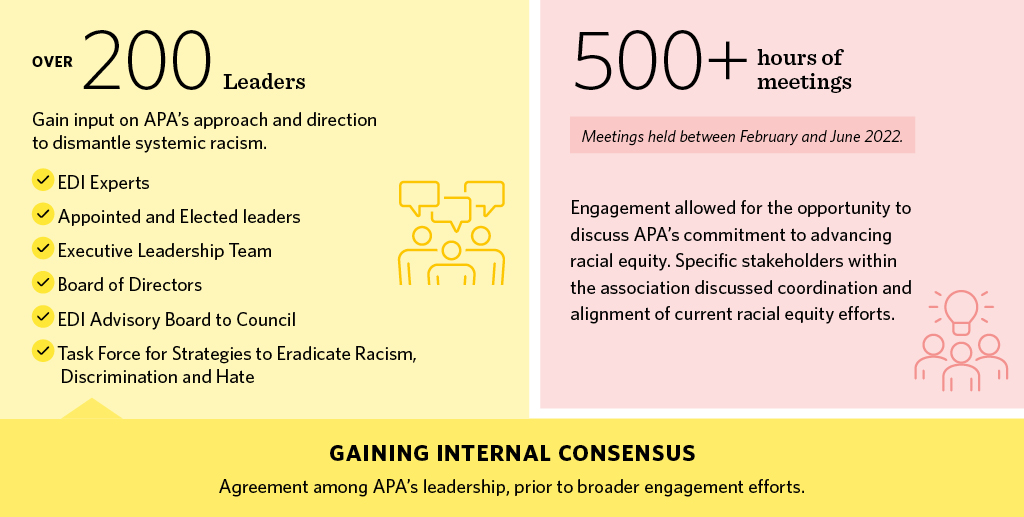
Full-size version with detailed description of gaining internal consensus infographic
Building and achieving consensus on strategy
Outlining areas of focus
In March 2022, APA began engaging in conversations to build consensus on the association’s strategy for advancing racial equity, including to what extent APA’s current efforts align with the priorities outlined in the Apology resolution. APA developed an initial outline consisting of areas of focus utilizing its strategic plan, the EDI Framework Guiding Principles, ‘Therefore’ statements from the October 2021 APA racism resolutions, and the Executive Summary of the Listening Sessions developed by Jernigan & Associates. Broad themes were identified to illuminate areas of redundancy.
Guiding conversations with elected and appointed leaders, psychologists of color, and racial equity advocates and experts
The association initiated a series of discussions with APA elected and appointed leadership including the APA Council Leadership Team, Board of Directors, the Task Force for Strategies to Dismantle Racism, Discrimination, and Hate, and the EDI Advisory Board to Council to begin building consensus around the following points of consideration:
- Do the focus areas begin to lead APA down a path where real structural and institutional change can be realized?
- Does APA have the capacity to effectively drive meaningful change in the proposed areas?
- How can we inspire unity throughout this process to ensure inclusivity for everyone?
Simultaneously, the association engaged with racial equity advocates and experts, and psychologists of color across the field and APA member groups, including 14 boards and committees, 17 APA divisions, and 19 State, Provincial and Territorial Psychological Associations (SPTAs) between March and June 2022. The purpose of these discussions was to keep member groups abreast of APA’s work toward developing a racial equity plan. It also allowed for the opportunity to discuss coordination and alignment of current racial equity efforts and to garner feedback on the association’s proposed strategies to dismantle systemic racism.
“Psychology’s Role in Dismantling Systemic Racism”—think tank and virtual summit
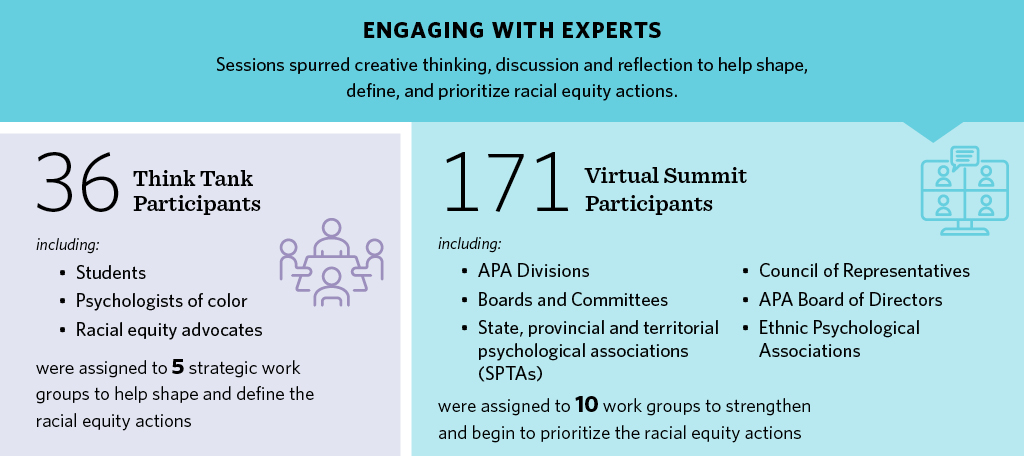
A group of interdisciplinary thought leaders and experts gathered in Washington, D.C., May 25 and 26, for a Think Tank aimed at curating an environment to spur creative thinking, discussion, and reflection to help define and prioritize APA’s action steps to advance racial equity. This collaborative space focused on the discussion of psychology’s role in dismantling systemic racism. The Think Tank engaged 36 experts, including students, psychologists, and racial equity advocates, in strategic workgroups focused on the five proposed domains of racial equity work. The efforts of the Think Tank participants led to a first draft of the racial equity priority actions intended to inform APA policy focused on repair, reconciliation, and healing for communities of color.
On June 6 and 7, APA then hosted a Virtual Summit to engage a wider group of stakeholders in critical conversations concerning the implementation of APA’s goals to dismantle systemic racism. The Virtual Summit brought together more than 100 participants representing multiple constituencies across the association, including divisions, boards and committees, state, provincial, and territorial psychological associations, the APA Council of Representatives, APA Board of Directors, and ethnic psychological associations. Email invitations were extended to all participants through member listservs. Participants were randomly assigned to one of 10 working groups. There were two groups focused on each domain area (e.g., Knowledge Production, Health, Training of Psychologists, APA/Psychology Workforce, and Education). Participants engaged in the small groups for critical conversations focused on the perceived strengths and concerns of the proposed racial equity actions. These conversations led to feedback on the proposed racial equity priority actions that were derived from efforts of the Think Tank work-group members. The suggested feedback from the Virtual Summit participants was reviewed and analyzed by the EDI Executive Office and resulted in revisions to the racial equity priority actions for further consideration by APA leadership.
Gathering input and data for further refinement of priority actions
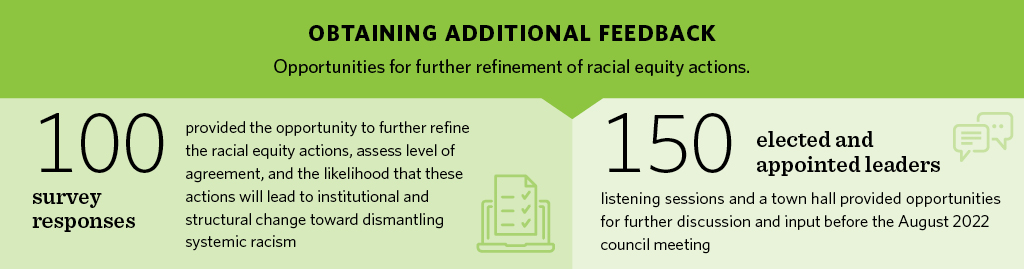
Following the Virtual Summit, participants were invited to complete a survey designed to assess their level of agree-ment with the proposed priority actions. Qualtrics, Provo, UT—an online data collection platform—was used to design and administer the survey. Participants were first asked to identify the domain area that was the focus of their small-group discussions (e.g., Knowledge Production, Health, Training of Psychologists, APA/Psychology Workforce, and Education). Then, participants rated the following on a five-point Likert scale:
- Prior to this meeting, how would you rate your exist-ing knowledge of the [domain] in general?
- How impactful do you think this planned work for the [domain] would be to advance racial equity?
- How likely is [priority action] to advance racial equity in [domain]?
In addition, volunteers from each of the 10 virtual summit working groups (e.g., two groups designated for each domain area) transcribed qualitative data focused on the following:
- Please list the overall strengths of the planned work that were discussed for the [domain] to advance racial equity.
- Please describe the concerns that were discussed for [priority action] in [domain].
These data were used to further refine the racial equity priority actions. The association then sought feedback from the Think Tank participants as experts and advocates in the proposed domains of racial equity work. The goal was to ensure that the revised priority actions maintained the integrity of those developed in the Think Tank work groups, while also addressing the reported concerns of APA members. Again, utilizing Qualtrics, Provo, UT, the Think Tank participants were first asked to identify the domain area that was the focus of their small-group work. Then, they were invited to rate the following on a five-point Likert scale:
- Is the revised [priority action] better or worse than the previous one?
Participants were given the opportunity to provide specific recommendations for improving the revised priority actions. Using the data, final revisions to the racial equity priority actions were made.
Council listening sessions and town hall
To provide opportunities for further discussion, input, and to share in collaborative thinking, the association offered a series of listening sessions designed to cultivate a collaborative space for engagement with elected and appointed leaders, who have demonstrated a commitment to embracing EDI principles and advancing racial equity. The listening sessions intended to offer space for participants to freely share feedback, to be heard by APA’s leadership, and to build consensus around the proposed language for the association-wide racial equity priorities. Each of the four designated listening sessions was facilitated by a member of APA’s leadership team.
- Frank C. Worrell, PhD
APA president
June 14, 12:00 pm–1:00 pm EST
- Jennifer F. Kelly, PhD
APA past president
June 14, 7:00 pm–8:00 pm EST
- Thema S. Bryant, PhD
APA president-elect
June 22, 12:00 pm–1:00 pm EST
- Arthur C. Evans, Jr., PhD
APA chief executive office/executive vice president
June 28, 6:00 pm–7:00 pm EST

Surveys
Feedback sought from all participants from both the Think Tank and Virtual Summit:
Expertise sought on
- Knowledge Production
- Health
- APA/Psychology Workforce
- Training of Psychologists
- Education
Participants rated the following
- Existing knowledge of domain areas
- Potential to bring about structural change
- Likelihood to advance racial equity
Follow-up survey sent to Think Tank participants to elicit feedback on revised actions:
Participants rated the following
- Agreement with revised actions
Content domains and priority actions
From all of these various inputs and feedback, five key domains emerged. These domains provide a framework to guide the association’s work going forward. They represent not just priorities, but pillars of a new way of operating—not only for the association, but ideally for the field of psychology.
- Knowledge production
- Health equity
- APA/Workforce
- Educational equity
EDI mission
To advance EDI through psychological science that champions thought leadership, innovation and excellence.


Knowledge production
Integrate the use of equitable and inclusive approaches to advance racially-conscious knowledge production and scholarship.
Priority actions
- Elevate the discipline’s understanding of, and regard for epistemic diversity and affirm that the body of psychological science centers the experiences of people of color and empirical work that aims to broaden our epistemology by evaluating diverse approaches such as indigenous knowledge, research, and a range of methodologies conducted across the epistemological continuum.
- Ensure equitable representation of scholars of color in scientific and scholarly leadership positions including, but not limited to, peer review panels and editorial boards.
- Redesign traditional methodologies used to conduct, review, communicate, disseminate, and report psychological research to ensure equity, diversity and inclusion, including expanding ways that the psychology community documents scientific, scholarly, and social impact.

Social Impact and Innovation
 Influence the profession to center racially-conscious community engaged scholarship and promote research that utilizes innovative, culturally-informed methodologies (e.g., indigenous healing, eastern medicine, faith-based practices)

Health equity
Utilize the full breadth of the field of psychology to promote, contribute, and advance health equity in communities of color.
Priority actions
- Disseminate and promote the use of race-conscious, trauma informed mental health information with community stakeholders including, but not limited to frontline workers, grassroots community organizations, and advocates.
- Advocate with federal research funding agencies (e.g., NIH, NSF, HRSA, PCORI) and private foundations for dedicated, sustained, and increased funding for research on community-driven holistic, whole person care.
- Influence curriculum development to incorporate qualitative, participatory, and socially engaged research, concepts of liberation psychology, systemic racism, and population health into the psychology curriculum across all levels of training.
- Promote education and training to improve literacy, knowledge, and awareness of systemic racism among healthcare professionals, as well as their responsiveness to structural racism.
- Elevate the value of community-engagement by cultivating partnerships and coalitions with community-based organizations, professional organizations, and policymaking organizations to address health inequities in communities of color.

Social Impact and Innovation
Support the development and expansion of models for integrating racially conscious psychological practice in communities of color.

APA/Workforce
Efforts that promote an equitable, diverse, and inclusive work environment within APA staff, the association at-large, and the broader psychology workforce, and serve as an exemplar for using EDI principles as foundational to fostering psychologically healthy workplaces.
Priority actions
- Model a culture and climate of psychological safety and belongingness throughout APA to fully include and support people of color at all levels of the organization.
- Increase collaboration and encourage connectedness within APA and among its membership to promote allyship and engage in organizational culture shifts that fully support people of color at all levels of the organization.
- Increase representation of people of color at all levels of APA and the psychology workforce and advocate for support structures, mentorship, professional development, and retention and recruitment of psychologists of color in leadership positions.
- Improve the psychology workforce talent pool by advocating for inclusive recruitment, hiring, pay equity, and promotion practices that attract, retain, and advance racially and ethnically diverse people.
- Generate and disseminate scientific knowledge based on the psychology of human behavior to advancce equity, diversity, and inclusion in the workplace and across sectors and settings in society.

Social Impact and Innovation
Support the development and expansion of models for integrating racially conscious psychological practice in communities of color.

Educational equity
Efforts that work to address racial inequities within learning institutions of all levels and promote racially conscious and equitable training to open pathways for students of color in pursuit of careers in psychology.
Priority actions
- Encourage and endorse the teaching of the history of racism is the U.S. to prepare students of all ages to think critically about identity, community, and civics.
- Develop resources and policies for educators that raise awareness about all aspects of privilege and mitigate biases that negatively affect learning and development among students of color.
- Partner with key stakeholders and advocate for equitable policies and increased investment and funding for students and psychologists from racially minoritized communities to close the opportunity gap and increase pathways to careers in psychology.
- Protect prospective students in higher education institutions by using psychological science to develop racially equitable admissions practices, including equitable application reviews, to mitigate barriers to program entry and increase retention for students of color.
- Improve the curriculum within psychology graduate education and training programs by including and centralizing diverse, non-Western cultural perspectives to enhance the visibility of psychologists with diverse backgrounds and promote epistemological justice.
- Support students of color in a successful transition into the field of psychology by using psychological science to establish racially equitable degree and training completion requirements and mitigate barriers to successful completion.

Social Impact and Innovation
Foster psychological safety, a healthier climate and a more inclusive culture in learning institutions and training programs by distributing resources that address equity and holistic well-being, increasing success rates of students of color, and regularly evaluating for equity, inclusion, and accessibility.
Next steps
These five content domains—developed collectively by elected and appointed leaders across the association, subject-matter experts, and key stakeholders—provide a set of aspirational ideals to guide APA’s racial equity work. To be successful, APA must be both methodical and planful as well as adaptable and responsive to the realities of the world around us. This includes continuing to build consensus among the broader APA membership, determining APA and psychology’s unique contributions to these domains, and developing organizational infrastructure and processes to sustain this work over the long term.
The issues before us are longstanding and complex. APA comes to these issues with a brain trust of passionate and committed individuals, a broad wealth of psychological knowledge, and a long-term organizational commitment to move this work forward. Taken together, these facets will enable APA to advance our collective goal of achieving racial equity, improving not only the lives of communities of color, but our broader society.

About this resource
This report is being issued by the APA Board of Directors and Chief Executive Officer, Arthur C. Evans, PhD on July 15, 2022.
Contributing authors
Maysa Akbar, PhD, ABPP
Chief Diversity Officer and Interim Chief of Psychology in the Public Interest
Triven Parker, MPH
Sr. Director, EDI Planning and Integration
Vanessa Hintz, PsyD
Sr. Director, EDI Engagement and Outreach
Nadia Dawood, MS
Equity, Diversity, and Inclusion Manager
Acknowledgments
Psychologists of color, students, and racial equity advocates who participated in the “Psychology’s Role in Dismantling Systemic Racism”—Think Tank and Virtual Summit including members of:
APA Divisions
APA Boards and Committees
APA Council of Representatives
Ethnic Psychological Associations
EDI Advisory Board to Council