


Foreword
Since issuing a formal apology in October 2021 for our historical role in promoting, perpetuating, and failing to challenge racism and human hierarchy, APA has been steadfast in its mission to rectify systemic inequities and foster an inclusive and equitable future. The apology marked the beginning of a profound transformation within our organization—one that acknowledges the previous actions and inactions of APA and psychology, improves coordination across the association and field, and commits to substantial, lasting change.
This Racial Equity Action Plan Progress and Impact Report describes the collaborative efforts undertaken to date and the tangible progress made toward dismantling systemic racism in psychology and society at large, as well as the strategic principles guiding this work. This report does more than highlight APA’s progress on this complex issue. It reaffirms our dedication to building a more equitable future for all.
As outlined in this report, APA’s work to help advance racial equity has relied on systematic engagement, continuous introspection, and the establishment of critical infrastructure to foster sustainability. Underlying all these strategies is the foundational belief that equity, diversity, and inclusion must be infused into our association’s fabric if we are to reach our goals successfully.
This journey has not been perfect. However, each day has been a learning opportunity, and we have remained committed to the process. APA remains dedicated to taking responsibility for our role in perpetuating inequalities, and continuously learning and evolving as we move forward.
Sincerely,
Arthur C. Evans Jr., PhD
Chief Executive Officer/Executive Vice President
Maysa Akbar, PhD, ABPP
Chief Diversity Officer
Chief of Psychology in the Public Interest
Background
Over the past two years, APA has made significant strides in advancing racial equity, guided by the Racial Equity Action Plan (REAP) (APA, 2022a) adopted by the APA Council of Representatives (CoR) in August 2022. This plan, a cornerstone of our mission to dismantle systemic racism, was developed through extensive community engagement, including the inaugural Racial Equity Think Tank. It outlines clear objectives and action steps to foster racial equity in the field of psychology and our broader society.
The plan is divided into four critical domains:
- Knowledge production
- Health equity
- APA/workforce
- Educational equity
Of these four domains, APA’s Board of Directors decided to focus on defining strategic goals and objectives for two domains per year. This allows for thorough planning, targeted resource allocation, and meaningful progress in each area. Based on feedback from the inaugural think tank, subsequent virtual summits, and town halls, which solicited input regarding the prioritization of these domains, APA prioritized health equity and knowledge production for implementation in 2023 and 2024. This decision was influenced by the association’s readiness and capacity to drive immediate and long-term impact in these areas.
This Racial Equity Plan Progress and Impact Report details the association’s advancements since adopting the REAP. The report also offers an update on demographic trends within its CoR, as last detailed in APA’s 2022 Racial Equity Audit Report (PDF, 1.53MB)opens in new window. Our approach integrates racial equity into all facets of our operations, promoting sustainable and systemic change within our organization and the field of psychology.
APA’s ongoing work toward dismantling systemic racism is guided by our commitment to examine, acknowledge, and chart an equitable path forward. This commitment has positioned APA as a leader in creating inclusive environments and achieving racial equity, improving not only the lives of communities of color, but also our broader society.
APA’s EDI Framework and Racial Equity Action Plan
APA’s Equity, Diversity, and Inclusion (EDI) Framework provides the foundation for our strategic planning, including the development of iterative goals and metrics. The REAP is a prime example of the framework in action, demonstrating APA’s commitment to a collaborative process that systematically and comprehensively advances racial equity. Aligning our racial equity work with the EDI Framework ensures our efforts are strategic, coordinated, and effective in fostering systemic, structural, and institutional change.
Guiding principles for systemic change
As we work toward progress, it is essential to highlight the guiding principles that underpin our efforts:
- Elevating and honoring voices and perspectives: Amplifying and respecting the voices of those most affected by structural racism, ensuring their experiences and insights shape our work.
- Leveraging partnerships: Recognizing and harnessing the power that arises from combining expertise, capabilities, information, creativity, and resources. Through strategic partnerships, we aim to achieve impact far beyond what any single organization may achieve alone.
- Maximizing long-term impact: Developing strategies dedicated to maximizing long-term impact, ensuring we respond to the needs of communities in the most effective manner possible.
- Accountability and ownership: Embracing full accountability for our actions and assuming responsibility for the outcomes of our work. By fostering a culture of ownership, we establish trust and strive toward the achievement of our goals.
- Building on progress: Honoring past accomplishments and building upon an established foundation to propel us toward continued growth and transformational change.
- Scientifically grounded, systemic solutions: Prioritizing data-driven and holistic approaches that can lead to large-scale solutions that address systemic issues and foster sustainable change.
Demonstrating APA’s work to advance racial equity aligned with the EDI Framework
The EDI Framework envisions APA as a leader in applying psychological science to advance EDI and racial equity across three levels: APA itself, the field of psychology, and society. APA’s commitment to advancing racial equity is evident in the work carried out across the association. APA has implemented various policies and practices that help address racial disparities and promote equity. Our organizational structure has purposely evolved, creating opportunities for increased diversity and inclusion. Furthermore, our partnerships with external organizations have amplified our impact, allowing us to extend our reach and influence in promoting racial equity. By implementing innovative solutions, we are addressing complex societal challenges and creating sustainable models for change.
Figure 1:
The APA Equity, Diversity, and Inclusion Model
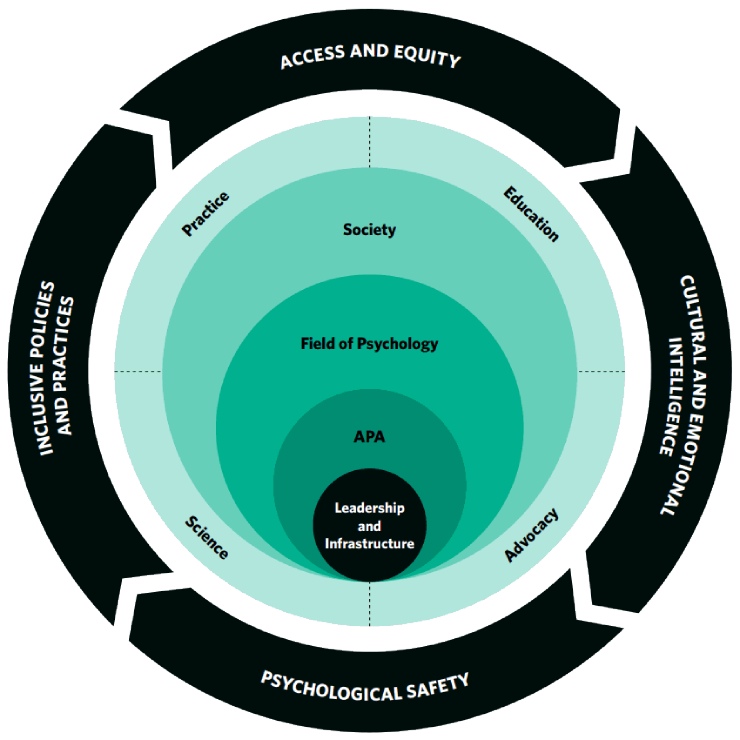
View full-size version with detailed description of Figure 1
The initiatives highlighted in this report exemplify the collective efforts across APA, utilizing a matrixed organizational strategy to support our racial equity agenda. This approach promotes collaborative implementation among and across APA directorates and offices. Leadership from staff in Advocacy, Communications, EDI, Governance, Human Resources, the Office of General Counsel, and APA Publishing in collaboration with various APA directorates including Science, Public Interest, Education, and Practice, have been instrumental in driving these initiatives.
The following examples demonstrate some of our collective efforts to influence systemic and institutional change that addresses structural racism and advances racial equity since the release of the REAP in 2022, aligned with the levels of the EDI Framework.
The APA level
APA is increasing the representation and participation of historically marginalized groups within its leadership and membership.
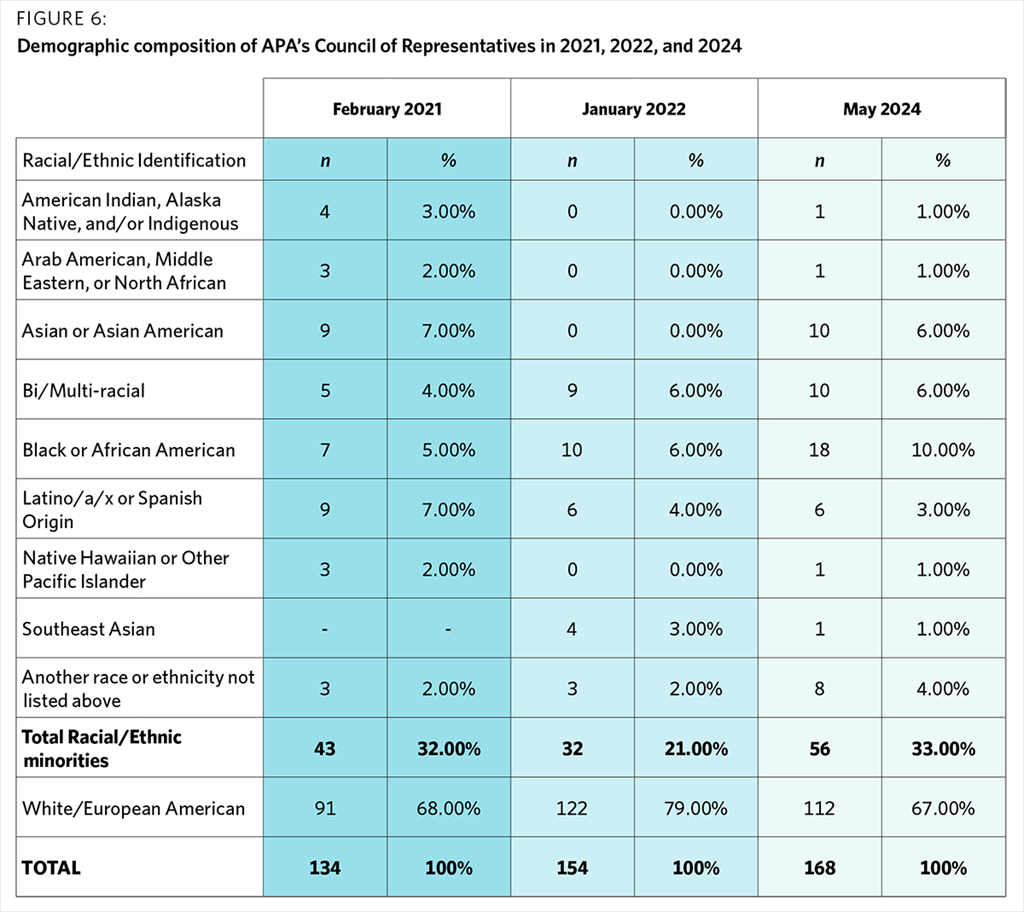
In 2022, an assessment of the CoR demographics revealed that the majority (68%) of the 154 members who responded self-identified primarily as White. From 2022 to 2024, APA has seen an increased percentage of CoR members who self-identify as a person of color (21% in 2022; 33% in 2024), demonstrating our commitment to enhancing diversity and representation among APA’s elected and appointed leadership.
This progress aligns with the commitments elevated in the EDI Framework and REAP to broaden the representation of diverse groups within the organization and profession—understanding that a heterogeneous association of people of diverse backgrounds and standpoints is critical for excellence and embedding a focus on EDI and racial equity is essential for APA to fulfill its mission.
APA is strengthening its institutional practices to promote equity, diversity, and inclusion and to dismantle systemic racism within the organization.
Transitioning from the Council Diversity Work Group to the Racial and Ethnic Diversity (RED) Task Force represents a significant structural change within APA. The RED Task Force now has a consultative position with APA’s Council Leadership Team, ensuring that APA’s institutional practices are firmly grounded in our commitment to EDI and dismantling systemic racism. This group provides critical perspectives on developing agendas, policies, procedures, and business items aimed at improving equity, increasing access, and facilitating opportunities for members of historically underrepresented and marginalized groups.
For instance, the RED Task Force provides guidance for drafting diversity impact statements as part of new business items and oversees the implementation of APA’s Diversity Matrix, which is a tool designed to broaden representation and promote inclusion among APA task forces, workgroups, boards, and committees.
APA is leveraging Employee Resource Groups (ERGs) to address the unique needs of its staff.
In 2022, APA administered to its staff a Skills and Climate-based Assessment aimed at assessing skills and identifying the support needed to effectively embed EDI principles into the association’s work, culture, and climate. Covering broad themes such as diversity, access, equity, belonging, inclusion, and psychological safety, the survey findings delved into the nuances of APA’s work environment. This data informed a pilot ERG for Black and African American women, which demonstrated high levels of perceived value, psychological safety, and effectiveness for networking and connection-building. Two additional ERGs are slated to launch by the end of 2024: one for LGBTQ+ staff and one for staff with disabilities.
APA’s commitment to advancing racial equity extends beyond internal practices to influence broader societal change
The field of psychology and society levels
APA is committed to leveraging policies to drive systemic change and address the deeply rooted issues of racism and discrimination that permeate our field and society.
APA’s CoR has made significant progress in advancing policies aimed at achieving racial equity. Over the past few years, more than 10 significant resolutions have been passed addressing areas such as criminal justice, discrimination, human rights, and other critical areas impacting society.
Significant resolutions
Criminal justice
- Resolution on Psychology’s Role in Addressing the Impact of, and Change Required With, Police Use of Excessive Force Against People of Color and Other Marginalized Communities in the United States (2022)
Discrimination
- Apology, on behalf of the American Psychological Association, to First Peoples in the United States (2023)
- Resolution on Advancing Health Equity in Psychology (2021)
- Apology to People of Color for APA’s Role in Promoting, Perpetuating, and Failing to Challenge Racism, Racial Discrimination, and Human Hierarchy in U.S. (2021)
- Role of Psychology and the American Psychological Association in Dismantling Systemic Racism Against People of Color in the United States (2021)
- Resolution on Gender Identity Change Efforts (2021)
- Resolution on Harnessing Psychology to Combat Racism: Adopting a Uniform Definition and Understanding (2021)
- Resolution on Sexual Orientation Change Efforts (2021)
Human rights
- Resolution on APA, Psychology, and Human Rights (2021)
Sexual orientation
- Policy Statement on Affirming Evidence-Based Inclusive Care for Transgender, Gender Diverse, and Nonbinary Individuals, Addressing Misinformation, and the Role of Psychological Practice and Science (2024)
Continuing education
- Resolution on Equity, Diversity, Inclusion, and Accessibility in Quality Continuing Education and Professional Development (2023)
Students
- Guidelines on Equitable and Respectful Treatment of Students in Graduate Psychology Programs (2023)
Persons with disabilities
- APA Guidelines for Assessment and Intervention With Persons With Disabilities (2022)
- Resolution on Parents with Disabilities (2024)
APA is strengthening relationships with Ethnic Psychological Associations to promote inclusivity and collaboration.
APA has made significant strides in fostering and strengthening its relationships with Ethnic Psychological Associations (EPAs) over the past three presidential cycles. These efforts have been marked by reoccurring annual meetings between the presidents of the EPAs and APA’s leadership, facilitating dialogue, collaboration, and mutual support.
Additionally, as part of the association’s efforts to reduce redundancies and restructure relationships, APA withdrew from the Council of National Psychological Associations for the Advancement of Ethnic Minority Interest, which was developed in 1992. Subsequently, they reorganized in 2023, forming the Council of National Racial and Ethnic Psychological Associations, whose membership consists of the EPAs and APA Division 45 (Society for the Psychological Study of Culture, Ethnicity, and Race). The association continued to realign its commitment to respect the independence of the EPAs and to be intentional about equity in the provision of support. This transition was necessary for organizational transformation.
In 2023, APA decided to allocate funds on a yearly basis that would support the annual conferences of the EPAs and Division 45. This financial commitment not only underscores APA’s dedication to promoting cultural and ethnic diversity within the field of psychology but also enhances the capacity of these organizations to advance their critical work. Through these initiatives, APA is reinforcing its commitment to the advancement of psychological science that respects and integrates diverse cultural perspectives.
As a tangible example, in lieu of an annual meeting, the Asian American Psychological Association used its 2023 funds to host a virtual benefit that would serve as a healing space following the Maui wildfires. All were welcomed to engage in radical self-healing while pausing to be in community with one another as they shared blessings, poetry, and other gifts of hope inspired by arts-based activism.
On June 26, 2023, at the 36th Annual SIP Convention in Utah, APA made an offer of a formal apology to the First Peoples and Nations of the United States for APA’s support of centuries-long abusive assimilation efforts and committed to learning about and valuing culturally appropriate approaches to care in the future. The offering of the apology by APA’s leadership signified the association’s commitment to ensuring that the voices, perspectives, and experiences of the Native community are mainstreamed into the organization.
APA is supporting cross-division collaboration to advance multiculturalism.
APA made a $3,500 donation to the 2024 Multicultural Summit, which celebrates individuals making significant positive impacts in communities through their work and advocacy. The biennial summit, hosted by APA Divisions 17, 35, 44, and 45, focuses on multiculturalism, encompassing various social identities and experiences, and aims to inform and inspire theory, research, practice, and advocacy in this critical area.
APA is supporting SPTAs in navigating the socio-political climate to advance racial equity.
In the current socio-political landscape, where efforts to promote EDI are met with varying levels of support and resistance, state-level organizations require guidance and consultation to advance these critical initiatives. Recognizing this need, APA is actively supporting State, Provincial, and Territorial Psychological Associations (SPTAs) as they navigate complex political environments and work towards advancing racial equity within their jurisdictions. This includes offering tailored support to address specific challenges faced by SPTAs in different states, where political climates can significantly impact the effectiveness of their efforts.
Supporting SPTAs
Resource allocation and strategic guidance
APA and APA Services, Inc. (APASI) allocate resources to SPTAs to strengthen their capacity to advocate for EDI and racial equity. This support includes funding, access to expert consultations, and strategic planning assistance to help SPTAs develop and implement effective policies and programs.
Advocacy and policy support
APA and APASI assist SPTAs in navigating state-level legislative and regulatory processes. By providing policy analysis, advocacy tools, and best practices, APA helps SPTAs effectively advocate for racial equity in environments that may be politically challenging.
Training and capacity building
APA and APASI offer training programs and workshops to enhance the skills and knowledge of SPTA leaders and members. These programs focus on EDI principles, effective advocacy strategies, and coalition-building techniques to foster a unified and powerful voice for racial equity. For example, in 2024, the Practice State Leadership hosted 20 Diversity Delegates from 19 different SPTAs, self-identifying as racial/ethnic minorities and/or gender diversity/sexual orientation minority, who received training on the critical impact of anti-EDI legislative trends on professional practice and psychology’s role in advancing health equity to meet the behavioral needs of the communities served.
Community engagement and collaboration
APA and APASI encourage and facilitate collaboration between SPTAs and local communities, including partnerships with grassroots organizations, community leaders, and other stakeholders. This collaborative approach ensures that EDI initiatives are community-driven and responsive to local needs.
APA is expanding its footprint and leveraging multisector and interdisciplinary partnerships to advance racial equity.
Recognizing that systemic change requires collaboration across various sectors and disciplines, APA has strategically expanded its footprint through multisector and interdisciplinary partnerships. These collaborations enable us to reach diverse populations and address complex social issues with comprehensive and culturally informed approaches.
The power of partnership and community engagement is central to our collective journey towards achieving racial equity. By working alongside influential organizations, APA leverages the combined expertise, resources, and networks of each partner to tackle critical societal issues impacting communities of color.
Partnership highlights
Sesame Street in Communities
APA engaged in an online seminar on racial justice with children and families and participated in the Wall Street Journal’s Future of Everything Festival in New York.
United Negro College Foundation
APA partnered with United Negro College Foundation on initiatives to support underrepresented students in psychology and to address the unique mental health needs of Black students at historically Black colleges and universities and predominantly Black institutions.
Florida State University
APA partnered with Florida State University (FSU) and provided financial support through APA’s Racial Equity Fund to launch the FSU-APA Summer Scholars Program in Psychology and Neuroscience, which introduces undergraduates from Spelman, Morehouse, and Alabama A&M University to PhD programs, including professional and academic development.
Historically Black Colleges and Universities
APA has partnered with institutions like Bowie State University, Morgan State University, and Alabama A&M University to amplify the achievements of student researchers of color, fostering a more inclusive and representative psychology workforce.
National Consortium for Ethnic and Racial Fairness
APA has been actively partnering with the National Consortium for Ethnic and Racial Fairness in Courts in efforts to eliminate racial and ethnic bias in the court system. In addition, APA has collaborated with the Japanese American Citizens League, the oldest and largest Asian American Asian civil rights organization in the U.S.
OWN Network
APA works in collaboration with the OWN Network to provide consultation on mental health awareness and resources for Black women.
Federal DEIA Community of Practices
APA is contributing its EDI Framework and REAP to enhance both short-term relationship-building and long-term integration of psychology-based EDI principles into federal practices across the federal workforce. APA led a discussion on measuring the impact of EDI practices at the inaugural meeting of the Federal Interagency DEIA Community of Practice. More than 30 federal agencies participated. Another example of APA’s contributions included providing informed insights to the NASA DEIA maturity model and their federal benchmarks for organizational EDI best-practices.
Association of American Publishers
APA collaborated with the Association of American Publishers on a DEI Summit for Publishers. APA unpacked the critical role of leadership from the C-suite in driving EDI and racial equity initiatives within publishing organizations. This collaboration resulted in a discussion about the use of strategies for engaging leadership in championing EDI, developing inclusive leadership competencies, and establishing accountability measures to ensure EDI is embedded in the organization’s vision, values, and decision-making processes.
APA is expanding its impact and reach, promoting racial equity in the media.
APA’s extensive range of resources, including policies, guidelines, and reports, provides crucial frameworks and actionable strategies to advance EDI and accessibility in psychology. Through compelling articles in APA’s membership magazine, the Monitor on Psychology, timely press releases, and updates on our ongoing EDI and racial equity initiatives, APA tackles critical issues such as bias in disciplinary actions, specialized care for marginalized communities, and the importance of cultural humility in psychological practice.
2023 racial equity content highlights
- Policies, guidelines, reports: 192,709 page views
- Monitor articles: 124,400 page views
- Press releases: 39,047 page views
- Updates on APA’s EDI and racial equity work: 3,339 page views
- APA convention: 1,934 page views (including YouTube views)
- Topics pages: 1,242,188 page views
Overall total page views in 2023 for content related to racial equity: 1,603,617
APA has reaffirmed its commitment to dismantling systemic racism and achieving racial equity by launching the Racial Equity Fund with an initial investment of $1.1 million.
Established in 2023 in partnership with the Tides Foundation and the American Psychological Foundation, the Racial Equity Fund (REF) is strategically designed to advance the priority areas in the REAP. The fund aims to mitigate barriers to funding for people of color, organizations serving them, and scholars engaged in research on vulnerable populations. Our goal is to remove obstacles that typically prevent accessing such funding.
Since its establishment, the REF has made progress through strategic grants and initiatives:
- Grant to the American Psychological Foundation: In 2023, the REF awarded its inaugural grant to the American Psychological Foundation. Through the application of psychological science, this grant supports projects, research, and interventions that dismantle systemic racism, reduce racial disparities, and improve the well-being of communities of color.
- Grant to Florida State University: In 2024, the REF built upon its foundational efforts, issuing grants that broaden the reach and impact of the REAP. Notably, APA provided a grant to FSU’s Department of Psychology. This funding supports a Summer Scholars Program in Psychology and Neuroscience to create opportunities to introduce undergraduates to psychology. Students from Spelman, Morehouse, and Alabama A&M University will engage in scholarship about the psychological needs of disadvantaged communities and advocate on behalf of access to quality mental health services for those in need.
Health equity
In 2024, APA allocated $50,000 to advance social innovation and enhance cultural competence of health care professionals.
A significant portion, $30,000, was dedicated to fostering social innovation that strengthens community-informed mental health services. By empowering mental health service innovators and supporting community-led initiatives, APA is not just expanding access to existing treatments; APA is also seeding the development of ground-breaking interventions that resonate with the unique needs of marginalized communities. An additional $20,000 has been dedicated to enhancing the cultural competence of health care professionals by improving their literacy on racial and ethnic health care disparities.
Knowledge production
In 2024, APA allocated $50,000 to enhance the integration of community knowledge into psychological research and promote multi-epistemic values in faculty evaluation.
A significant portion, $30,000, was dedicated to projects that enhance the integration of community knowledge into psychological research, fostering epistemic diversity, and contributing to the advancement of the field that reflects the diverse voices and perspectives of the communities it serves. Additionally, APA has dedicated $20,000 to promote the adoption of faculty evaluation practices within psychology departments that are grounded in multi-epistemic values and viewpoints.
Future plans
An open call is planned for 2025 to broaden our reach and establish a robust grant management infrastructure for sustained grant-making, ensuring continuous support for innovative projects that drive systemic change and promote racial equity in the field of psychology and in society.
APA is cultivating leaders for a more equitable future through its Leadership Development Institute.
Announced alongside the REAP, the Leadership Development Institute (LDI) serves as a central hub for all leadership development, training, and mentoring programs, including the Leadership Institute for Women in Psychology and the Minority Fellowship Program. The LDI’s goal is to develop and advance leadership in the field of psychology broadly; it also provides an opportunity for APA to accelerate its racial equity work through the cultivation of leaders who can advance the principles of EDI globally.
Fellows in the Leadership Development Institute: Past and current participants
- 2024: 128 fellows
- 2023: 79 fellows
APA has been at the forefront of advocating for policy changes that impact structural racism and improve health equity for marginalized populations.
Below are examples of areas where APA is influencing systemic and institutional changes at the federal level in 2023 and 2024.
Legislation endorsed/supported by APA
Mental Health for Latinos Act (H.R. 4884/S. 2476): Develops a behavioral and mental health outreach and education strategy to reduce stigma among Hispanic and Latino populations.
Black Maternal Health “Momnibus” Act (H.R. 3305/S. 1606): Addresses maternal mortality, morbidity, and disparities, particularly in African American communities.
Pursuing Equity in Mental Health Act (H.R. 3548/S. 2700): Tackles disparities in access to mental health resources for underserved communities.
NIH Clinical Trials Diversity Act (H.R. 3503): Seeks to diversify participation in clinical trials by race, ethnicity, age, and sex.
Preventing Adverse Childhood Experiences (PACE) Act (S. 3085): Promotes research on adverse childhood experiences, focusing on historically traumatized communities, including American Indians and Alaska Natives.
Support for Deferred Action for Childhood Arrivals (DACA): Advocates for permanent resident status for certain non-U.S. nationals who arrived as minors, including support for The DREAM Act (S. 365) and comments to the Department of Homeland Security.
Responses to proposed rules and initiatives
Centers for Medicare and Medicaid: Supported increased access to mental health services for Medicaid beneficiaries, citing disparities in communities of color.
Office of Management and Budget: Advocated for updated statistical standards on race and ethnicity, emphasizing accurate data collection as crucial for identifying and addressing health disparities.
National Institutes of Health: Addressed mental health disparities by highlighting factors such as law enforcement interactions, hate crimes, and immigration status.
White House Initiative on Women’s Health Research: Promoted research on
- Differences in symptoms, diagnosis, treatment, and outcomes among diverse populations of women
- Racial and ethnic disparities among women
- Causal factors and interventions to reduce Black women’s maternal morbidity and mortality.
Office of Head Start (Administration of Children and Families): Focused on
- Addressing disparities in school discipline.
- Strengthening access to mental health services.
- Tackling adverse childhood experiences (ACEs).
Shifting approaches for systemic change: APA’s impact across racial equity domains
APA has made significant progress in advancing racial equity since conducting the Racial Equity Audit in 2022. The audit served as an initial baseline, reporting over 100 programs specifically focused on influencing racial equity across various sectors in society, as well as programs that advance health equity in communities of color.
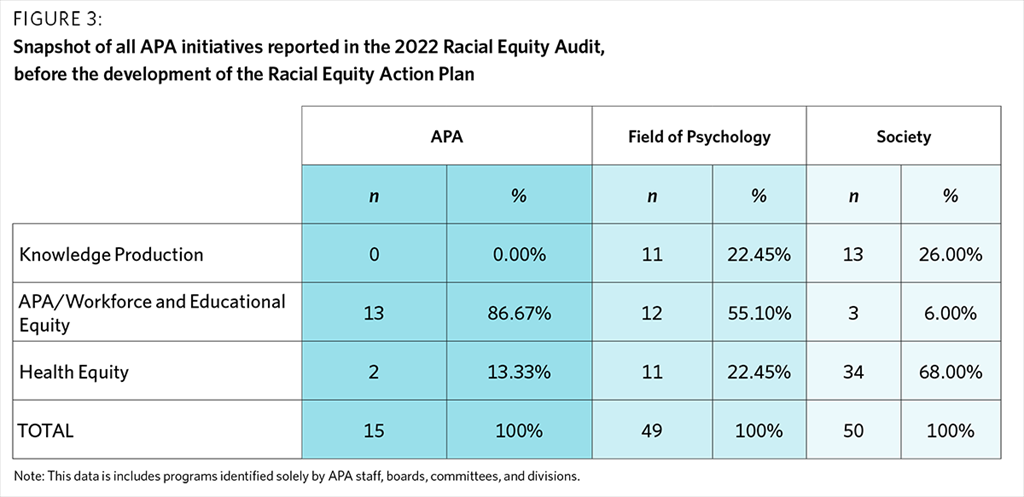
The 2022 Racial Equity Audit revealed numerous programs (Figure 3), yet we have learned that quantity does not equate to impact. The audit provided valuable insight into the much-needed coordination and consolidation of APA’s racial equity efforts and the need to develop short- and long-term actions aimed at creating immediate and sustainable structural change. This resulted in the REAP.
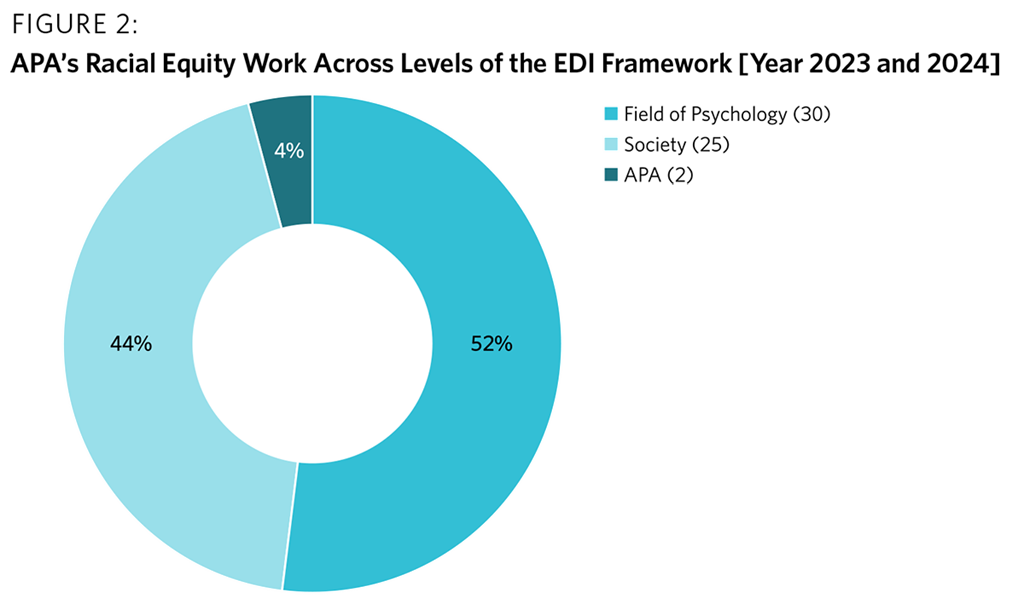
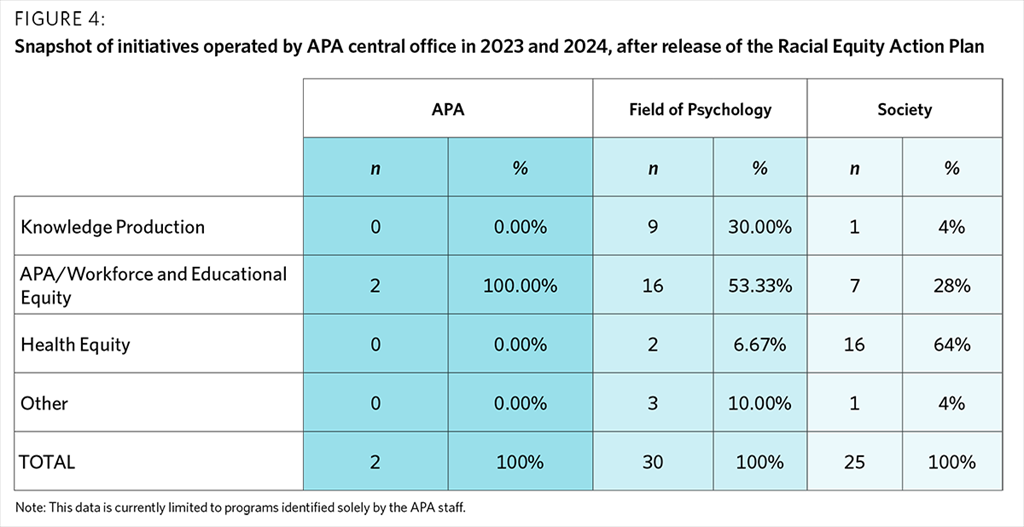
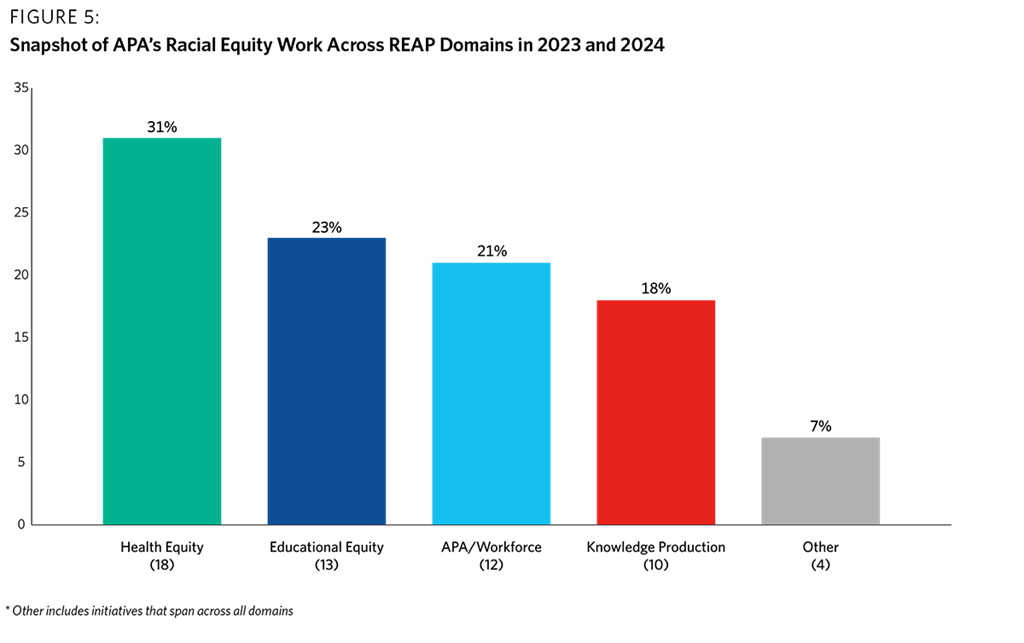
As we move forward, we are adopting a coordinated approach to concentrate our efforts and resources on shared objectives for maximum effectiveness. We are prioritizing strategic, systemic, and high-impact initiatives. Since adopting the REAP, APA has launched numerous initiatives that align with this vision (Figure 4). In 2023 and the first half of 2024, 57 programs reported advancing racial equity, with 10 focused on the advancement of knowledge production and 18 on health equity.
Enhancing diversity: Insights into representation across APA
As part of our ongoing commitment to fostering diversity and inclusion within APA, we have diligently tracked the representation of people of color across APA’s CoR. By examining the demographic composition of key decision-making bodies, APA aims to identify areas of improvement and celebrate the strides taken toward creating a more inclusive organization.
View a full-size version with detailed description of Figure 6
Key Observations: From 2022 to 2024, we have seen an increase in the percentage of CoR members who self-identify as a person of color (21% in 2022; 33% in 2024). In 2021, we had a lower response rate, which may have been attributed to several uncontrollable factors, such as the Covid-19 pandemic and societal tensions in the United States. As a result, the racial and ethnic representation may be additionally skewed in 2021, suggesting that there was a decline in the percentage of CoR members who self-identify as a person of color from 2021 to 2022. However, we know this may not be a true reflection of the change in racial/ethnic representation. It is also important to note that this data is self-provided and voluntary. Not all 182 members of CoR respond, and some select “prefer not to answer.” These responses have been removed to provide more accurate percentages of those who have volunteered racial/ethnic information.
Knowledge production and health equity priorities
The impact summaries in this section provide insight into the initiatives implemented over the last two years that advance knowledge production and health equity priorities in the REAP, as prioritized by the APA Board of Directors.
This report is currently limited to programs identified solely by APA staff. However, future iterations of this report will extend its reach to APA constituent groups, providing a more comprehensive overview of our racial equity endeavors.
Priority 1: Advancing racially conscious knowledge production and scholarship
Background and summary
Psychological science aims to understand human behavior holistically, yet systemic biases and practices have historically contributed to a predominantly White perspective in research. APA acknowledges its role in promoting and perpetuating racism and White supremacy. As described in an APA published historical chronology on racial hierarchy and psychology (APA, 2021e), White males who established APA and many of whom supported early 20th-century eugenics created a foundation for the discipline that has systematically disadvantaged communities of color through its theories, methods, and practices. This early history of psychology, rooted in oppressive psychological science to protect Whiteness and White epistemologies, reflected, and reinforced the social and political landscape of the U.S. at that time.
Eugenicists focused on measuring intelligence, health, and capability; concepts adopted by psychology to create ideologies of White supremacy. These practices contributed to the financial wealth gap, social class disparities, and systemic oppression experienced by many communities of color. Psychological tests and instruments, developed and applied by psychologists, often disadvantaged communities of color, leading to overdiagnosis, misdiagnosis, and a lack of culturally appropriate diagnostic criteria. The discipline’s failure to elevate the science behind adverse social determinants of health and the impact of climate change on communities of color has further compounded these disparities.
Recognizing these profound impacts on society and the field, a multipronged approach was needed as part of APA’s formal apology to people of color and its commitment to rectify past injustices. To address these issues, we have focused on modifying how research is conducted, reported, reviewed, and disseminated along with addressing disparities in the number of scholars of color, and opportunities to conduct research among minoritized populations.
Challenging systemic racism requires multisystemic change (Buchanan et al., 2021). To dismantle these oppressive structures, it is critical to ensure that scholars of color have safe and equitable environments for conducting research, access to research funding, and opportunities to disseminate their work through highly visible scholarly journals and publications. APA’s efforts to integrate equitable and inclusive approaches aim to elevate epistemic diversity and center the experiences of people of color in psychological science. This includes incorporating diverse methodologies, such as Indigenous knowledge and community-based research, to enrich the discipline.
Racial Equity Fund: 2024 funding priorities for knowledge production
Enhancing epistemic diversity to advance racially conscious knowledge production
- Funding goal: To enhance the integration of community knowledge, foster epistemic diversity, and contribute to the advancement of psychology as a field that reflects the diverse voices and perspectives of the communities it serves.
- Award amount: $30,000
Enhancing epistemic diversity to advance racially conscious knowledge production
- Funding goal: To promote the adoption of faculty evaluation practices within psychology departments that are grounded in multi-epistemic values, emphasizing diverse ways of knowing and understanding.
- Award amount: $20,000
Priority actions in APA’s racial equity action to advance racially conscious knowledge production are as follows:
- Elevate the discipline’s understanding of, and regard for, epistemic diversity and affirm that the body of psychological science centers the experiences of people of color and empirical work that aims to broaden our epistemology by evaluating diverse approaches such as Indigenous knowledge, research, and a range of methodologies conducted across the epistemological continuum.
- Ensure equitable representation of scholars of color in scientific and scholarly leadership positions including, but not limited to, peer review panels and editorial boards.
- Redesign traditional methodologies used to conduct, review, communicate, disseminate, and report psychological research to ensure equity, diversity, and inclusion, including expanding ways that the psychology community documents scientific, scholarly, and social impact.
- Social impact and innovation: Influence the profession to center racially-conscious community engaged scholarship and promote research that utilizes innovative, culturally-informed methodologies (e.g., Indigenous healing, Eastern medicine, faith-based practices).
APA’s collaborative work to advance racially conscious knowledge production and scholarship
APA is providing guidance to eliminate a White default in psychological science.
The APA Style Journal Article Reporting Standards for Race, Ethnicity, and Culture (JARS–REC), developed in collaboration with seven other scientific societies, provide guidance for how to equitably discuss race, ethnicity, and culture in scientific manuscripts. The goal is to promote research transparency and methodological rigor. The JARS–REC provide recommendations for authors, reviewers, and editors of scientific manuscripts for ensuring that all psychology research, regardless of topic, address race, ethnicity, and culture, and is conducted and reported with the highest standards of scientific integrity. The JARS-REC reached over 6,000 visitors in its first 2 months.
APA is elevating non-Western perspectives by expanding global representation in APA Journals.
APA is increasing the number of submissions and accepted articles from authors outside the United States. This initiative involves collaboration with international psychological societies, including the Brazilian Association of Psychology and Behavioural Medicine; the Korean Psychological Association; the Nigerian Psychological Association; and the Japanese Psychological Association. By enhancing support and outreach for international authors, APA aims to diversify research methods, highlight underrepresented populations, and provide a safe platform for scholars working on topics restricted in their home countries.
APA is developing resources to change how science is conducted.
APA is developing a free-standing, open access curricular resource on “Race and Racism in Psychological Science” to educate psychologists and graduate students on the history of race and racism in psychology, the importance of racial consciousness in psychological research, and guidelines for conducting antiracist research. This curriculum can be used by faculty and graduate student scholars to influence how race and ethnicity are studied in science, as well as with undergraduate students first learning about psychological research methods to cultivate a new generation of scholars to eradicate White-centric approaches used in our discipline.
APA is ensuring broad representation in psychological science leadership and on editorial boards.
APA is committed to reducing bias in the scientific review process and to elevating leadership opportunities for early-career psychologists from historically excluded groups.
APA’s comprehensive EDI Toolkit for Journal Editors helps explicate the processes that editors can use to reduce biases and systemic practices within manuscript reviews and editorial decision-making. The toolkit offers 30 actionable recommendations to advance EDI within journals. These recommendations focus on increasing representation on editorial boards, adopting inclusive reporting standards, and addressing bias in peer review. APA Publishing has seen significant uptake of the toolkit’s recommendations across its 89 journals. Notable actions include requiring author contribution statements, diversity statements, detailed participant demographic descriptions, inclusive reference lists, and positionality statements in author notes.
APA’s Editorial Fellowship Program offers leadership opportunities to psychologists from diverse racial and ethnic backgrounds, scholars from other underrepresented groups such as LGBTQ+ individuals and people with disabilities, and scholars who engage in research on EDI in psychology on journal editorial teams. In a 2-year period (2023–2024), 139 editorial fellows were appointed across 20 participating journals. By promoting opportunities for research and publishing leadership roles, APA seeks to enhance the representation of diverse voices leading psychological science.
Impact of the EDI Toolkit for Journal Editors on APA journals (2023–2024)
Significant growth
APA’s 89 journals have seen double-digit increases in recommended or required EDI reporting standards and initiatives.
Contribution statements
Nearly 2/3 of APA journals now ask for contribution statements.
Sample diversity justification
1/3 of APA journals require authors to justify the diversity of their samples.
Adoption of diversity statements
35% of APA journals have adopted diversity statements.
Over 50% require participant demographic descriptions.
APA is fostering representation in psychology by spotlighting student researchers of color.
APA is recognizing research conducted by students and recent graduates of historically Black colleges and universities through its Spotlight on Student Researchers of Color series. In this series, undergraduate and graduate students highlight their recent research projects, share their reasons for pursuing psychology careers, and discuss their postgraduation plans. This series uses APA’s vast reach to amplify these students’ work and contributions to the field with a goal of improving long-term outcomes for their psychology careers. APA has partnered with institutions like Bowie State University, Morgan State University, and Alabama A&M University and will continue to expand these partnerships to support and celebrate the achievements of student researchers of color, fostering a more inclusive and representative future for psychological science.
APA is advancing equity in its journals by utilizing demographic data.
APA Journals collects deidentified demographic data from authors, reviewers, and editors through an optional questionnaire in Editorial Manager. This data is used to create reports presented in APA Journals governance meetings and for annual reporting to publishing partners, informing EDI efforts and tracking progress towards EDI-related goals.
APA is developing guidance for promoting racial equity in scholarly leadership and peer review.
APA is equipping peer reviewers with the necessary skills to promote racial equity in the research and peer review process. This effort focuses on reducing bias and ensuring inclusivity in published research. In April 2024, a reviewer feedback survey was sent to more than 47,000 reviewers to quantify challenges, motivations, and preferences for resources, including those related to racial equity. As part of a multiyear project, APA is developing guidance for evaluating papers with EDI and racial equity in mind. This initiative aims to strengthen the rigor and integrity of psychological research, eliminate harm to marginalized communities, and ensure that published research is equitable and inclusive.
APA has created curricula that addresses race and racism in psychological science.
APA has developed a comprehensive mini curriculum designed to serve as a crucial learning tool for psychological scientists, graduate students, and professionals from other disciplines. The curriculum focuses on the significance of race and racism in psychological science, emphasizing the importance of reflexivity and positionality in psychological research, and aims to teach best practices for disrupting the influence of racism in knowledge production.
Priority 2: Utilizing the breadth of the field to advance health equity in communities of color
Health equity remains an essential goal in APA’s mission to dismantle systemic racism. Understanding that psychology has the scientific knowledge to effectively challenge and dismantle systemic racism, APA’s leadership, under the guidance of past president Jennifer Kelly, PhD, embarked on a series of initiatives to confront psychology’s historical role in perpetuating racial disparities in health. These efforts culminated in the development of three key APA policy resolutions, including the APA Resolution on Advancing Health Equity in Psychology.
As described in the resolution (APA, 2021d), profound disparities in health care access and quality experienced by communities of color have roots in the historical and systemic exclusion from equitable health care. The dominant health care model, predominantly derived from White and Western populations, often fails to incorporate diverse cultural perspectives, leading to practices that do not adequately address the needs of non-White communities. This exclusion has resulted in significant health inequities, underutilization of health services, and inappropriate care that can exacerbate existing disparities.
Recognizing the role of racism and discrimination in affecting social determinants of health, APA has prioritized efforts to enhance culturally competent and accessible care models. This involves advocating for and training in culturally responsive practices that elevate the needs of communities of color. The foundational work for these initiatives is encapsulated in the Resolution on Advancing Health Equity in Psychology and the April 2023 special issue of American Psychologist “How Psychologists Can Help Achieve Equity in Health Care: Advancing Innovative Partnerships and Models of Care Delivery,” which underscores the importance of integrating diverse perspectives and addressing the limitations of traditional, White-centric health care models.
The Covid-19 pandemic further highlighted these disparities, disproportionately impacting communities of color and magnifying the barriers to accessing essential health services. The pandemic underscored the urgent need for a health care system that is inclusive, culturally responsive, and capable of addressing the unique challenges faced by marginalized communities.
Priority actions to advance health equity:
- Disseminate and promote the use of race-conscious, trauma-informed mental health information with community stakeholders including, but not limited to frontline workers, grassroots community organizations, and advocates.
- Advocate with federal research funding agencies (e.g., NIH, NSF, HRSA, PCORI) and private foundations for dedicated, sustained, and increased funding for research on community-driven holistic, whole person care.
- Influence curriculum development to incorporate qualitative, participatory, and socially engaged research, concepts of liberation psychology, systemic racism, and population health into the psychology curriculum across all levels of training.
- Promote education and training to improve literacy, knowledge, and awareness of systemic racism among health care professionals, as well as their responsiveness to structural racism.
- Elevate the value of community engagement by cultivating partnerships and coalitions with community-based organizations, professional organizations, and policy-making organizations to address health inequities in communities of color.
- Social impact and innovation: Support the development and expansion of models for integrating racially conscious psychological practice in communities of color.
Racial Equity Fund: 2024 funding priorities for health equity
Social innovation to advance health equity
- Funding goal: Expand access to evidence-based or evidence-informed treatments, interventions, and programs, while developing new and innovative solutions to strengthen mental health services in communities of color.
- Award amount: $30,000
Improving health care professionals’ literacy on racial and ethnic health care disparities
- Funding goal: Develop programs, workshops, and resources to increase professionals’ literacy, knowledge, and awareness of racial and ethnic health care disparities.
- Award amount: $20,000
APA’s collaborative work to advance health equity
APA is advocating with the White House to improve health care access for Asian American, Native Hawaiian, and Pacific Islander communities.
APA joined APA 2024 president, Cynthia de las Fuentes, PhD, and president-elect, Debra Kawahara, PhD, in a meeting with senior White House officials to discuss Asian American, Native Hawaiian, and Pacific Islander (AANPHI) mental health. The discussion highlighted various issues affecting the AANPHI population and emphasized the importance of equity and access to behavioral health care for individuals in the community.
APA is collaborating with Sesame Street to leverage psychological science in helping children and caregivers discuss race, enhancing children’s emotional well-being.
APA’s partnership with Sesame Workshop in 2023 focused on nurturing the emotional well-being in young children through a lens of racial equity. Key activities include a virtual workshop to improve racial literacy among APA members and provide resources for discussing race and racial identity with children and caregivers. This ongoing collaboration has increased awareness, promoted inclusive environments, and supported families in navigating challenging conversations about race and emotional distress.
APA is using psychological science to promote mental health equity in corporate environments.
In partnership with Health Action Alliance, APA has advanced health excellence in the workplace with a strong focus on EDI and racial equity. In 2023, APA sponsored the second annual mental health equity at work summit, “Breaking Barriers: Empowering Business Excellence through Mental Health Equity” attracting nearly 2,000 participants from diverse organizations, including Fortune 1000 companies like Wells Fargo, Johnson & Johnson, Jacobs, Accenture, Apple Inc., Delta, and Gartner.
APA united over 100 thought leaders at the population health science summit to advance psychological well-being.
Bringing together over 100 of the nation’s thought leaders, APA hosted the Population Health Science Summit to advance a comprehensive equitable approach to psychological well-being. Addressing the mental health crisis caused by decades of underfunding, provider shortages, and the flawed separation of mental and physical health, summit participants gathered to build a future agenda for psychological science using a population health framework.
APA is expanding access to mental health resources through diverse community partnerships.
APA’s Magination Press is expanding its reach to diverse communities by partnering with Lerner Publishing, aiming to bring evidence-based psychological content to more public libraries and community spaces. This collaboration is designed to help kids and teens navigate challenges, champion inclusion, and promote social change. With over a quarter million books sold annually, Magination Press’s long-term goal is to ensure their books are accessible to all children and families, supporting intellectual freedom and safe community spaces. Short-term goals include increasing reach, measured by increase in book sales by 20% over three years.
APA is infusing racial equity into psychological practice and policies.
APA is committed to infusing racial equity principles into practice policies, guidelines—such as the APA Clinical Practice Guideline for the Nonpharmacological Treatment of Chronic Musculoskeletal Pain in Adults, the update to the Clinical Practice Guideline for the Treatment of PTSD in Adults, the update to the Clinical Practice Guideline for the Treatment of Obesity and Overweight in Children and Adolescents, and the Proposed Revision of Guidelines for Psychological Evaluations in Child Protection Matters, the Proposed Guidelines on Key Considerations for Working with Adults with PTSD and Traumatic Stress Disorders—for delivering psychological services, and educational materials for psychologists and the public.
Our processes encompass advancing racial equity in practice governance, integrating inclusive approaches into service delivery, making significant changes to processes and methods from the ground up, and empowering stakeholders to tackle systemic racism and discrimination. Through inclusive communication practices and policy advocacy, APA employs a range of strategies to ensure that racial equity is ingrained in every facet of psychological practice and education.
In recognition of these efforts, APA was recently invited to attend and present at a national health equity summit focused on racial and ethnic health equity in evidence-based guidelines and systematic reviews, sponsored by the Agency for Healthcare Research and Quality. APA presented as an invited exemplar on its efforts to an audience representing multiple federal agencies, national groups such as the U.S. Preventive Services Task Force, Patient-Centered Outcomes Research Institute, universities, and many professional associations.
APA is partnering to drive change for Native American child health.
APA is collaborating with the American Academy of Pediatrics Committee on Native American Child Health (CONACH) to address issues facing American Indian/Alaska Native children. CONACH meets twice a year: once in Washington, DC, for Hill visits and a legislative briefing, and once for consultation site visits in an Indian Health Service Area. In 2024, psychologists conducted site visits in the Navajo Area, and APA Services and psychologists participated in Hill visits focused on funding services supporting the Indian Child Welfare Act. APA works closely with the Society of Indian Psychologists (SIP) to enhance the effectiveness of this vital initiative.
Recognizing the need for greater psychological involvement in the International Meeting on Indigenous Child Health, an event supported by the American Academy of Pediatrics and the Canadian Pediatric Society, members of CONACH requested the participation of a psychologist on the conference steering committee. As a result, both SIP and APA are now partnering organizations for this important conference, contributing to the advancement of Indigenous child health initiatives.
APA secured reimbursement for psychologists providing social determinants of health and principal illness navigation services.
APA successfully advocated to the Centers for Medicare and Medicaid Services for psychologists to receive reimbursement for new services in 2024 related to Social Determinants of Health (SDOH) Risk Assessment and Principal Illness Navigation (PIN). These services, initially proposed to exclude psychologists, are now recognized for their role in identifying unmet social needs and guiding patients through the health care system, contributing to health equity as highlighted in the 2024 Physician Fee Schedule Final Rule.
The APA article “It’s never too early to teach kids about race and racial justice. Here’s how to do it—with a little help from Elmo” has garnered more than 7,000 page views since April 2023.
Looking ahead to 2025 and 2026
As we look ahead to 2025 and 2026, APA will prioritize the educational equity and APA/workforce domains for the next phase of our REAP implementation. Our third racial equity think tank, scheduled for 2025, will continue to serve as a collaborative space, bringing together thought leaders, practitioners, and community stakeholders to brainstorm innovative solutions and share best practices. The Racial Equity Fund will also begin making targeted awards to support initiatives in these domains.
While these domains are earmarked for focused implementation in the coming years, substantial work is already underway, aligning with our long-term objectives. In the realm of educational equity, we are dedicated to breaking down systemic barriers to ensure all students have fair access to educational resources and opportunities. Our efforts in the APA/workforce domain are focused on creating an inclusive and representative professional environment within psychology and supporting diverse talent recruitment and advancement. Here are some highlights of our current initiatives that set the stage for these future priorities.
Snapshot of APA’s workforce and educational equity activities
APA has begun to collect baseline information on its current workforce and educational equity activities. This data will be instrumental in guiding the discussions at the 2025 Racial Equity Think Tank, where we will develop comprehensive solutions to drive structural and institutional change in these areas.
Priority 3: APA/workforce
| Description | EDI Framework Level |
|---|---|
|
Fostering inclusivity in the psychology workforce |
Field of Psychology |
|
Mentoring and leadership initiatives in psychology |
Field of Psychology |
Priority 4: Educational equity
| Description | EDI Framework Level |
|---|---|
|
Integrating the history of racism into psychology education Disseminating the National Standards for High School Psychology Curricula, which reaches 800,000 students annually, emphasizing the importance of understanding the psychological effects of privilege, stereotypes, prejudice, and discrimination. |
Society |
|
Advocating for equity in undergraduate psychology education Engaging educators and students at 2-year colleges, where a significant proportion of Hispanic and Black undergraduates are enrolled. |
Field of Psychology |
|
Cultivating diversity and equity in cognitive psychology education The SPARK initiative is dedicated to fostering sustainable diversity within cognitive psychology, ensuring increased representation and a supportive environment for historically excluded and marginalized groups |
Field of Psychology |
|
Addressing inequities in academic promotion and tenure The Task Force on Inequities in Academic Promotion and Tenure, in collaboration with the Council of Graduate Departments of Psychology, offers new guidance and recommendations for promotion and tenure reviews and a blueprint for academic administrators to foster systemic change within their institutions. |
Field of Psychology |
|
Advancing underrepresented scholars through fellowships The SUPER Fellowship Program is increasing representation of underrepresented identities in psychological science by offering laboratory training and mentorship to 25 fellows annually. |
Field of Psychology |
Conclusion
The initiatives highlighted in this report underscore APA’s steadfast commitment to advancing racial equity in psychology. From increasing representation in leadership roles to advocating for support structures and mentorship opportunities for psychologists of color, APA is actively working to dismantle systemic barriers and promote inclusivity at all levels. It is imperative that each of us takes ownership of implementing these approaches in our work, recognizing that fostering racial equity is a collective responsibility. By prioritizing EDI in our programs, policies, and practices, APA can collectively contribute to creating a more just and equitable landscape for all individuals in the field of psychology. Let APA and the field of psychology remain committed to sustaining these efforts and continuing to strive towards a future where racial equity is not only prioritized but fully realized in every aspect of our work and society.
References
American Psychological Association (2022a). Racial equity action plan. https://www.apa.org/about/apa/addressing-racism/racial-equity-action
American Psychological Association. (2021a). Equity, diversity, and inclusion framework. https://www.apa.org/about/apa/equity-diversity-inclusion/framework.pdfopens in new window
American Psychological Association. (2021b). Role of psychology and the American Psychological Association in dismantling systemic racism against People of Color in the United States. https://www.apa.org/about/policy/resolution-dismantling-racism.pdfopens in new window
American Psychological Association (2021c). APA resolution on harnessing psychology to combat racism: Adopting a uniform definition and understanding. https://www.apa.org/about/policy/resolution-combat-racism.pdfopens in new window
American Psychological Association. (2021d). Advancing health equity in psychology. https://www.apa.org/about/policy/advancing-health-equity-psychology
American Psychological Association (2022b). The racial equity audit report. https://www.apa.org/about/apa/addressing-racism/racial-equity-audit-report.pdfopens in new window
American Psychological Association (2021e). Historical chronology examining psychology’s contributions to the belief in racial hierarchy and perpetuation of inequality for people of color in U.S. https://www.apa.org/about/apa/addressing-racism/historical-chronology
Buchanan, N. T., Perez, M., Prinstein, M. J., & Thurston, I. B. (2021). Upending racism in psychological science: Strategies to change how science is conducted, reported, reviewed, and disseminated. American Psychologist, 76(7), 1097–1112. https://doi.org/10.1037/amp0000905