Take a moment to imagine what members of Psi Chi Honor Society look like.
Did you just now picture a group of high-achieving undergraduate psychology students, together at a local induction ceremony or perhaps conducting a service activity? If so, perhaps your vision looked something like this:

The University of Mary Washington Chapter welcoming new members with a special candlelight ceremony.
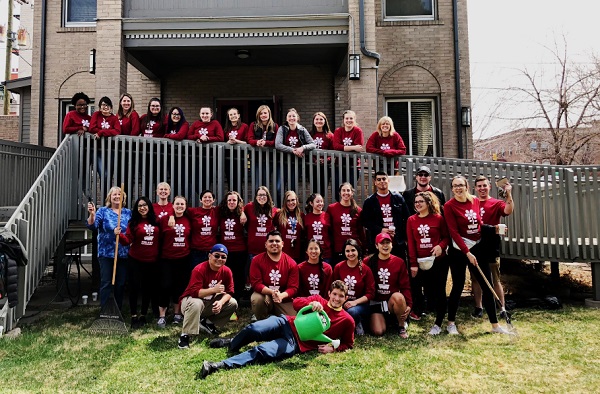
Five chapters getting together before RMPA 2018 in order to support a nonprofit that serves adults with mental illness.
These two images above, taken from Psi Chi’s 2017–18 Annual Report (PDF, 8.75MB)opens in new window, are both great representations of the kind of events that happen across many local college chapters around the world (Psi Chi currently has 1,150+ chapters including 24 outside the US 50 states). However, today, I wanted to share another image of Psi Chi that you might not have considered.
It is important to remember that all memberships in Psi Chi are lifetime. Once a member, always a member. Therefore, many people who joined as undergraduate students are now graduate students, faculty and professionals in other areas of psychology and beyond.
Furthermore, membership eligibility guidelinesopens in new window welcome graduate students and full-time faculty members to join Psi Chi too. (Yes, this invitation applies even if you weren’t previously a member at the undergraduate level.)
Psi Chi encourages graduate students and faculty to join; these members play an invaluable role in our Honor Society. So, when you picture members of Psi Chi, remember to include some graduate and faculty members too. Here are some examples that you can keep in mind:

West Virginia University doctoral students participating in a Graduate Student Panel at a chapter meeting to discuss their experiences in graduate school.

Four University of Mary Washington (VA) faculty from the Department of Psychological Science providing insightful input on graduate school.
As many graduate students and faculty have discovered first-hand, Psi Chi offers unique membership benefits to specially support graduate students and faculty. So, in this article, let’s briefly discuss some of the key reasons why graduate students and faculty should become a part of Psi Chi.
Graduate student benefits
- Financial support: This includes scholarships, research grants, travel grants and moreopens in new window. Specifically, $63,900 was earmarked for graduate students in 2017–18, with an additional $103,050 open to both graduate students and undergraduates. As soon as prior undergraduate members arrive at a psychology graduate school program, they can start applying for graduate-level awards and grants. This is true even if their new graduate school campus doesn’t have a local chapter.
- Unique academic publication opportunities:Psi Chi Journalopens in new window provides educational feedback based on the first author’s developmental level. Submissions are open year round.
- Officer leadership opportunities: Yes, graduate students can become chapter officers, just like undergraduate students. Consider taking on one of these leadership rolesopens in new window.
- More benefits:Learn aboutopens in new window mentorship opportunities, convention networking, and transferring your membership to your new graduate school chapter.
Faculty member benefits
- Financial support: In the 2017–18 year, Psi Chi reserved $89,000 to recognize outstanding faculty members, support faculty research and cover the costs of convention travel. See upcoming programs and deadlinesopens in new window.
- Publishing and research opportunities: Many faculty members regularly submit their research to Psi Chi Journalopens in new window, offer to review student research, and participate in one or more of Psi Chi’s collaborative research projectsopens in new window with their students.
- Classroom materials: Faculty members will receive notifications so that they are in-the-know about the latest Psi Chi resources. For example, Psi Chi recently released an APA style masked manuscript template (PDF, 1.99MB)opens in new window.
- Leadership opportunities: Faculty who decide to take on the role of faculty advisor (or co-advisor) at a chapter are then able to run for regional vice-president positions on Psi Chi’s Board of Directors. Vice-presidents are ultimately eligible to run for president of Psi Chi’s Board.
- More benefits: Learn aboutopens in new window advisor appreciation meals at conventions, awards and grants reviewer opportunities and more.
What if I graduated and didn’t become a professor?
Because Psi Chi membership is lifetime, there are also special benefits for alumni professionals who do not go on to become college faculty members. For example, many chapters regularly welcome back alumni professionals to share their experiences with current students. In addition, Psi Chi publishes brief Alumni in the News submissions in its quarterly magazine, and professionals can also seek or post a psychology-related job on Psi Chi’s Career Center. You can learn more about alumni benefitsopens in new window on the Psi Chi website.
Due to guidelines set by the Association for College Honor Societies, psychology professionals who are not located at a school with a Psi Chi chapter generally cannot join Psi Chi. However, there is one exception: if a chapter was established at your old school after you graduated, then you may be eligible if your final transcript meets that chapter’s current membership standards. View the full membership guidelinesopens in new window to learn more.
Start your journey with Psi Chi
Would you like to see yourself in one of the pictures above? Psi Chi embraces people of all ages, genders, sexual orientations, races, handicaps or disabilities, religions, national and ethnic origins. Each day, countless chapters participate in local educational events, community service projects and fundraisers — all of which are memorable activities designed to strengthen your academic experience. These activities also contribute to students’ ability to form lasting friendships in the psychology department and create networking opportunities. See a great sampling of Psi Chi activities and endeavors in our latest Annual Report (PDF, 8.75MB)opens in new window.
Today, I hope that you will consider becoming a part of this professional organization. Undergraduates, graduate students and faculty members are welcome to apply onlineopens in new window. And last but not least, if there isn’t already a Psi Chi chapter at your local university or college, then I encourage you to view the guidelines to start a chapteropens in new window. Psi Chi is the world’s largest student psychological organization; new chapters are being established all around the globe.
About the author
 In 2013, Bradley Cannon joined the Psi Chi Central Office staff in Chattanooga, Tennessee. Originally an intern, he is now Psi Chi’s full-time writer/managing editor, working closely with Psi Chi’s department of communications and the editorial team of Psi Chi Journal of Psychological Research. Bradley received a bachelor’s degree in creative writing from the University of Tennessee at Chattanooga. In his spare time, he enjoys spending time with his wife and son.