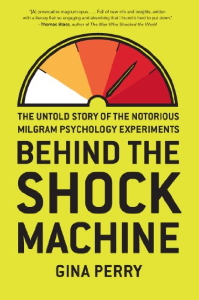
 Title: "Behind the Shock Machine: The Untold Story of the Notorious Milgram Psychology Experiments"
Author: Gina Perry, PhD
Publisher: The New Press
Copyright year: 2013
ISBN: 159558921X
Number of pages: 352 pages
Price: $21.71 (paperback)
"Behind the Shock Machine: The Untold Story of the Notorious Milgram Psychology Experiments" (Perry, 2013) and "The Lost Boys: Inside Muzafer Sherif's Robbers Cave Experiment" (Perry, 2019) were both written by the Australian psychologist and writer Gina Perry, PhD. Both books are detailed, well-researched accounts of two famous studies covered in most introductory psychology courses: the Milgram obedience experiment and the Robber’s Cave study. Both books include information that has recently been discovered, and detail how the personal lives and values of Stanley Milgram and Muzafer Sherif affected what they did and the conclusions they made.
Carly Erani is a senior at Glen Rock High School in New Jersey. She studied AP psychology as a sophomore and the course sparked her interest in the field. After learning about social psychology experiments such as the Milgram obedience experiment and the Robber’s Cave study, she saw a particular view of human nature that led her to Perry’s in-depth analysis and reasoned skepticism of these two studies in the two books mentioned above. After reading her books she was left with more questions, which led her to interview Perry. Below is Ms. Erani’s interview with Perry on "Behind the Shock Machine: The Untold Story of the Notorious Milgram Psychology Experiments". A second interview on "The Lost Boys: Inside Muzafer Sherif's Robbers Cave Experiment" can be found online.
Interview with Gina Perry
What is the most surprising new information that you found out about the Milgram obedience study?
The most surprising information I found out about the Milgram obedience experiment was the significant variation in the obedience rates between experimental conditions. I found that if you looked at each of the 24 variations it is difficult to make a single statement about obedience levels overall. So, I was surprised that Milgram's research has been presented as a statement about our tendency to obey when the data often indicated the opposite; that disobedience or defiance was the major behavioral outcome of subjects across all variations.
Another surprising element was that many of Milgram's subjects expressed various levels of skepticism about the experimental setup and this affected people’s behavior during the experiment. A correlation was found between people’s belief in the subjects being harmed and low rates of obedience.
Another surprising finding for me was the unstandardized and improvisational nature of the experiment. It was depicted as highly rigorous, but when you listen to the audio tapes it was really them improvising as they went along, I think, to improve the rates of obedience.
Milgram’s research is taught in numerous high school and college courses and is portrayed as being revolutionary and as one of the most important experiments in the history of psychology. Do you agree with this assessment?
I think it’s one of the most interesting experiments because of what it tells us about the psychologist behind it, and what it tells us about subjectivity and psychological research. I don’t think by any means it was revolutionary, but I think it shows you that psychologists can gain results from an experiment to suit a particular framework or narrative.
What do you consider to be the most important and valuable findings from the Milgram obedience study?
We should be more critical about social psychological research and look to primary sources and examine the data carefully. This close examination reveals a very different picture of subject behavior than the one Milgram himself communicated.
To what extent does the claim that the experiment explains the Holocaust have any validity?
Milgram was trying to find a psychological explanation for the Holocaust but the way the Holocaust unfolded was the result of a much more complex set of systemic events. It was a much more complex picture than the individual psychology of specific people; so, I don’t think that Milgram’s experiment explains the Holocaust.
Were the people in the study unethical or was it the power of the situation that made them do what they did?
I don’t believe the people who volunteered for the study were unethical. I think they struggled to work out what was right in terms of the direction they were getting from the experimenter, and I think that if we shift our focus to the ethics of Milgram and the research team it gives us a better understanding of some of the issues that arise in experimentation. I think that you’ll find in my book that the quotes from John Williams (the experimenter) showed he was actively coercing subjects across different variations of the experiment.
Do you think every person in a position of power (e.g., police, prison guards) or in similar potentially harsh environments should have to learn about the Milgram Experiment? Do you think knowledge of Milgram study would help prevent people from being mindlessly obedient?
Can studying Milgram’s experiment inoculate people against mindless obedience? Many social psychologists argue that this is the value of the experiment — that it helps people change their behavior in the future. I think when you ask most people about the Milgram experiment they are very willing to talk about what Milgram’s subjects did, but I don't think many people believe if they were in that situation they would have behaved as Milgram’s subjects did. I think that social psychological research like Milgram’s is a moral fable in disguise, a warning about that we supposedly will mindlessly obey. Except if you think about it there are many instances in our daily lives where we don’t mindlessly obey and that goes to the heart of the weakness of Milgram’s explanatory theory of the agentic state that has been discredited by later research. What knowledge are we taking from Milgram’s study? I think what we take from Milgram’s study is that we should be more questioning and critical of presentations of the results of social psychological research. We should ask what influences — personal, social, cultural — shaped this research and its findings.
References
Perry, G. (2013). Behind the Shock Machine: The Untold Story of the Notorious Milgram Psychology Experiments. The New Press.
Perry, G. (2019). The Lost Boys: Inside Muzafer Sherif's Robbers Cave Experiment. Scribe.