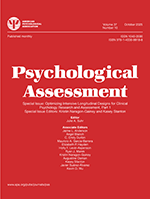

Guest Editors
Table of contents
View the table of contents with abstracts on APA PsycNetopens in new window
Articles
- How Do Participant Preferences, Expectancies, and Perceptions of Ecological Momentary Assessment Impact Adherence? A Mixed-Methods Analysis
Marilyn L. Piccirillo, Erin B. Rapp, Tessa Frohe, Mira Reichman, Mawaddah Joban, Sonja Lee, Riley Tingman, Abigail Okesanya, Katie Malloy Spink, Laila Volpe, Katherine Walukevich-Dienst, and Katherine T. Foster - Exploring Research-Participant Perceptions of Experience Sampling Studies on Self-Harm
Reed M. Morgan, Gabrielle S. Ilagan, Christopher C. Conway, and Emilia Soroko - Reactivity to Experience Sampling Among Adolescents With and Without a Lifetime or Current History of Self-Harm Thoughts or Behaviors
Olivia J. Kirtley, Bloeme Sohier, Benjamin Šimsa, Robin Achterhof, Inez Myin-Germeys, and Ginette Lafit - Utilizing Qualitative Methods to Detect Validity Issues in Clinical Experience Sampling Methodology (ESM)
Leonie Schorrlepp, Marie Stadel, Laura F. Bringmann, Mithra Hesselink, and Dominique Maciejewski - Assessing the Internal Consistency Reliability of Ecological Momentary Assessment Measures: Insights From the WARN-D Study
Sebastian Castro-Alvarez, Di Jody Zhou, Laura F. Bringmann, Rayyan Tutunji, Ricarda K. K. Proppert, Carlotta L. Rieble, Eiko I. Fried, and Siwei Liu - The Importance of Examining Measurement Properties in Ecological Momentary Assessment Research: An Illustrative Example in Suicide Research
Megan L. Rogers, Morgan Robison, Olivia C. Lawrence, Elizabeth F. Mattera, and Dea Mitaj - Affect Dynamics or Response Bias? The Relationship Between Extreme Response Style and Affect Dynamics in a Controlled Experiment
Mirka Henninger, Niels Vanhasbroeck, and Francis Tuerlinckx - Exploring the Predictive Value of Different Affect Dynamics for Psychological Treatment Outcome
Miriam I. Hehlmann, Björn Siepe, Fabienne Mink, Juan Segundo Peña Loray, Juan Martín Gomez Penedo, Jessica Fritz, Danilo Moggia, Julian A. Rubel, and Wolfgang Lutz