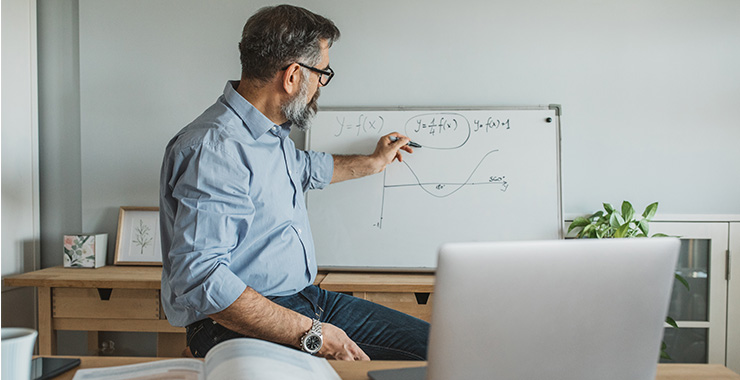
Many of my teacher friends are moving to online instruction right now, and they are working really hard to try to figure out how to make teaching and learning online work well for students. I’ve seen dozens of articles about what online systems might work well, as well as overall guides about online teaching and learning, and I’m grateful that many organizations are producing these guides for teachers trying to make these changes quickly and effectively.
There is one “bottom line” generalization that I think might be useful during discussions of online teaching: Thinking matters. There are many different ways to express this idea. I think Daniel Willingham’s summary might be my favorite: “Memory is the residue of thought.” (Willingham, 2009) Cognitive psychology researchopens in new window consistently shows that cognitive processes like deep processing (and related processes like effortful encoding, elaborative encoding, desirable difficulty, semantic encoding, etc.) are necessary for the kinds of long term, transferable learning we are all after. Teachers should set up learning situations that increase the chances that students will do the kinds of thinking in working memory that will help move information and skills into long term memory and be able to recall the information and skills when they need to.
So how do we do this in the context of online instruction? Daisy Christodoulou offers interesting advice in this blog postopens in new window, but it’s easy to get lost in the blizzard of suggested websites and apps. If I was a classroom teacher right now, I think I would pick a few online tools and use them to increase the chances that students are doing the cognitive work they need to do to learn. Here are the tools and steps I would think about using. (Note: The context I’m most familiar with is Google Classroom, and that’s the tool I would use to “push out” these kinds of learning experiences):
- My first step would be to take any existing presentation slides I have for upcoming lessons and put blank “reflection slides” in the presentation. I wrote about that idea onlineopens in new window.
- I would create hyperdocs as a way for students to follow a series of “learning content,” “explore,” and “try it on your own” steps. I like this Cult of Pedagogy blog post about hyperdocsopens in new window. I think well-designed hyperdocs can help increase the chances that students will do the thinking we need them to do, even when we can’t “be” there.
- I would consider changing some of my presentation slides to the Peardeckopens in new window (or Nearpodopens in new window) format. These tools allow teachers to embed “check for understanding” slides into existing presentation slides and quickly/easily see student thinking (and use that information to modify future teaching). Both Peardeck and Nearpod are probably more effective ways to accomplish the “reflection thinking” idea I described in step 1 (but it will take more work).
Many other teachers are developing different and possibly better plans than these three steps. But I think every effective plan will share one underlying characteristic: Effective online teaching plans will all emphasize student thinking (rather than compliance, amount of work completed, amount of time spent online, effective graphics/videos, effort, etc.) Humans learn what we think deeply about. Memory (and learning) are the residue of thought, whether we are learning face to face or online.
 Rob McEntarffer, PhD, taught psychology, AP psychology, and philosophy for 13 years at Lincoln Southeast High School in Lincoln, Nebraska. While teaching he became interested in educational measurement issues and got a master’s degree in educational measurement from the University of Nebraska, Lincoln in 2003. McEntarffer was involved with the AP psychology reading for many years, serving as a reader, table leader, and question leader. He has been involved with TOPSS for years, serving on the TOPSS committee and helping to establish the Nebraska Teachers of Psychology in Secondary Schools. McEntarffer started his work as an assessment/evaluation specialist with Lincoln Public Schools in 2005 and works with the district on large-scale and classroom assessment issues. He is the co-author of Barron's “AP Psychology” and the upcoming “AP Q & A Psychology” books. McEntarffer earned his doctorate degree in teaching, learning, and teacher education in 2013, focusing his research on how teachers make room for formative assessment processes in their classrooms. He lives with his wife, two kids, dog, and cat in Lincoln, and works for Lincoln Public Schools.