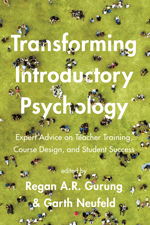
 Editors: Regan A.R. Gurung and Garth Neufeld
Publisher: American Psychological Association
Copyright: August 2021
ISBN: 978-1-4338-3472-1
Pages: 295
Price: $44.99 (members) $59.99 (nonmembers)
Between the 840,000 high school students in the US who earn high school credit in psychology each year (National Center for Education Statistics, 2022), and the estimated 1.2 - 1.6 million students who take an introductory psychology course in college each year (Gurung et al., 2016), this course offers tremendous opportunities. A high-quality introductory psychology course has the potential to:
- elevate the public’s understanding of psychology as science with broad applications that can benefit society and improve lives;
- help students to cultivate the skills needed to thrive academically and personally;
- raise awareness of the prevalence and harms associated with misinformation and mental health stigma; and
- attract diverse talent into the field of psychology.
On the other hand, this potentially transformative class can also be a challenging one to teach. The breadth of material can be overwhelming, and instructors may feel discomfort teaching outside of their area of expertise. Fortunately, APA has long been committed to supporting educators in the design and delivery of this course. Most recently, as part of the Introductory Psychology Initiative (IPI), APA convened a working group of 22 teachers and scholars of introductory psychology working in diverse contexts across high schools, community colleges, and four-year institutions to develop evidence-based recommendations for transforming introductory psychology. Transforming introductory psychology: Expert advice on teacher training, course design, and student success (Gurung & Neufeld, 2022), authored by this group, summarizes these recommendations, and provides a tremendous wealth of practical advice on how to integrate them into your teaching.
Part I of the book presents an overarching evidence-informed framework that readers can use to begin to transform their introductory psychology course. A broad array of recommendations is provided that covers course design, student skill development, the promotion of a welcoming and inclusive learning environment, and models of teacher training.
Instructors who struggle with the broad range of content typically covered in introductory psychology textbooks will welcome the proposed student learning outcomesopens in new window (SLOs) described in Chapter 3. What I find most powerful about these SLOs is the emphasis on psychology’s integrative themes that cut across content areas. The authors make a compelling case for how highlighting these themes help students to better appreciate psychology as a coherent discipline. Notably, these themes are also highlighted in the newly released National Standards for High School Psychology. Chapter 4 provides practical examples of how to assess students’ understanding of these themes (and the other SLOs) and lays out the steps instructors can follow to design a course in instructional methods, and assessments with expected outcomes. Chapter 5 acknowledges common challenges that can arise when implementing evidence-based instructional methods in introductory psychology and provides a decision tree that educators can use to navigate these challenges.
Most of us are drawn to teach because we want to make a difference in the lives of our students. I found considerable inspiration in Chapter 6 of this book as it describes the ways in which introductory psychology can be a means of helping students improve their academic and workforce-readiness skills, increase their health and wellness, and foster cultural competence. Part I concludes with recommendations for the formal training structures and informal communities of practice that can be designed to promote and maintain the teaching of introductory psychology.
Part II of this book is incredibly unique in that it captures the lived experiences of instructors as they attempted to apply select recommendations from the Introductory Psychology Initiative across diverse settings, from high schools to doctoral granting institutions. In each chapter, the authors outline the context in which they teach, delineate the unique challenges they face, and describe their current and planned implementation of the IPI recommendations. Reading Part II helped me to feel like part of a larger community that was working together to make meaningful changes to this challenging, powerful course.
References
Gurung, R. A. R., Hackathorn, J., Enns, C., Frantz, S., Cacioppo, J. T., Loop, T., & Freeman, J. E. (2016). Strengthening introductory psychology: A new model for teaching the introductory course. American Psychologist, 71, 112–124. https://doi.org/10.1037/a0040012opens in new window.
Gurung, R. A., & Neufeld, G. E. (2022). Transforming introductory psychology: Expert advice on teacher training, course design, and student success. American Psychological Association.
National Center for Education Statistics. (2022). Results from the 2019 NAEP high school transcript study. The Nation's Report Card. Retrieved August 24, 2022, from https://www.nationsreportcard.gov/hstsreport/#homeopens in new window