

This document is constructed to guide curriculum decisions by providing content standards and learning targets to guide teachers and other stakeholders in designing instruction. The standards are hierarchically organized to reflect increasing levels of specificity (i.e., pillars, standard areas, content standards, and learning targets).

American Psychological Association. (2022, November 9). National standards for high school psychology curricula. https://www.apa.org/education-career/k12/national-standards
expand all
Working Group and Task Force Members
National Standards for High School Psychology Curricula Working Group (2018—22)
Tina Athanasopoulos, Chair, Prospect High School, Mount Prospect, Illinois
Barney C. Beins, PhD, Ithaca College, Ithaca, New York
Stephen W. T. Foley, The Linsly School, Wheeling, West Virginia
Terri A. Lindenberg, Lake Park High School, Roselle, Illinois
Jennifer Simonds, PhD, University of Maryland Global Campus, Adelphi, Maryland
Samuel Y. Song, PhD, University of Nevada, Las Vegas, Las Vegas, Nevada
Terry Wick, Hartford Union High School, Hartford, Wisconsin
Amy C. Fineburg, PhD, The College Board, New York, New York (ex officio)
National Standards Advisory Panel (2018—22)
Joseph A. Allen, PhD, University of Utah, Salt Lake City, Utah
David F. Bjorklund, PhD, Florida Atlantic University, Boca Raton, Florida
Kimberly L. D'Anna-Hernandez, PhD, State University California San Marcos, San Marcos, California
Erika K. Fulton, PhD, Idaho State University, Pocatello, Idaho
Regan A. R. Gurung, PhD, Oregon State University, Corvallis, Oregon
Kevin Martin, Hartford Union High School, Hartford, Wisconsin
Richard L. Miller, PhD, Texas A&M University—Kingsville, Kingsville, Texas
Carlota Ocampo, PhD, Trinity Washington University, Washington, DC
Bonnie Perdue, PhD, Agnes Scott College, Atlanta, Georgia
Yadira Sánchez, PsyD, Duquesne University, Pittsburgh, Pennsylvana
Katherine Serafine, PhD, University of Texas El Paso, El Paso, Texas
Traci Sitzmann, PhD, University of Colorado Denver, Denver, Colorado
Keith A. Trujillo, PhD, California State University San Marcos, San Marcos, California
Jonathan Tullis, PhD, University of Arizona, Tucson, Arizona
Amy Lynn Young, PsyD, HSP, Spalding University, Louisville, Kentucky
APA staff liaisons
Emily Leary ChesnesRobin J. Hailstorks, PhD
Susan M. Orsillo, PhD
National Standards for High School Psychology Curricula Working Group (2007—11)
Amy C. Fineburg, PhD, Chair, Oak Mountain High School, Birmingham, Alabama
James E. Freeman, PhD, University of Virginia, Charlottesville, Virginia
David G. Myers, PhD, Hope College, Holland, Michigan
Debra E. Park, Rutgers University—Camden, Camden, New Jersey; West Deptford High School, Westville, New Jersey (retired)
Hilary Rosenthal, Glenbrook South High School, Glenview, Illinois
National Standards Advisory Panel (2007—11)
Elizabeth Ligon Bjork, PhD, University of California Los Angeles, Los Angeles, California
Joan C. Chrisler, PhD, Connecticut College, New London, Connecticut
James W. Kalat, PhD, North Carolina State University, Raleigh, North Carolina
Cheryl A. Luis, PhD, Roskamp Institute Memory Clinic, Tampa, Florida
S. Morton McPhail, PhD, Valtera Corporation, Houston, Texas
Jeffery Scott Mio, PhD, California State Polytechnic University, Pomona, California
David B. Mitchell, PhD, Kennesaw State University, Kennesaw, Georgia
Patricia Puccio, EdD, College of DuPage, Glen Ellyn, Illinois
Daniel Reisberg, PhD, Reed College, Portland, Oregon
Susan Krauss Whitbourne, PhD, University of Massachusetts, Amherst, Massachusetts
National Standards for High School Psychology Curricula Working Group (2005)
Kristin H. Whitlock, Chair, Viewmont High School, Bountiful, Utah
Amy C. Fineburg, Spain Park High School, Hoover, Alabama
James E. Freeman, PhD, University of Virginia, Charlottesville, Virginia
Marie T. Smith, PhD, Thomas S. Wootton High School, Rockville, Maryland
National Standards for High School Psychology Curricula Working Group (1999—2004)
Laura L. Maitland, Chair, Mepham High School, Bellmore, NY
Rob McEntarffer, Lincoln Southeast High School, Lincoln, Nebraska Kenneth A. Weaver, PhD, Emporia State University, Emporia, KS
Kristin H. Whitlock, Viewmont High School, Bountiful, Utah
Task Force Members and Standards Authors (1994–1999)
Laura L. Maitland, Chair, Mepham High School, Bellmore, New York
Ruth M. Anderson, Clovis West High School, Clovis, California
Charles T. Blair-Broeker, Cedar Falls High School, Cedar Falls, Iowa
Carol J. Dean, EdD, Lake Park High School, Roselle, Illinois
Randal M. Ernst, Lincoln High School, Lincoln, Nebraska
Jane S. Halonen, PhD, James Madison University, Harrisonburg, Virginia
Bates Mandel, Benjamin Franklin High School, Philadelphia, Pennsylvania
Wilbert J. McKeachie, PhD, University of Michigan, Ann Arbor, Michigan
Marilyn J. Reedy, Alverno College, Milwaukee, Wisconsin
This document is the most recent revision of the document originally entitled National Standards for the Teaching of High School Psychology, first approved by the APA Council of Representatives in August 1999 and revised as the National Standards for High School Psychology Curricula in August 2005 and again in August 2011. This third revision is effective as of February 2022 and supersedes the previous versions.
Suggested bibliographic reference: American Psychological Association. (2022). National Standards for High School Psychology Curricula. https://www.apa.org/education-career/k12/national-standards
Copyright © 2022 by the American Psychological Association. This material may be reproduced and distributed without permission for educational or research purposes provided that acknowledgment is given to the American Psychological Association. This material may not be translated or commercially reproduced without prior permission in writing from the publisher. For permission, contact APA, Rights and Permissions, 750 First Street, NE, Washington, DC 20002–4242.
Preface
Teaching psychology as a science
In this version of the National Standards for High School Psychology Curricula, centering the foundational role of scientific methods in the development of psychological knowledge is a core priority. From the inception of the project to revise the National Standards, the authors set the goal that this document should shepherd the teaching of psychology in high schools through the transition to being recognized and taught as a science. Though many high school psychology teachers enjoy the opportunity to introduce their students to the field of psychology, this opportunity carries the responsibility to accurately represent the nature of psychological science as rooted in empirical research. These National Standards emphasize this foundational reality, and instruction that is in alignment with these National Standards will reflect psychology’s scientific nature.
Many teachers of high school psychology may find the directive to focus on the field’s scientific foundations to be intimidating. However, the consequences of shying away from embracing and communicating this reality to students may be significant. Misrepresenting the field by neglecting this crucial framework or by including pseudoscience in the psychology course fails to adequately equip students to understand psychological science and to apply psychology productively to their own lives, and may dissuade them from pursuing further study in psychology in college and beyond. As students’ guides through their first contact with the field of psychology, high school psychology teachers should ensure that they prepare students to fully engage with the field, and so it is increasingly important that they represent psychological science as a science.
To help teachers of high school psychology accurately represent psychological science, these Standards frame and connect the learning targets in the course to a set of Integrative Themes that show how psychological knowledge is interconnected, including a foundational theme that describes how psychological science depends on empirical data. Resources to support teachers in adapting their instruction to achieve these learning targets are available on the APA website.
The initial intent of the National Standards Working Group that revised this latest (2022) document was to demonstrate how psychology standards promote and align to the scientific practices and crosscutting principles provided in the Next Generation Science Standards (NGSS Lead States, 2013; see Table 1). As detailed by Foley (2018), psychology instruction engages students in the scientific practices and meets crosscutting principles by asking students to identify natural phenomena, ask questions, and investigate and explain what they are studying. Psychology students can learn science by engaging in science, the cornerstone of science education per the NGSS.
The Working Group discussed at length how the NGSS science practices and crosscutting concepts could be woven into the National Standards and considered adding action-oriented learning targets into this document to demonstrate how students could learn by doing. Ultimately, the Working Group concluded that there were too many differences between the science standards for entire branches of science (e.g., Physical Science, Life Science, Earth and Space Sciences) taught across K-12 education, and these National Standards for a specific high school course. However, the Working Group drafted the National Standards document to demonstrate the scientific nature, content, and foundation of psychology, with the hope that the National Standards could help the transition toward a broad acceptance that high school psychology courses should be recognized as science courses. The Working Group supports the recommendations from High School Psychology is Science: A Report from the APA Summit on High School Psychology Education (Alston et al., 2019) as well as other efforts to recognize high school psychology as a STEM subject. The Working Group shares the goal stated in the Alston et al. (2019) report that students taking high school psychology courses should be able to earn science credit upon completion of the course. The Working Group is hopeful that this latest reiteration of the National Standards will continue to support the scientific nature and foundation of the course.
Table 1: Science Practices and Crosscutting Concepts from the Next Generation Science Standards
See Foley (2018) for a summary of how psychology advances the practices and concepts outlined below.
Scientific and Engineering Practices
These Practices are “the major practices that scientists employ as they investigate and build models and theories about the world... [The term “practices” emphasizes] that engaging in scientific investigation requires not only skill but also knowledge that is specific to each practice… As in all inquiry-based approaches to science teaching, [the] expectation is that students will themselves engage in the practices and not merely learn about them secondhand. Students cannot comprehend scientific practices, nor fully appreciate the nature of scientific knowledge itself, without directly experiencing those practices for themselves.” (NRC, 2012, p. 30):
- Asking questions (for science) and defining problems (for engineering)
- Developing and using models
- Planning and carrying out investigations
- Analyzing and interpreting data
- Using mathematics and computational thinking
- Constructing explanations (for science) and designing solutions (for engineering)
- Engaging in argument from evidence
- Obtaining, evaluating, and communicating information
Crosscutting Concepts
The crosscutting concepts have application across all science disciplines:
- Patterns
- Cause and effect: Mechanism and explanation
- Scale, proportion, and quantity
- Systems and system models
- Energy and matter: Flows, cycles, and conservation
- Structure and function
- Stability and change
Source: A Framework for K-12 Science Education: Practices, Crosscutting Concepts, and Core Ideas (NRC, 2012)
Though this version of the National Standards shifts the emphasis of the course to highlight psychology’s scientific foundation and Integrative Themes, experienced teachers of high school psychology will find much of the content of the National Standards to be familiar. As the scientific study of behavior and mental processes, psychology continues to be a field that informs our understanding of society’s most challenging problems—including crime, poverty, prejudice, violence, and environmental sustainability. Well-informed students of psychology can apply psychological science to their daily lives to great effect.
The need for National Standards
Although psychology is a science, across the United States, high school psychology courses are taught by teachers situated in either social studies departments or science departments because of variability across states in teacher credentialing in psychology and unique departmental structures. Consequently, students’ first exposure to psychology as a discipline may be vastly different in content and level of challenge across districts and schools. Additionally, neither social studies nor science curriculum standards have adequately addressed psychology as a discipline.
For psychology to be adequately taught as a scientific discipline at the secondary level, learning targets are essential. Thus, in 1994 the American Psychological Association commissioned the Task Force for the Development of National High School Psychology Standards to develop standards that identify what students in an introductory high school psychology course should learn. Task force members included experienced psychology educators at the secondary and university levels.
The task force members anticipated the need for periodic revision of the standards due to the continued advancement of psychology as a discipline. Soon after the original approval in August 1999 of the psychology standards, the National Standards for High School Psychology Curricula Working Group was formed to coordinate the first revision process. They facilitated a rigorous review process to produce a document that represents the best practices in the teaching of psychology as both a natural and social science. The first revision of these psychology standards was published in 2005, and a second revision was published in 2011. This third and most current version of the standards reflects the evolving body of psychological knowledge.
The task force members and subsequent working group members designed these standards to enhance quality curricula, express learning goals for students, and promote excellence in the teaching of the high school introductory psychology course. The public has a right to expect a course in psychology to meet criteria for quality. Expectations with respect to learning goals should be clear. Standards related to the knowledge and skills expected of students should be high but attainable. This document represents a vision of what students should know after completing the high school psychology course.
Executive Summary
The goal of the National Standards for High School Psychology Curricula is to help teachers and others responsible for the development of psychology curriculum at the secondary school level develop an accurate, comprehensive, and developmentally appropriate introductory psychology course aimed at students in grades 9 through 12. The National Standards does not define the discipline of psychology, nor does it prescribe what should be taught in an introductory psychology course at the postsecondary level. Rather, the National Standards provides a framework for teachers and others to craft introductory psychology courses for high school students. Mindful of this curricular context and student audience, the National Standards is an outline of the basic core essentials of psychological science and practice to be taught in the introductory psychology course and is intended to be relevant to the lives of high school students.
Teachers need not use the National Standards for daily lesson planning. Rather, teachers should use the National Standards to determine the overall content and learning objectives for students who are first learning about psychology in high school. Teachers can use a variety of resources, including those available through the American Psychological Association’s website, to develop daily lesson plans that support the content and learning objectives in the National Standards.
Teachers should also use the National Standards to promote psychological literacy in their students. Teachers can achieve this learning outcome by balancing the opportunities for their students to discover new knowledge with opportunities to learn about established research findings and theories about human and non-human animal behavior in their lectures. Students should understand the major ideas found in psychology today and appreciate how psychologists try to understand the world, make new discoveries, and apply psychological knowledge to solve problems.
The mission of the original task force that developed these standards and the subsequent revision committees was to prepare a document to be used by educational leaders, teachers, and other stakeholders to determine what high school psychology students ought to be taught in a high school psychology classroom. Use of the term standards in this document is consistent with national practices in K-12 education when disciplinary societies, teacher organizations, or other non-regulatory groups develop benchmark learning objectives for curriculum development and assessment of student learning in particular subjects of study. Consistent with the use of the term standards in a secondary school setting, these standards are advisory.
Structure of the National Standards and integrative themes
The National Standards is not presented as a taxonomy nor is it organized to suggest that the course content be taught in a particular sequence. Rather, the aim of its design is to help teachers see how psychological knowledge rests on a foundation of scientific methodology, how the content of the course can be conceptualized at multiple levels, and how several Integrative Themes connect and unite psychological science.
The National Standards suggests four levels of understanding for psychology content. First, the Foundation of Scientific Inquiry and Research Methods and the five thematic Pillars represent overarching areas that encompass broad areas of psychological methodology, knowledge, and study. Next, the Standard Areas are unit topics that represent closely related theories and findings regarding more specific areas of knowledge and study. The Content Standards are specific topics teachers can use as starting points to build lessons. Finally, within each content standard, students should receive instruction that would enable them to meet specific Learning Targets, or objectives for each content standard.
As described in the Preamble to the National Standards, this document also features seven Integrative Themes that connect and unite psychological science. These themes emerge across the content of the course, demonstrating the interconnected nature of psychological knowledge and how psychological science impacts the world. These Integrative Themes were developed by APA’s Introductory Psychology Initiative as one of three Student Learning Outcomes for the undergraduate introduction to psychology course. The Integrative Themes reflect a unified vision for the nature of psychological knowledge as interconnected and interdependent. The three Student Learning Outcomes recommended by the APA Introductory Psychology Initiative are provided in Table 2. Unlike the APA Introductory Psychology Initiative work, which was content agnostic, these National Standards address the content of the introductory course. Teachers can use the first two Student Learning Outcomes as needed in their course planning.
Table 2: APA Introductory Psychology Initiative (IPI) Student Learning Outcomes for Introductory Psychology
In an introductory psychology course, students are expected to:
Psychology Content: Identify basic concepts and research findings
1.1. Define and explain basic psychological concepts.
1.2. Interpret research findings related to psychological concepts.
1.3. Apply psychological principles to personal growth and other aspects of everyday life.
Scientific Thinking: Solve problems using psychological methods
2.1. Describe the advantages and limitations of research strategies.
2.2. Evaluate, design, or conduct psychological research.
2.3. Draw logical and objective conclusions about behavior and mental processes from empirical evidence.
2.4. Examine how psychological science can be used to counter unsubstantiated statements, opinions, or beliefs.
Key Themes: Provide examples of psychology's integrative themes
A. Psychological science relies on empirical evidence and adapts as new data develop.
B. Psychology explains general principles that govern behavior while recognizing individual differences.
C. Psychological, biological, social, and cultural factors influence behavior and mental processes.
D. Psychology values diversity, promotes equity, and fosters inclusion in pursuit of a more just society.
E. Our perceptions and biases filter our experiences of the world through an imperfect personal lens.
F. Applying psychological principles can change our lives, organizations, and communities in positive ways.
G. Ethical principles guide psychology research and practice.
Source: (APA, 2021)
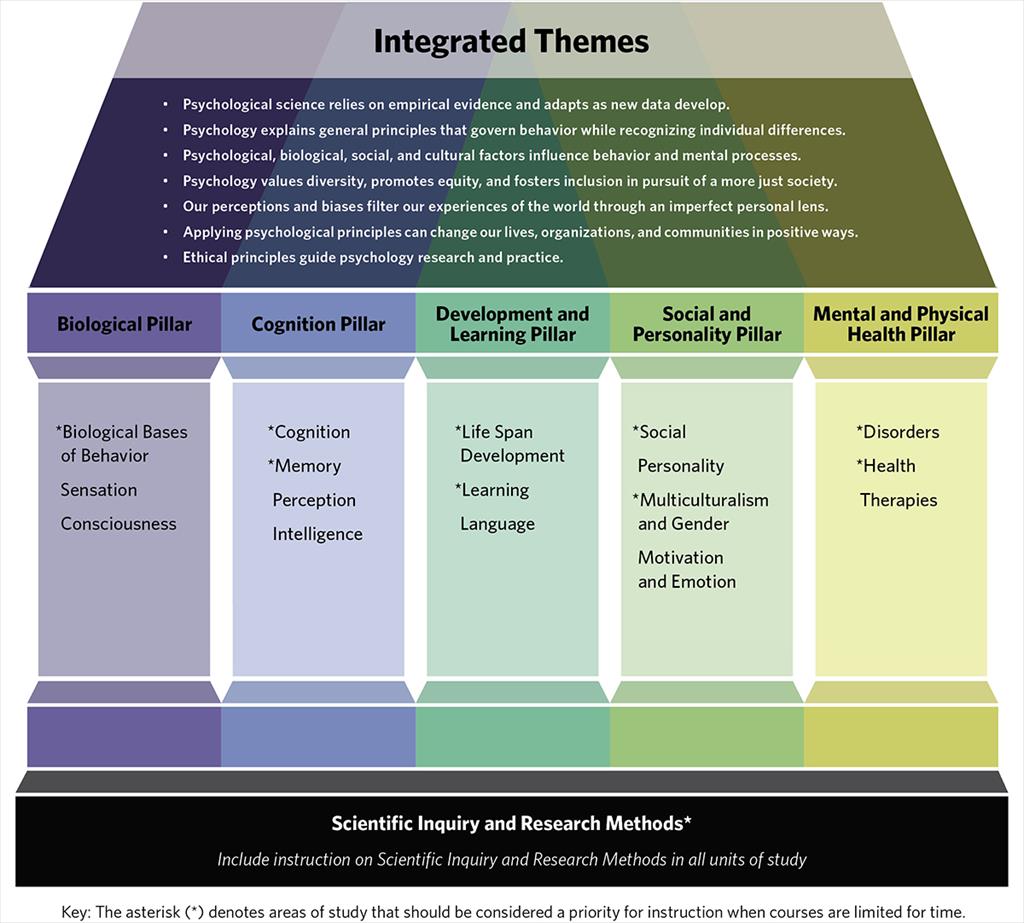
A graphic illustration for this version of the National Standards below shows how psychological knowledge builds on itself using scientific inquiry and is united by several themes. The following explanation is provided to assist the reader in understanding this illustration.
- The Scientific Inquiry and Research Methods Foundation creates the base of the Pillar Model, demonstrating that the perspectives in psychological science and the research methods, measurement, and statistics used to study psychological phenomena are the foundation of all psychological research and study. Behavior and mental processes are understood better when theories and practices are empirically supported. Teachers should teach specifically about scientific practices and integrate instruction about scientific inquiry and research methods into every part of the course, and they should avoid teaching pseudoscience. This Foundation is supported by the Integrative Theme A, which states that psychological science relies on empirical evidence and adapts as new data develop. This Foundation provides the base from which all other psychological knowledge is built. With this understanding that psychology is a science, students can fully appreciate the ongoing significance of the work of psychologists in understanding behavior and mental processes in reliable and valid ways.
- The five Pillars each contain units organized by content area. The Biological Pillar, which includes units on the biological bases of behavior, sensation, and consciousness, shows that physical processes underlie psychology, and that biology influences behavior. The Cognition Pillar, which includes units on cognition, memory, perception, and intelligence, investigates the mental processes that drive behavior. The Development and Learning Pillar, which includes units on life span development, learning, and language, studies the roles of environment, experience, and maturation on behavior across the life span. The Social and Personality Pillar, which includes units on social psychology, personality, multicultural and gender, and motivation and emotion, highlights individual differences that occur among humans and delves into how social, cultural, and economic factors shape behavior. The Mental and Physical Health Pillar, which includes units on disorders, health, and therapies, demonstrates how applied psychological science promotes healthy living and contributes to well-being.
- In addition to the first Integrative Theme mentioned above, there are six additional Integrative Themes that cut across all Pillars, demonstrating that psychological science is inherently interconnected. Each Integrative Theme can be taught within each Pillar, and throughout the course, the Integrative Themes can appear in each unit. For instance, Theme F (Applying psychological principles can change our lives, organizations, and communities in positive ways) may be more directly taught in areas like therapy, but may also be discussed when teaching motivation or personality. Likewise, Theme D (Psychology values diversity, promotes equity, and fosters inclusion in pursuit of a more just society) is directly relevant to the social and personality pillar, but issues of equality, diversity, and inclusion are relevant to each unit within the psychology course. Indeed, teachers can apply every theme in every unit, although they are not expected to do so as this might be an overwhelming task. Instead, teachers are encouraged to consider how the content already being taught or assessments being used can demonstrate the Integrative Themes throughout the course. Teaching the course using Integrated Themes can help elevate the student experience from rote memorization to application and connection to their own lives. Teachers and stakeholders should refer to the Preamble and Appendix A for additional information on the Integrative Themes.
All of the standard areas within each Pillar address important areas of psychology, but a high school teacher may not have the time to teach all the units comprehensively, especially in a one-semester course. The Pillar model indicates recommended Standard Areas that all high school psychology courses should include, as indicated by asterisks. Additionally, the Working Group provides suggestions in Appendix B for how to include fundamental content into courses. These suggestions are provided by experienced teachers of psychology to assist teachers in planning their overall course content.
Important considerations for teaching high school psychology
Equity, diversity, and inclusion
The centrality of equity, diversity, and inclusion to psychology is evident across several of the Integrative Themes included in this document. Teachers of high school psychology should be aware of the necessity of understanding diversity to understand human behavior and interactions. Teachers should also incorporate diversity, equity, and inclusion issues throughout the course, such as by emphasizing the role of individual differences in shaping human behavior and highlighting how psychology promotes equity and fosters inclusion in pursuit of a more just society. In the introductory psychology course, teachers should present psychological science through a lens that is comprehensive of the field’s diverse topics of study, representative of the field’s diverse contributors, and respectful of the field’s diverse research participants. Teachers should incorporate issues of race and ethnicity, culture, gender identity and expression, sexual orientation, disability, religion, socioeconomic status, national origin, and age into the psychology course. Teachers may also want to address how psychology’s history includes both successes and abuses, and how psychologists contribute to building a just, diverse, and equitable society.
Using evidence-informed instruction
Psychology teachers have the unique opportunity to apply the content in their course to the methods they use to teach each day. Units such as memory, learning, and motivation give relevant, often practical, strategies teachers and students can apply daily in class. Teachers are encouraged to use strategies from psychology to teach psychology. By incorporating elaborative rehearsal, distributed retrieval practice, incentives, metacognition, and important concepts like the Yerkes–Dodson Law into daily instruction, teachers can help students not only learn these content standards but also become better learners in the process.
Learning is a dynamic experience, so teachers should have planned multiple teaching practices and learning strategies that consider the student, the content, and the learning environment, as well as the teacher’s strengths in each lesson.
Resources for lesson plan development
Much of the content included in this document only hints at the wealth of research literature addressing each topic. Thus, high school teachers are strongly encouraged to use various resources during lesson planning to make decisions about what to teach. Teachers should strive to use multiple textbooks, scholarly publications, and other instructional resources to plan lessons in each Standard Area. The APA and the APA Teachers of Psychology in Secondary Schools (TOPSS) have a wide variety of vetted teacher resources, including unit lesson plans, available at the TOPSS website. Using these materials can assist teachers in presenting the most relevant, developmentally appropriate, and current information to students. Additional resources include those from the Society for the Teaching of Psychology (STP; APA Division 2), APA’S Project Assessment, and APA’s Online Psychology Laboratory. Appendix C provides additional resources for psychology teachers.
Representing the global nature of psychology
Teachers should not limit themselves to drawing upon resources developed in the United States. As psychology becomes an increasingly global discipline, teachers should present research that represents participants from diverse backgrounds and multiple cultures. Psychological research conducted in non-Western cultures often shows how psychological phenomena may operate differently than in Western cultures. By presenting these types of findings to students, teachers can reinforce the idea that researchers should be careful about generalizing research findings beyond the populations studied. Teachers of the psychology course can take advantage of the resources available from reliable sources worldwide to increase their ability to demonstrate to their students the globalized and diverse nature of psychological science. International Psychology (APA Division 52) and the Society for the Teaching of Psychology’s (APA Division 2) International Committee are resources for teachers; both websites and additional resources on international research are provided through Appendix C.
The process of revising the standards
Many individuals and groups contributed to the initial development of these standards. Virginia Andreoli Mathie, PhD, and her committee from the APA National Conference on Enhancing the Quality of Undergraduate Education in Psychology (St. Mary’s College, June 1991); the APA Board of Educational Affairs (BEA); the Task Force for the Development of National High School Psychology Standards; and Jill Reich, PhD, executive director of the Education Directorate, were key leaders in the development of the original psychology curricula standards published in August 1999.
The BEA first approved the beginning of the psychology curricula standards project in spring 1994. The APA Board of Directors approved a Task Force for the Development of National High School Psychology Standards in June 1994, with subsequent approval of the task force by the APA Council of Representatives. The task force developed the initial set of standards in 1995, and the document went through seven drafts as APA boards, committees, divisions, and APA members and affiliates reviewed the standards and submitted comments for consideration. In spring 1998, the final version was approved by BEA. The APA Board of Directors approved the final version in fall 1998, followed by the APA Council of Representatives’ approval in August 1999.
First revision of the standards (2005)
The APA Council of Representatives approved the National Standards with the understanding that they should be reviewed and revised on an ongoing basis. Council specified that a revision of the standards should be undertaken on a 7-year cycle. This is consistent with provisions of APA Association Rule 30-8.3, requiring cyclical review of approved standards and guidelines within periods not to exceed 10 years.
In 2001, the National Standards for High School Psychology Curricula Working Group started the first revision process by soliciting nominations for content reviewers for each of the five original domains of the National Standards (i.e., Methods, Biopsychological, Developmental, Cognitive, and Sociocultural). The National Standards Working Group then sought broad feedback to update the content standards, performance standards, and performance indicators. The National Standards Working Group integrated changes into a revised draft of the standards in November 2003. APA boards, committees, divisions, and state, provincial, and territorial psychological associations were then given an opportunity to review and provide comments on the standards. A new National Standards Working Group convened in January 2005 and incorporated the additional suggestions. The APA Council of Representatives approved the revised National Standards as APA policy in August 2005.
Second revision of the standards (2011)
Soon after the approval of the standards in 2005, planning for the second revision began. APA boards and committees nominated members for a new National Standards Working Group and a National Standards Advisory Panel. The Advisory Panel was made up of 10 experts, two for each of the five domains of the National Standards (APA, 2005) (i.e., Methods, Biopsychological, Cognitive, Developmental, and Variations in Individual and Group Behavior).
In 2007, the National Standards Working Group invited the National Standards Advisory Panel; APA members and affiliates; and all APA boards, committees, divisions and state, provincial, and territorial psychological associations to submit feedback on the National Standards. The National Standards Working Group met in November 2007 to review all feedback submitted in response to the document. The National Standards Working Group and the National Standards Advisory Panel met jointly in September 2008. In 2009, the National Standards Working Group provided a revised draft of the document to APA boards; committees; divisions; and state, provincial, and territorial psychological associations for feedback. In the fall of 2009, the National Standards Working Group reviewed all submitted feedback and responded to each comment. A 90-day public comment period was held in early 2010, and the National Standards Working Group met in July 2010 to review all submitted comments and make additional changes to the draft document as appropriate. Upon the recommendation of BEA, the National Standards Working Group invited APA governance groups to review the draft of the National Standards in the fall of 2010. In February 2011, the National Standards Working Group provided the revised National Standards to the Office of the General Counsel for a final legal review. Upon the recommendation of BEA, APA governance groups received an action item recommending that the Council of Representatives approve the National Standards as association policy. Following approval of the revised National Standards by the APA Board of Directors in June 2011, the APA Council approved the second revision of the National Standards in August 2011.
APA Summit on High School Psychology Education (2017) and the third revision of the standards (2022)
In July 2017, over 70 psychology educators from high schools, community colleges, and undergraduate psychology programs participated in the APA Summit on High School Psychology Education, held at Weber State University in Ogden, Utah. The mission of the summit was to create the best future for high school psychology education and to improve the value, delivery, and reach of psychology by strengthening the teaching of high school psychology. During the summit, participants worked in eight separate working groups to develop resources and recommendations to support the mission of the summit. One of the working groups was charged with recommending a framework for the next iteration of the National Standards. This working group developed such a framework and declared an intention for the National Standards to communicate psychology’s status more clearly as a science.
In 2018, APA boards and committees nominated members for a new National Standards Working Group and a National Standards Advisory Panel. The Advisory Panel was made up of 16 experts, two for each of the seven domains of the National Standards (APA, 2011) (i.e., Scientific Inquiry, Biopsychological, Development and Learning, Sociocultural Context, Cognition, Individual Variation, and Applications of Psychological Science) as well as two K-12 science experts. BEA approved both groups in 2018.
That same year, the National Standards Working Group invited APA members and affiliates, and all APA boards, committees, divisions and state, provincial, and territorial psychological associations to submit feedback on the 2011 National Standards. The National Standards Working Group met in December 2018 to review all feedback submitted and start revising the policy document. In 2019, a revised draft of the National Standards was shared with the Advisory Panel for review and feedback. The National Standards Working Group met again in December 2019 to continue the revision process.
In mid-2020, following BEA approval, the National Standards Working Group provided a revised draft of the document to several groups that represented the interests of high school psychology teachers: the APA Committee of Teachers of Psychology in Secondary Schools (TOPSS), the APA Committee of Associate and Baccalaureate Education (CABE), BEA, the APA Introductory Psychology Initiative Steering Committee, and the Society for the Teaching of Psychology (APA Division 2). The draft was also shared with the Advisory Panel. The Working Group reviewed received feedback and revised the document accordingly. Following legal review and BEA approval, a 60-day public comment period was held in early 2021, and the National Standards Working Group reviewed all submitted comments and made additional changes to the draft document as appropriate.
In September 2021, the National Standards Working Group provided the revised National Standards to the Office of the General Counsel for a final legal review. BEA then reviewed and approved sending the draft National Standards to the APA Board of Directors and Council of Representatives. Following approval of the revised National Standards by the APA Board of Directors in December 2021, the APA Council of Representatives approved the third revision of the National Standards in February 2022.
Resources
The working group focused on the National Standards at the 2017 APA Summit on High School Psychology Education used the following resources to inform their recommended framework for the high school psychology standards: National Standards for High School Psychology Curricula (APA, 2011), Strengthening the Common Core of the Introductory Psychology Course (APA, 2014), Report of the APA 2009 Presidential Task Force on the Future of Psychology as a STEM Discipline (APA Task Force on Psychology as a Core STEM Discipline, 2010), AP Biology Course and Exam Description (College Board, 2014), AP Chemistry Course and Exam Description (College Board, 2014), AP Physics 1: Algebra-based Course and Exam Description (College Board, 2014), AP Physics 2: Algebra-based Course and Exam Description (College Board, 2014), AP Psychology Course and Exam Description (College Board, 2014), Education and Training in the Social and Behavioral Sciences: A Plan to Action. A Report to the National Science Foundation (Levine, Abler, & Rosich, 2004), College, Career and Civic Life C3 Framework for Social Studies State Standards (NCSS, 2013), A Framework for K-12 Sciences Education: Practices, Crosscutting Concepts, and Core Ideas (NRC, 2012), Access the Next Generation Science Standards by Topic (NSTA, 2014), and Behavioral and Social Sciences in STEM Education: A Workshop Summary (OBSSR, National Institutes of Health, 2010).
Resources used to inform earlier versions of the psychology curricula standards included references to existing high school standards promulgated by similar disciplinary organizations. Examples in other areas of K–12 study are the English language arts standards set forth by the National Council of Teachers of English, math standards set forth by the National Council of Teachers of Mathematics, history standards set forth by the National Center for History in the Schools, social studies standards promulgated by the National Council for the Social Studies, and science education standards promulgated by the National Research Council (NCHS, 1996; NCTE, 1996; NCTM, 1999; NCSS, 2010; NRC, 1998). The work of the APA Introductory Psychology Initiative and the NGSS (NGSS Lead States, 2013) also informed the revision of the National Standards.
The content that is contained in the National Standards is consistent with the Ethical Principles of Psychologists and Code of Conduct (APA, 2017). Finally, APA Guidelines for the Undergraduate Psychology Major (APA, 2013) and Undergraduate Education in Psychology: A Blueprint for the Future of the Discipline (Halpern, 2010) offer guidance regarding curricula for the undergraduate major. The psychology curricula standards are designed to address the introductory course in psychology; hence, these publications on undergraduate psychology education provided support for the domains of introductory psychology. Transforming Introductory Psychology: Expert Advice on Teacher Training, Course Design, and Student Success (Gurung & Neufeld, 2021) is a useful resource for teachers regarding recommendations for the introductory psychology course.
Feedback
The National Standards Working Group views this publication as a “living document.” We invite your comments and suggestions. Please send feedback to the National Standards Working Group, c/o APA Education Directorate, 750 First Street, NE, Washington, DC 20002–4242 (education@apa.org).
References
Alston, N., Baker, S., Beins, B., Blair-Broeker, C., Miller, R., Nielsen, A., Rozanes, D., Wang, R., & Whitlock, K. (2019). High School Psychology is Science: A Report from the APA Summit on High School Psychology Education. https://www.apa.org/ed/precollege/topss/science
American Psychological Association. (2007). APA guidelines for the undergraduate psychology major. https://www.apa.org/ed/precollege/undergraduate-major
American Psychological Association (2021). APA Introductory Psychology Initiative (IPI) student learning outcomes for introductory psychology. https://www.apa.org/about/policy/introductory-psychology-initiative-student-outcomes.pdfopens in new window
American Psychological Association. (2017). Ethical principles of psychologists and code of conduct (2002, Amended January 1, 2017). https://www.apa.org/ethics/code
American Psychological Association. (2011). National Standards for High School Psychology Curricula. https://www.apa.org/education-career/k12/national-standards
American Psychological Association. (2014). Strengthening the common core of the introductory psychology course. Washington, DC: American Psychological Association, Board of Educational Affairs. https://www.apa.org/ed/governance/bea/intro-psych-report.pdfopens in new window
American Psychological Association, Task Force on Psychology as a Core STEM Discipline. (2010). Report of the APA 2009 presidential task force on the future of psychology as a STEM discipline.
College Board. (2014). AP biology course and exam description. https://secure-media.collegeboard.org/digitalServices/pdf/ap/ap-biology-course-and-exam-description.pdfopens in new windowlogin requiredlogin required
College Board. (2014). AP chemistry course and exam description. https://secure-media.collegeboard.org/digitalServices/pdf/ap/ap-chemistry-course-and-exam-description.pdfopens in new windowlogin requiredlogin required
College Board. (2014). AP physics 1: Algebra-based course and exam description. https://apcentral.collegeboard.org/media/pdf/ap-physics-1-course-and-exam-description.pdfopens in new window
College Board. (2014). AP physics 2: Algebra-based course and exam description. https://apcentral.collegeboard.org/pdf/ap-physics-2-course-and-exam-description.pdfopens in new window
College Board. (2014). AP Psychology course description. https://secure-media.collegeboard.org/digitalServices/pdf/ap/ap-psychology-course-description-2014-15.pdfopens in new windowlogin requiredlogin required
Foley, S. (2018, September). A case for psychology as science: A review of the APA National Standards for High School Psychology Curricula and the Next Generation Science Standards Science Practices and Crosscutting Concepts. Psychology Teacher Network, 28(3). https://www.apa.org/ed/precollege/ptn/2018/09/high-school-next-generation
Governing Board of the National Research Council. (1998). National science education standards. https://www.nap.edu/catalog/4962/national-science-education-standardsopens in new window
Gurung, R. A. R., & Neufeld, G. (Eds.) (2021). Transforming introductory psychology: Expert advice on teacher training, course design, and student success. American Psychological Association.
Halpern, D. F. (Ed.) (2010). Undergraduate education in psychology: A blueprint for the future of the discipline. American Psychological Association.
Levine, F. J., Abler, R. F., & Rosich, K. J. (2004). Education and training in the social and behavioral sciences: a plan to action. A report to the National Science Foundation. https://www.nsf.gov/pubs/2004/nsf0442/nsf0442.pdfopens in new window
National Center for History in the Schools. (1996). National standards for history.
National Council for the Social Studies. (2013). College, career and civic life C3 framework for social studies state standards. https://www.socialstudies.org/sites/default/files/c3/C3-Framework-for-Social-Studies.pdfopens in new window
National Council for the Social Studies. (2010). National curriculum standards for social studies. https://www.socialstudies.org/standardsopens in new window
National Council of Teachers of English & the International Reading Association. (1996). Standards for English language arts.
National Council of Teachers of Mathematics. (2000). Principles and standards for school mathematics.
National Research Council, Committee on a Conceptual Framework for New K-12 Science Education Standards. (2012). A framework for K-12 science education: practices, crosscutting concepts, and core ideas. Washington, DC: The National Academies Press. https://www.nap.edu/read/13165/chapter/1opens in new window
National Science Teachers Association. (2014). Access the Next Generation Science Standards by topic.
NGSS Lead States. (2013). Next Generation Science Standards: For States, By States. Washington, DC: The National Academies Press.
Office of Behavioral and Social Sciences Research (OBSSR), National Institutes of Health. (2010). Behavioral and social sciences in STEM education: A workshop summary.
Preamble
Integrative themes
The National Standards for High School Psychology Curricula attempts to outline introductory content in the field of psychology in developmentally appropriate ways. Psychology is a popular high school course, one that can introduce students to scientific inquiry and engage them in the learning process. However, it is difficult for even the best teachers to present all of psychology in a single course (whether taught in one semester or as a yearlong course), especially with high school students who begin with virtually no formal knowledge of psychology. Thus, this document serves as an outline of accessible content topics that represent introductory knowledge in psychology.
Since the first course in psychology is a survey course, the content addresses many units of knowledge and inquiry in ways that might suggest that each chapter, unit, or module is distinct within the discipline of psychology. However, the units taught in an introductory psychology course share common themes, and the content in each unit often overlaps with content in others.
Consequently, communicating the complex, integrated nature of psychological knowledge and inquiry can seem overwhelming to teachers and students in the first course in psychology, whether it be taught or taken in high school or college. To demonstrate overarching ideas and concepts that connect psychological content together, the National Standards Working Group has incorporated seven Integrative Themes into this document, as proposed by the APA Introductory Psychology Initiative. The Integrative Themes are designed to guide teachers and students to common threads across content throughout the course. These Integrative Themes are:
A. Psychological science relies on empirical evidence and adapts as new data develop.
B. Psychology explains general principles that govern behavior while recognizing individual differences.
C. Psychological, biological, social, and cultural factors influence behavior and mental processes.
D. Psychology values diversity, promotes equity, and fosters inclusion in pursuit of a more just society.
E. Our perceptions and biases filter our experiences of the world through an imperfect personal lens.
F. Applying psychological principles can change our lives, organizations, and communities in positive ways.
G. Ethical principles guide psychology research and practice
The Integrative Themes provide a set of generally accepted ideas that weave together content in psychology that may seem disconnected to the novice learner. Psychologists recognize that most of the finer details of what people learn are not often retained past the initial learning experience. Usually, students don’t remember specific definitions of concepts or bits of trivia they learn in class. Teachers hope students will walk away from class with an appreciation for the subject or an understanding of why the subject is important to learn. The Integrative Themes are an effort to provide students structure for discovering what to appreciate and understand about psychology to retain long after they finish their final exams.
Instructional planning for the high school psychology course should begin with an understanding that the Integrative Themes play a key role in defining why the subject is important to learn. Teachers familiar with a backward-design philosophy, a design strategy that begins with articulating the learning goals of the course (Wiggins & McTighe, 2005), may recognize that the Integrative Themes can serve as overall course goals or enduring understandings that drive the other elements of course planning, namely unit sequence and daily lesson planning. The Integrative Themes should be represented in each pillar and each unit taught in the high school course. Throughout this document, the Integrative Themes are displayed at the beginning of each Pillar to emphasize that the themes should be woven across all Standard Areas (or units) taught in the course. Sample suggestions on how the Integrative Themes can be highlighted in each Pillar are provided in Appendix A to these curriculum standards. These suggestions are not meant to be comprehensive but are meant to show how a teacher might pace Integrative Themes across all units so students ultimately get a fuller picture of psychology by the end of the course.
Practically speaking, the classroom or laboratory activities teachers choose will determine which themes are highlighted for students. The authors encourage teachers to be intentional about tying the Integrative Themes together with the course content so that students understand how knowledge of psychology can benefit them in the future.
The authors and editors of the psychology curriculum standards recommend that teachers design courses to highlight units from the Scientific Inquiry and Research Methods foundation and each pillar found in the standards (i.e., Biological, Cognition, Development and Learning, Social and Personality, and Mental and Physical Health). Within each pillar, the Working Group has recommended which units any course must cover; additional units can be taught as time allows. The pillar-driven course exposes students to the diversity of scholarship in psychology.
The public has a right to expect a course in psychology to meet criteria for quality. Expectations with respect to learning goals should be clear. Standards related to knowledge and skills expected of students should be high but attainable. The policy document that follows represents a vision of what students should know and be able to do after completing the high school psychology course.
The role of diversity in the high school psychology course
Psychology must be understood within the context of diversity, equity, and inclusion. While theories in psychology provide general explanations and predictions about behavior and mental processes, interpretation of even the most robust findings must acknowledge that individual differences and intersectionality may place important qualifications on the cultural relevance of conclusions that can be drawn from those studies. Topics that must be incorporated into the psychology course include, but are not limited to, race/ethnicity, culture, gender identity and expression, sexual orientation, disability, religion, socioeconomic status, national origin, and aging. Pedagogically, teachers must consider whether they will teach about diversity topics as stand-alone content, infuse the content throughout the course, or combine both approaches. The National Standards Working Group suggests that teachers do both. Stand-alone content is outlined in these standards, and teachers should reference relevant content and research findings to highlight how diversity, equity, and inclusion relate to and impact each standard.
The world in which we now live is becoming increasingly diverse, globalized, and multi-ethnic. The students taking high school psychology come from a variety of backgrounds and communities. The history of psychology, rooted in a narrow perspective and practices from predominantly Western, White, and male researchers, has neglected the importance of individual and group-level differences, and has used psychology to justify disparate treatment of various groups. Contrary to this history, it is imperative that high school psychology courses demonstrate that psychological science relates to all populations and that all students should see themselves in the content of the course. As the first and possibly only formal introduction to the field students receive in their education, high school psychology courses should help promote cultural competence in young students and support efforts to combat racism and discrimination. Teachers should incorporate research studies that explore and promote human diversity and introduce students to a wide variety of psychologists from the past and present to show the diversity of the field. By infusing such content into the introductory psychology course, teachers present psychological science through a lens that is comprehensive and representative of today’s diverse student population.
Introduction
Development of the National Standards for High School Psychology Curricula originated in 1994 when a task force commissioned by the American Psychological Association (APA) identified what students in an introductory high school psychology course should learn. The psychology curricula standards were adopted as APA policy in 1999 and revised in both 2005 and 2011; this current revision reflects advances in the field and updates in content.
This document is constructed to guide curriculum decisions by providing content and performance standards to guide teachers in designing instruction. The standards are organized hierarchically to reflect increasing levels of specificity (i.e., pillars, standard areas, content standards, and learning targets).
Use of the term standards in this document is consistent with national practices in K-12 education when disciplinary societies, teacher organizations, or other non-regulatory groups develop benchmark learning objectives for curriculum development and assessment of student learning in particular subjects of study. Consistent with the use of the term standards in a secondary school setting, these standards are advisory 1 .
Pillars and standard areas
Organization of these standards reflects a foundational base to the course, Scientific Inquiry and Research Methods, and five pillars: Biological, Cognition, Development and Learning, Social and Personality, and Mental and Physical Health, as seen in the graphic below. The pillars were previously referred to as domains in earlier versions of the standards.
Each standard area refers to a major topic or unit in psychology. The respective standard areas within each of the broad pillars are also listed below.
Scientific Inquiry and Research Methods Foundation
Scientific Inquiry and Research Methods
Biological Pillar
Biological Bases of Behavior
Sensation
Consciousness
Cognition Pillar
Cognition
Memory
Perception
Intelligence
Development and Learning Pillar
Life Span Development
Learning
Language
Social and Personality Pillar
Social
Personality
Multiculturalism and Gender
Motivation and Emotion
Mental and Physical Health Pillar
Disorders
Health
Therapies
Content Standards
Content Standards are more explicit than pillars and are grouped within each standard area. For example, the standard area Scientific Inquiry and Research Methods contains the following Content Standards:
- The nature of psychological science
- Research methods and measurements used to study behavior and mental processes
- Ethical issues in research with human and non-human animals
- Basic concepts of data analysis
Therefore, a curriculum designed to meet the Scientific Inquiry and Research Methods standard area would include instruction in the four Content Standards.
Learning targets
Within each of the Content Standards, students should receive instruction that would enable them to meet specific learning targets. For example, four learning targets are included in the Content Standard: The nature of psychological science.
1.1 Define psychology as a discipline and identify its goals as a science
1.2 Differentiate scientific and non-scientific approaches to knowledge
1.3 Explain the value of both basic and applied psychological research with human and non-human animals
1.4 Identify careers individuals can pursue in psychological science
1.5 Identify ways individuals can use psychological science in any career
The learning targets were previously referred to as performance standards in earlier versions of the standards.
Note on model below: This model was developed from the work of Gurung et al. (2016). The integrative themes at the top of this model mirror the integrative themes from the APA Introductory Psychology Initiative. Teachers should include instruction on the Integrated Themes across all units of study and/or pillars. The asterisk (*) denotes areas of study that should be considered a priority for instruction when courses are limited for time.
1 The meaning of the term standards within the K-12 context is different than its meaning under APA Association Rule 30-8.1. These national standards for high school psychology curricula constitute guidelines for the APA, meaning that while they are not enforceable, they are aspirational.
References
Gurung, R. A. R., Hackathorn, J., Enns, C., Frantz, S., Cacioppo, J. T., Loop, T., & Freeman, J. E. (2016). Strengthening introductory psychology: A new model for teaching the introductory course. American Psychologist, 71(2), 112–124. https://doi.org/10.1037/a0040012opens in new window
Wiggins, G., & McTighe, J. (2005). Understanding by Design (2nd Ed.). ASCD.
Scientific Inquiry and Research Methods Foundation
Integrative themes
To help students develop an enduring understanding of the discipline of psychology, and to avoid portraying psychology as a collection of siloed content areas, teachers should weave the integrative themes listed below into each pillar and across standard areas. The National Standards Working Group encourages teachers to make these themes explicit to students throughout the course, to highlight course material that exemplifies these themes, and to assess students’ understanding of the themes in formative and summative assessments. For additional guidance on incorporating these themes into the high school psychology course, teachers are encouraged to refer to Appendix A of these standards.
A. Psychological science relies on empirical evidence and adapts as new data develop.
B. Psychology explains general principles that govern behavior while recognizing individual differences.
C. Psychological, biological, social, and cultural factors influence behavior and mental processes.
D. Psychology values diversity, promotes equity, and fosters inclusion in pursuit of a more just society.
E. Our perceptions and biases filter our experiences of the world through an imperfect personal lens.
F. Applying psychological principles can change our lives, organizations, and communities in positive ways.
G. Ethical principles guide psychology research and practice
Standard area: Scientific Inquiry & Research Methods
Content Standards
After concluding this unit, students understand:
- The nature of psychological science
- Research methods and measurements used to study behavior and mental processes
- Ethical issues in research with human and non-human animals
- Basic concepts of data analysis
Content Standards with learning targets
Content Standard 1: The nature of psychological science
Students are able to (learning targets):
1.1 Define psychology as a discipline and identify its goals as a science
1.2 Differentiate scientific and non-scientific approaches to knowledge
1.3 Explain the value of both basic and applied psychological research with human and non-human animals
1.4 Identify careers individuals can pursue in psychological science
1.5 Identify ways individuals can use psychological science in any career
Content Standard 2: Research methods and measurements used to study behavior and mental processes
Students are able to (learning targets):
2.1 Describe research methods psychological scientists use
2.2 Compare and contrast quantitative and qualitative research methods used by psychological scientists
2.3 Describe the importance of representative samples in psychological research and the need for replication
2.4 Explain how and why psychologists use non-human animals in research
2.5 Explain the meaning of validity and reliability of observations and measurements
Content Standard 3: Ethical issues in research with human and non-human animals
Students are able to (learning targets):
3.1 Identify ethical requirements for research with human participants and non-human animals
3.2 Explain why researchers need to adhere to an ethics review process
Content Standard 4: Basic concepts of data analysis
Students are able to (learning targets):
4.1 Define descriptive statistics and explain how they are used by psychological scientists
4.2 Draw appropriate conclusions from correlational and experimental designs
4.3 Interpret visual representations of data
Biological Pillar
Integrative themes
To help students develop an enduring understanding of the discipline of psychology, and to avoid portraying psychology as a collection of siloed content areas, teachers should weave the integrative themes listed below into each pillar and across standard areas. The National Standards Working Group encourages teachers to make these themes explicit to students throughout the course, to highlight course material that exemplifies these themes, and to assess students’ understanding of the themes in formative and summative assessments. For additional guidance on incorporating these themes into the high school psychology course, teachers are encouraged to refer to Appendix A of these standards.
A. Psychological science relies on empirical evidence and adapts as new data develop.
B. Psychology explains general principles that govern behavior while recognizing individual differences.
C. Psychological, biological, social, and cultural factors influence behavior and mental processes.
D. Psychology values diversity, promotes equity, and fosters inclusion in pursuit of a more just society.
E. Our perceptions and biases filter our experiences of the world through an imperfect personal lens.
F. Applying psychological principles can change our lives, organizations, and communities in positive ways.
G. Ethical principles guide psychology research and practice
Standard area: Biological Bases of Behavior
Content Standards
After concluding this unit, students understand:
- Structure and function of the nervous system and endocrine system in human and non-human animals
- The interaction between biological factors and experiences
Content Standards with learning targets
Content Standard 1: Structure and function of the nervous system and endocrine system in human and non-human animals
Students are able to (learning targets):
1.1 Identify the major divisions and subdivisions of the human nervous system and their functions
1.2 Identify the parts of the neuron and describe the basic process of neural transmission
1.3 Describe the structures and functions of the various parts of the central nervous system
1.4 Explain the importance of plasticity of the nervous system
1.5 Describe the function of the endocrine glands and their interaction with the nervous system
1.6 Identify methods and tools used to study the nervous system
Content Standard 2: The interaction between biological factors and experiences
Students are able to (learning targets):
2.1 Describe concepts in behavioral genetics and epigenetics
2.2 Describe the interactive effects of heredity and environment
2.3 Explain general principles of evolutionary psychology
Standard area: Sensation
Content Standards
After concluding this unit, students understand:
- The functions of sensory systems
- The capabilities and limitations of sensory processes
Content Standards with learning targets
Content Standard 1: The functions of sensory systems
Students are able to (learning targets):
1.1 Explain the process of sensory transduction
1.2 Explain the basic concepts of psychophysics such as threshold and adaptation
Content Standard 2: The capabilities and limitations of sensory processes
Students are able to (learning targets):
2.1 Identify different stimuli for which humans have sensory receptors and explain what this means for their sensory abilities
2.2 Describe the visual sensory system
2.3 Describe the auditory sensory system
2.4 Describe chemical and tactile sensory systems
Standard area: Consciousness
Content Standards
After concluding this unit, students understand:
- The different states and levels of consciousness
- Characteristics and functions of sleep and theories that explain why we sleep and dream
- Categories of psychoactive drugs and their effects
Content Standards with learning targets
Content Standard 1: The different states and levels of consciousness
Students are able to (learning targets):
1.1 Identify states of consciousness
1.2 Distinguish between processing that is conscious (i.e., explicit) and other processing that happens without conscious awareness (i.e., implicit)
1.3 Identify the effects of meditation, mindfulness, and relaxation
1.4 Describe characteristics of and current conceptions about hypnosis
Content Standard 2: Characteristics and functions of sleep and theories that explain why we sleep and dream
Students are able to (learning targets):
2.1 Describe the circadian rhythm and its relation to sleep
2.2 Describe the sleep cycle
2.3 Compare theories about the functions of sleep and of dreaming
2.4 Describe types of sleep disorders
Content Standard 3: Categories of psychoactive drugs and their effects
Students are able to (learning targets):
3.1 Characterize the major categories of psychoactive drugs and their effects
3.2 Describe how psychoactive drugs work in the brain
3.3 Describe the physiological and psychological effects of psychoactive drugs
Cognition Pillar
Integrative themes
To help students develop an enduring understanding of the discipline of psychology, and to avoid portraying psychology as a collection of siloed content areas, teachers should weave the integrative themes listed below into each pillar and across standard areas. The National Standards Working Group encourages teachers to make these themes explicit to students throughout the course, to highlight course material that exemplifies these themes, and to assess students’ understanding of the themes in formative and summative assessments. For additional guidance on incorporating these themes into the high school psychology course, teachers are encouraged to refer to Appendix A of these standards.
A. Psychological science relies on empirical evidence and adapts as new data develop.
B. Psychology explains general principles that govern behavior while recognizing individual differences.
C. Psychological, biological, social, and cultural factors influence behavior and mental processes.
D. Psychology values diversity, promotes equity, and fosters inclusion in pursuit of a more just society.
E. Our perceptions and biases filter our experiences of the world through an imperfect personal lens.
F. Applying psychological principles can change our lives, organizations, and communities in positive ways.
G. Ethical principles guide psychology research and practice
Standard area: Cognition
Content Standards
After concluding this unit, students understand:
- Fundamental processes of thinking and problem solving
- Effective thinking processes
Content Standards with learning targets
Content Standard 1: Fundamental processes of thinking and problem solving
Students are able to (learning targets):
1.1 Describe cognitive processes related to concept formation
1.2 Explain processes involved in problem solving and decision making
Content Standard 2: Effective thinking processes
Students are able to (learning targets):
2.1 Describe obstacles to effective information processing and decision making
2.2 Describe convergent and divergent thinking in problem solving and decision making
Standard area: Memory
Content Standards
After concluding this unit, students understand:
- Processes of memory
- Factors influencing memory
Content Standards with learning targets
Content Standard 1: Processes of memory
Students are able to (learning targets):
1.1 Explain the processes of encoding, storage, and retrieval
1.2 Describe systems of memory (i.e., sensory, working, and long-term memory)
1.3 Differentiate types of memory (i.e., implicit and explicit)
Content Standard 2: Factors influencing memory
Students are able to (learning targets):
2.1 Explain strategies for improving the encoding, storage, and retrieval of memories
2.2 Describe memory as a reconstructive process
2.3 Explain kinds of forgetting or memory failures
2.4 Identify disorders that impact the function of memory
Standard area: Perception
Content Standards
After concluding this unit, students understand:
- The process of perception
- The interaction between the person and the environment in determining perception
Content Standards with learning targets
Content Standard 1: The process of perception
Students are able to (learning targets):
1.1 Describe principles of perception
1.2 Explain the concepts of bottom-up and top-down processing
Content Standard 2: The interaction between the person and the environment in determining perception
Students are able to (learning targets):
2.1 Explain Gestalt principles of perception
2.2 Describe binocular and monocular depth cues
2.3 Describe perceptual constancies
2.4 Describe the nature of attention
2.5 Explain how diverse experiences and expectations influence perception
Standard area: Intelligence
Content Standards
After concluding this unit, students understand:
- Perspectives on intelligence
- Assessment of intelligence
- Issues in intelligence
Content Standards with learning targets
Content Standard 1: Perspectives on intelligence
Students are able to (learning targets):
1.1 Explain intelligence as a construct
1.2 Describe various conceptualizations of intelligence
1.3 Describe the effects of differences in intelligence on everyday functioning
Content Standard 2: Assessment of intelligence
Students are able to (learning targets):
2.1 Analyze the history of intelligence testing, including historical use and misuse in the context of fairness
2.2 Identify current methods of assessing human cognitive abilities
2.3 Describe measures of and data on reliability and validity for intelligence test scores
Content Standard 3: Issues in intelligence
Students are able to (learning targets):
3.1 Explain the complexities of interpreting scores on intelligence tests
3.2 Describe the influences of biological, cultural, and environmental factors on intelligence
Development and Learning Pillar
Integrative themes
To help students develop an enduring understanding of the discipline of psychology, and to avoid portraying psychology as a collection of siloed content areas, teachers should weave the integrative themes listed below into each pillar and across standard areas. The National Standards Working Group encourages teachers to make these themes explicit to students throughout the course, to highlight course material that exemplifies these themes, and to assess students’ understanding of the themes in formative and summative assessments. For additional guidance on incorporating these themes into the high school psychology course, teachers are encouraged to refer to Appendix A of these standards.
A. Psychological science relies on empirical evidence and adapts as new data develop.
B. Psychology explains general principles that govern behavior while recognizing individual differences.
C. Psychological, biological, social, and cultural factors influence behavior and mental processes.
D. Psychology values diversity, promotes equity, and fosters inclusion in pursuit of a more just society.
E. Our perceptions and biases filter our experiences of the world through an imperfect personal lens.
F. Applying psychological principles can change our lives, organizations, and communities in positive ways.
G. Ethical principles guide psychology research and practice
Standard area: Life Span Development
Content Standards
After concluding this unit, students understand:
- Methods and issues in life span development
- Physical, cognitive, and social development across the life span (prenatal, infancy, childhood, adolescence, emerging adulthood, adulthood, and older adulthood)
Content Standards with learning targets
Content Standard 1: Methods and issues in life span development
Students are able to (learning targets):
1.1 Explain the interaction of environmental and biological factors in development, including the role of the brain in all aspects of development
1.2 Explain issues of continuity/discontinuity and stability/change
1.3 Distinguish methods used to study development
1.4 Describe the role of sensitive and critical periods in development
Content Standard 2: Physical, cognitive, and social development across the life span (prenatal, infancy, childhood, adolescence, emerging adulthood, adulthood, and older adulthood)
Students are able to (learning targets):
2.1 Identify key features of physical development from prenatal through older adulthood
2.2 Identify key features of cognitive development from prenatal through older adulthood
2.3 Identify key features of social development from prenatal through older adulthood
Standard area: Learning
Content Standards
After concluding this unit, students understand:
- Classical conditioning
- Operant conditioning
- Observational learning, social learning theory, and mental processes in learning
Content Standards with learning targets
Content Standard 1: Classical Conditioning
Students are able to (learning targets):
1.1 Describe the processes of classical conditioning
1.2 Describe clinical and experimental examples of classical conditioning
Content Standard 2: Operant Conditioning
Students are able to (learning targets):
2.1 Describe the processes of operant conditioning
2.2 Describe clinical and experimental examples of operant conditioning
Content Standard 3: Observational learning, social learning theory, and mental processes in learning
Students are able to (learning targets):
3.1 Describe observational learning and social learning theory
3.2 Describe the role of mental processes in learning
Standard area: Language
Content Standards
After concluding this unit, students understand:
- Structural features and development of language
- Language and the brain
Content Standards with learning targets
Content Standard 1: Structural features and development of language
Students are able to (learning targets):
1.1 Describe the structure of language from the level of speech sounds to communication of meaning
1.2 Describe the relationship between language and cognition
1.3 Explain the language acquisition process and theories
Content Standard 2: Language and the brain
Students are able to (learning targets):
2.1 Identify the brain structures associated with language
2.2 Explain how damage to the brain may affect language
Integrative themes
To help students develop an enduring understanding of the discipline of psychology, and to avoid portraying psychology as a collection of siloed content areas, teachers should weave the integrative themes listed below into each pillar and across standard areas. The National Standards Working Group encourages teachers to make these themes explicit to students throughout the course, to highlight course material that exemplifies these themes, and to assess students’ understanding of the themes in formative and summative assessments. For additional guidance on incorporating these themes into the high school psychology course, teachers are encouraged to refer to Appendix A of these standards.
A. Psychological science relies on empirical evidence and adapts as new data develop.
B. Psychology explains general principles that govern behavior while recognizing individual differences.
C. Psychological, biological, social, and cultural factors influence behavior and mental processes.
D. Psychology values diversity, promotes equity, and fosters inclusion in pursuit of a more just society.
E. Our perceptions and biases filter our experiences of the world through an imperfect personal lens.
F. Applying psychological principles can change our lives, organizations, and communities in positive ways.
G. Ethical principles guide psychology research and practice
Standard area: Social
Content Standards
After concluding this unit, students understand:
- Social cognition
- Social influence
Content Standards with learning targets
Content Standard 1: Social cognition
Students are able to (learning targets):
1.1 Describe attributional explanations of behavior
1.2 Explain how experiences shape attitudes and beliefs
1.3 Explain how attitudes, biases, and beliefs affect behavior and relationships with others
Content Standard 2: Social influence
Students are able to (learning targets):
2.1 Explain how the presence of other people can affect behavior
2.2 Describe how intergroup dynamics influence behavior
2.3 Explain how persuasive methods affect behavior and beliefs
2.4 Identify factors influencing attraction and relationships
2.5 Identify factors influencing aggression and conflict
2.6 Identify factors influencing altruism and helping behaviors
Standard area: Personality
Content Standards
After concluding this unit, students understand:
- Empirical approaches to studying and understanding personality
- Assessment of personality
Content Standards with learning targets
Content Standard 1: Empirical approaches to studying and understanding personality
Students are able to (learning targets):
1.1 Explain how biological and environmental factors interact to influence personality
1.2 Explain social-cognitive approaches to understanding personality
1.3 Explain trait-based approaches to understanding personality
1.4 Describe methods used to study personality scientifically
1.5 Define self-concept
Content Standard 2: Assessment of personality
Students are able to (learning targets):
2.1 Differentiate personality assessment techniques
2.2 Describe the reliability and validity of personality assessment techniques
2.3 Analyze how personality researchers address issues of stability and change
Standard area: Multiculturalism and Gender
Content Standards
After concluding this unit, students understand:
- Psychological constructs of culture
- Psychological constructs of gender and sexual orientation
Content Standards with learning targets
Content Standard 1: Psychological constructs of culture
Students are able to (learning targets):
1.1 Define culture and describe its role in individual and group characteristics
1.2 Describe the relationship between culture and conceptions of self and identity development
1.3 Explain how inequality of power and resources relate to privilege, stereotypes, prejudice, and discrimination
1.4 Describe psychological effects of privilege, stereotypes, prejudice, and discrimination based on cultural identity
Content Standard 2: Psychological constructs of gender and sexual orientation
Students are able to (learning targets):
2.1 Compare and contrast sex, gender identity, and sexual orientation
2.2 Describe diversity of gender identity and sexual orientation
2.3 Describe psychological effects of privilege, stereotypes, prejudice, and discrimination based on gender and sexual orientation
Standard area: Motivation and Emotion
Content Standards
After concluding this unit, students understand:
- Influences of motivation
- Domains of motivated behavior in humans
- Perspectives on emotion
- Emotional interpretation and expression (interpersonal and intrapersonal)
- Domains of emotional behavior
Content Standards with learning targets
Content Standard 1: Influences of motivation
Students are able to (learning targets):
1.1 Explain biological, cognitive, and social factors that influence motivation
1.2 Explain the role of culture in human motivation
Content Standard 2: Domains of motivated behavior in humans
Students are able to (learning targets):
2.1 Identify factors in motivation that influence eating and sexual behaviors
2.2 Identify motivational factors that influence achievement and affiliation
Content Standard 3: Perspectives on emotion
Students are able to (learning targets):
3.1 Explain the biological and cognitive components of emotion
3.2 Describe the psychological research on basic human emotions
3.3 Differentiate among theories of emotion
Content Standard 4: Emotional interpretation and expression (interpersonal and intrapersonal)
Students are able to (learning targets):
4.1 Explain how biological factors influence emotional interpretation and expression
4.2 Explain how culture and gender influence emotional interpretation and expression
4.3 Explain how other environmental factors influence emotional interpretation and expression
Content Standard 5: Domains of emotional behavior
Students are able to (learning targets):
5.1 Identify biological and environmental influences on the expression and experience of negative emotions
5.2 Identify biological and environmental influences on the expression and experience of positive emotions
Mental and Physical Health Pillar
Integrative themes
To help students develop an enduring understanding of the discipline of psychology, and to avoid portraying psychology as a collection of siloed content areas, teachers should weave the integrative themes listed below into each pillar and across standard areas. The National Standards Working Group encourages teachers to make these themes explicit to students throughout the course, to highlight course material that exemplifies these themes, and to assess students’ understanding of the themes in formative and summative assessments. For additional guidance on incorporating these themes into the high school psychology course, teachers are encouraged to refer to Appendix A of these standards.
A. Psychological science relies on empirical evidence and adapts as new data develop.
B. Psychology explains general principles that govern behavior while recognizing individual differences.
C. Psychological, biological, social, and cultural factors influence behavior and mental processes.
D. Psychology values diversity, promotes equity, and fosters inclusion in pursuit of a more just society.
E. Our perceptions and biases filter our experiences of the world through an imperfect personal lens.
F. Applying psychological principles can change our lives, organizations, and communities in positive ways.
G. Ethical principles guide psychology research and practice
Standard area: Disorders
Content Standards
After concluding this unit, students understand:
- Perspectives of abnormal behavior
- Categories of psychological disorders
Content Standards with learning targets
Content Standard 1: Perspectives of abnormal behavior
Students are able to (learning targets):
1.1 Define abnormal behavior
1.2 Describe cross-cultural views of abnormality
1.3 Describe major medical and biopsychosocial models of abnormality
1.4 Explain how stigma relates to abnormal behavior
1.5 Explain the impact of psychological disorders on the individual, family, and society
Content Standard 2: Categories of psychological disorders
Students are able to (learning targets):
2.1 Describe the classification of psychological disorders
2.2 Describe the challenges associated with diagnosing psychological disorders
2.3 Describe symptoms of psychological disorders
Standard area: Health
Content Standards
After concluding this unit, students understand:
- Stress and coping
- Psychological science promotes mental and physical health and wellness
Content Standards with learning targets
Content Standard 1: Stress and health
Students are able to (learning targets):
1.1 Define stress as a psychophysiological response to the environment
1.2 Explain sources of stress across the life span
1.3 Explain physiological and psychological consequences of stress for health and wellness
1.4 Explain physiological, cognitive, and behavioral strategies to deal with stress
Content Standard 2: Psychological science promotes mental and physical health and wellness
Students are able to (learning targets):
2.1 Describe factors that promote resilience and flourishing
2.2 Identify evidence-based strategies that promote health and wellness
Standard area: Therapies
Content Standards
After concluding this unit, students understand:
- Types of treatment
- Legal, ethical, and professional issues in the treatment of psychological disorders
Content Standards with learning targets
Content Standard 1: Types of treatment
Students are able to (learning targets):
1.1 Describe different types of biomedical and psychological treatments
1.2 Explain why psychologists use a variety of psychological treatments
1.3 Describe appropriate treatments for different populations, including historical use and misuse of treatment
Content Standard 2: Legal, ethical, and professional issues in the treatment of psychological disorders
Students are able to (learning targets):
2.1 Identify differences among licensed mental health providers
2.2 Identify legal and ethical requirements for licensed mental health providers
2.3 Identify resources available to support individuals with psychological disorders and their families
Appendix A
Integrative themes
The Integrative Themes listed below were recommended by the APA Introductory Psychology Initiative to demonstrate overarching ideas and concepts that connect psychological content together. According to Halonen, Thompson, Whitlock, Landrum, and Franz (2021), these themes foster “the ability of students to recognize how the values of the discipline of psychology surface across specialized content areas throughout the course… Addressing the themes effectively in course design will help students discern the true nature of the discipline and may be instrumental in facilitating [future coursework in psychology]” (p 72). These themes were developed to help teachers plan intentionally to include enduring understandings in daily lesson planning. Teachers are encouraged to plan daily lessons that address these Integrative Themes.
Teachers can incorporate the Integrative Themes into their courses in a variety of ways and should consider what will work best for their course and their students. Teachers may be able to incorporate these themes into their courses by simply looking for them in their existing content, or by emphasizing different course content to illustrate these themes more effectively (APA, n.d.).
The IPI Steering Committee and National Standards Working Group encourage teachers to make these themes explicit to students by describing them and/or mentioning when course concepts relate to an integrative theme. Teachers may want to create opportunities for students to think and communicate about the integrative themes through informal class discussions, elaborate classroom activities, and assessments. Teachers are encouraged to measure students’ understanding of the integrative themes throughout and/or at the end of the course (APA, n.d.). The Integrative Themes that emerge in a lesson will depend on the activities teachers choose or the questions used for formative and summative assessments. For additional guidance on incorporating these themes into the high school psychology course, teachers are encouraged to refer to Halonen, Thompson, Whitlock, Landrum, and Franz (2021) and the APA Introductory Psychology Initiative website.
The charts below were developed to help teachers intentionally plan to include the Integrative Themes in daily lesson planning by giving suggestions of how the themes might be highlighted across each Standard Area. These suggestions are not meant to be exhaustive or required. The Integrative Themes that emerge in a lesson will depend on the activities teachers choose or the questions used for formative and summative assessments. Teachers are encouraged to plan daily lessons so that every Integrative Theme is emphasized at least once per Pillar.
The check marks in the chart below are examples of places teachers might readily incorporate the respective Integrative Theme into their instruction or assessments. The dots in the chart show where each Theme could be addressed in the course. Teachers are encouraged to consider focusing on a few Themes throughout the course, or all Themes across different Standard Areas, but the intent is not to overwhelm teachers or require that all eight themes be addressed in each unit. The National Standards Working Group recommends that each Theme could be highlighted at least once into each Pillar, but teachers should use these Themes as best suits their own classroom.
Scientific Inquiry & Research Methods Foundation
As the foundational base, Scientific Inquiry & Research Methods can provide students with an opportunity to connect all the Integrative Themes to the content.
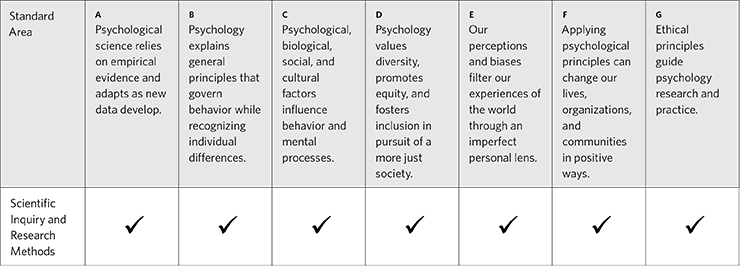
Biological Pillar
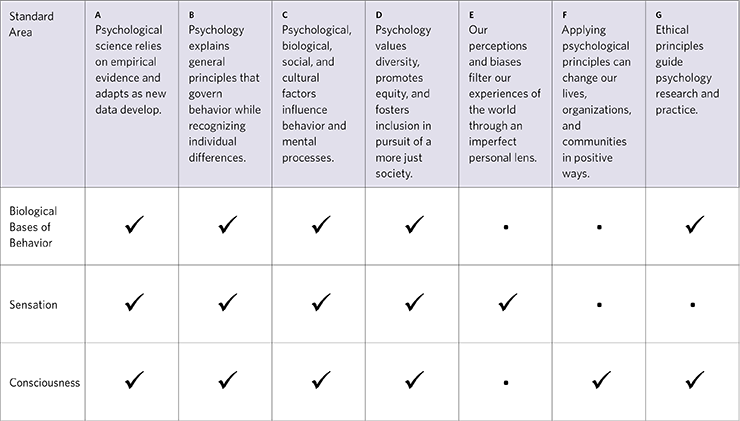
Cognition Pillar
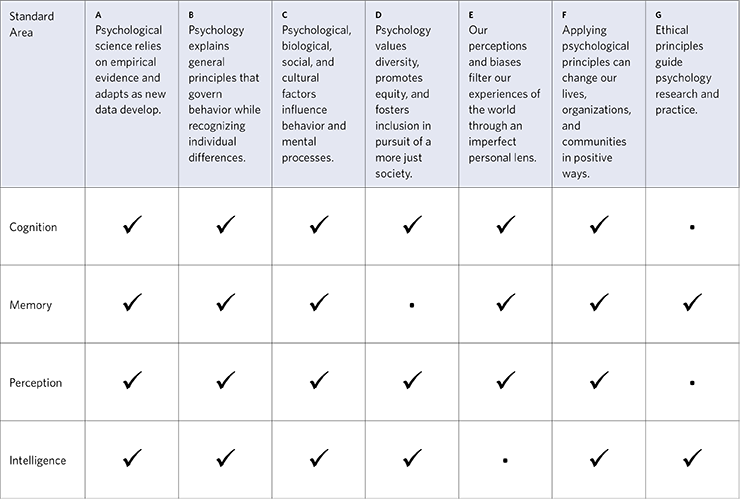
Development and Learning Pillar
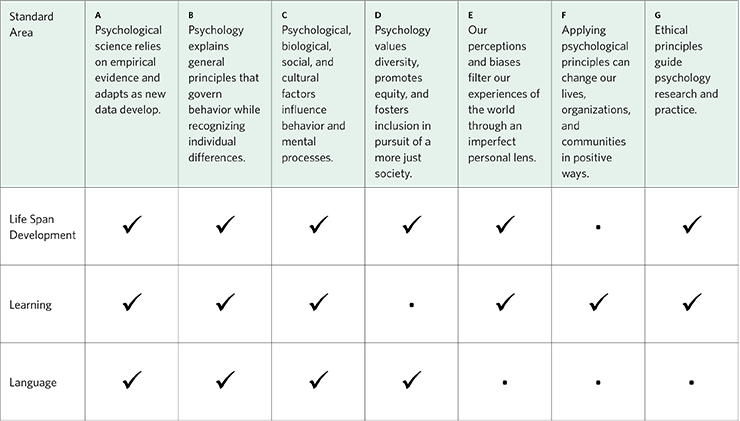
Social and Personality Pillar
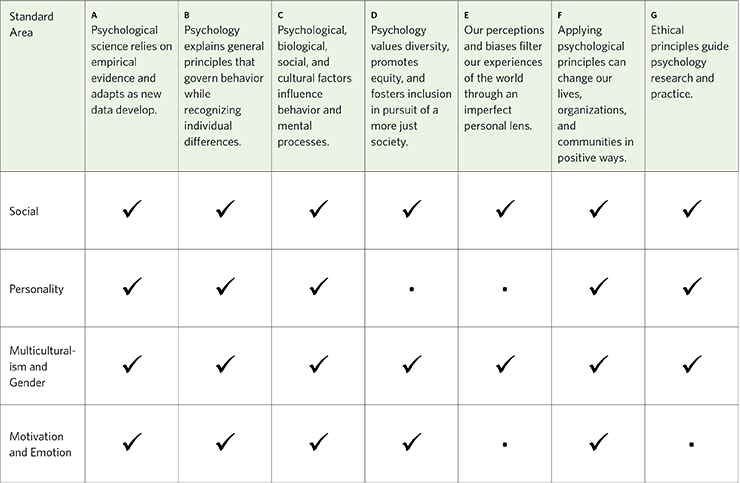
Mental and Physical Health Pillar
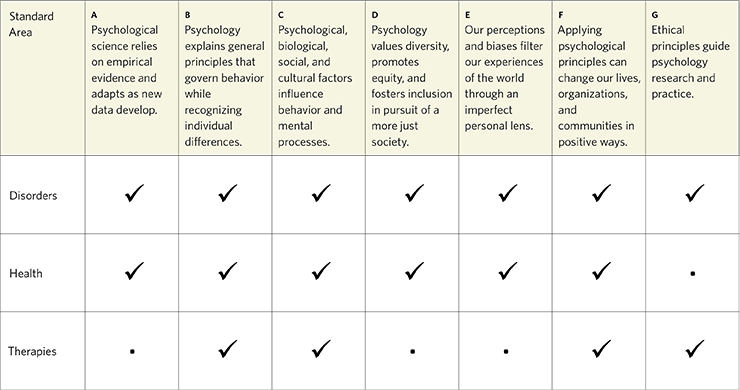
References
American Psychological Association. (n.d.) The APA Introductory Psychology Initiative (IPI) Course Design Suggestion to Use Psychology’s Integrative Themes. https://www.apa.org/ed/precollege/undergrad/introductory-psychology-initiative/course-design.pdfopens in new window
Halonen, J.S., Thompson, J.L.W., Whitlock, K. H., Landrum, R.E., & Franz, S. (2021). Measuring Meaningful Learning in Introductory Psychology: The IPI Student Learning Outcomes. In R. A. R. Gurung & G. Neufeld (Eds.), Transforming introductory psychology: Expert advice on teacher training, course design, and student success (pp. 57-80). American Psychological Association.
Appendix B
How to use the National Standards for High School Psychology Curricula in day-to-day lesson plans
Accountability legislation typically demands that teachers demonstrate how their lessons and courses align with local, state, and national standards. Some local school districts and state boards of education have adopted standards for teaching high school psychology that are based on this Standards document. Along with, or in the absence of, local or state guidelines for teaching high school psychology, teachers can use these Standards as a starting point for daily lesson planning, after scope and sequence for the course are determined.
The APA Introductory Psychology Initiative (IPI) has worked to develop a course framework that guides teachers to develop a more integrated approach to instruction. Since the first course in psychology is usually a survey-of-the-discipline course, a common approach to instruction involves teaching content areas of psychology as being independent of each other. Students may get the impression that social psychologists don’t consider biological bases of behavior in their work, or that cognitive psychologists rarely delve into group dynamics. In reality, psychology content is interwoven and overlapping.
To combat the misconception that psychology comprises several siloed content areas, the IPI framework—incorporated in these Standards—emphasizes several Integrative Themes in psychology that can be illustrated across various content areas. The Integrative Themes are designed to be the enduring lessons students can take away about the discipline of psychology from the introductory course. Thus, the content covered in each lesson should be explicitly connected to one or more Integrative Themes. To be clear, the Integrative Themes could be used in every unit and in every lesson, depending on the activities or assessments the teacher chooses to use. Which theme(s) are highlighted in each lesson is the teacher’s choice. We recommend that teachers strive to include at least one or more of these themes in each unit so students will come to understand by the end of the course that psychological knowledge is interconnected.
In addition, the IPI proposes a set of student learning outcomes that serve to identify the skills students should gain by taking a first course in psychology, as described in the Executive Summary. These learning outcomes form the basis for how teachers can assess students’ understanding of what they learn. Just as the Integrative Themes can be used in every unit, so, too, can the learning outcomes. Teachers should consider activities and assessments for class that challenge students to demonstrate these learning outcomes in every unit. This way, teachers and students can be more confident of what students have learned throughout the course.
Many other resources can help build the standards into an effective course. The APA Education Directorate and the APA Teachers of Psychology in Secondary Schools (TOPSS) have been especially active in publishing a series of unit lesson plans designed to help instructors teach a scientifically based course. Each of these plans contains a suggested procedural outline, a content outline, activities, critical-thinking exercises, discussion questions, and a bibliography. As they are developed, these unit plans are posted online and shared with TOPSS members. Previously published units are available online through the TOPSS website.
In addition, APA is a rich resource for enhancing a person’s own knowledge of psychology and for enriching course content for high school students. Becoming an APA High School Teacher Affiliate/TOPSS member can be beneficial because APA resources can be key tools for planning, preparing, and teaching a high school psychology course. TOPSS provides high-quality curricular materials, as well as a professional connection with other high school psychology teachers and a variety of student-oriented benefits, among other things. Appendix C provides additional information about TOPSS.
Teachers can also use materials provided with psychology textbooks. Most textbooks have an extensive package of materials that can be used to teach content more effectively. Perhaps the most helpful of these materials is the instructor’s manual, which generally contains background information for the concepts covered in the text, lecture ideas, and suggestions for activities, demonstrations, and assignments. The usefulness of this information may vary, and one way to help select the most valuable information is to use the instructor’s manual in conjunction with these standards. Time is at a premium for most teachers, so the standards can be helpful in choosing what to emphasize. Ideally, the teacher can relate every class activity to these standards.
From online resources to listservs to social media, technological resources also provide teachers with support in the form of specific classroom activities and can be used in conjunction with these standards. Technology and software can enhance the teaching of high school psychology by promoting active learning; most of the major textbook publishers have developed software to accompany their introductory psychology textbooks, and other distributors have marketed relevant software. Listservs and social media provide teachers with the opportunity to communicate with other teachers with relative ease and convenience and are an excellent way to get answers to questions about the teaching of psychology. Appendix C contains information on several online resources and provides examples of several listservs that are of particular interest to psychology high school teachers.
The best thing for a teacher to do is to start with the basic framework provided by the standards to determine which parts of the textbook will be taught. The teacher needs to explore other sources of information to continually refine and improve the psychology course. Teachers should use materials and activities that align to the standards suggested in this document so that students can experience a high-quality introduction to the science of psychology.
This appendix contains a Lesson Planning Sheet to help connect teachers’ present teaching strategies and materials to the psychology curricula standards and to help teachers develop new lessons designed specifically to meet one or more learning target(s). The format of the sheet makes it possible to integrate the standards quickly and efficiently into the curriculum in a practical, useful way. To show how the Lesson Planning Sheet might be used, a blank planning sheet and a sample lesson are included at the end of this section.
Suggested scope and sequence for a high school psychology course
Deciding what to teach and when to teach it is the first decision teachers face in any course, and psychology is no exception. Psychology teachers have many options for determining the scope and sequence of their courses based on the standards contained in this document. Ideally, psychology should be a yearlong course covering all units within each standard area relatively equitably. In a yearlong course, teachers can take roughly two weeks to teach each standard area, thus providing enough time to cover the material adequately and leave time for discussions, active learning, and inevitable interruptions in school schedules.
Not all teachers, however, have the luxury of teaching psychology as a yearlong course. Block scheduling and scheduling priority for required courses may leave schools that want to offer psychology little choice other than to offer it as a one-semester course. A one-semester course challenges a teacher’s ability to spend sufficient time to teach units (i.e., standard areas) that enable students to achieve all the standards. However, the standards do provide flexibility for teachers whose schedules are limited. The authors and editors of the psychology curriculum standards recommend that teachers design courses to highlight the Foundation of Scientific Inquiry and Research Methods as well as units from each of the five core pillars (i.e., Biological Pillar, Cognition Pillar, Development and Learning Pillar, Social and Personality Pillar, and Mental and Physical Health Pillar) found in the standards. Designing a pillar-driven course gives teachers creative avenues to solve the scope-and-sequence problem in semester courses. The pillar-driven course also exposes students to the diversity of scholarship in psychology. As indicated in the Pillar Model (see Introduction), the National Standards Working Group has also recommended specific Standard Areas that should be considered a priority when courses are limited for time. These priority areas are Scientific Inquiry and Research Methods, Biological Bases of Behavior, Cognition, Memory, Life Span Development, Learning, Social, Multiculturalism and Gender, Disorders, and Health.
Previous versions of the National Standards have provided sample course outlines to provide suggested scope and sequence for a high school psychology course. Given the 10 priority unit areas listed above, the National Standards Working Group decided not to provide course outlines here. However, teachers can refer to sample pacing calendars the APA TOPSS Committee has made available to teachers.
Curricular decisions are made for a variety of reasons. For example, instructors may choose to put the areas that they are most comfortable teaching earlier than other areas. Alternatively, the choice may be made to time content areas to correspond with related current events (e.g., aligning the Life Span Development lessons to occur shortly before graduation). An instructor whose students participate in a science fair may choose to emphasize units that seem most likely to generate ideas for research projects. No matter which unit order instructors choose, or how many units they teach, they can cover psychology at an appropriate level and with appropriate breadth by structuring the course around the 10 priority units.
Lesson planning sheet
Standard Area (Unit Name):
Domain:
Targeted Content Standard(s):
Targeted Learning Target(s):
Performance Objective:
Materials Needed:
Notes:
Sample lesson planning sheet
Standard Area (Unit Name): Health
Pillar: Mental and Physical Health
Targeted Content Standard(s):
Content Standard: Stress and Coping
Targeted Learning Target(s):
1.2 Explain sources of stress across the life span
- Teaching strategy to be used: Discussion of stress across the life span and its sources
- Assessment technique: Relevant activity
- Estimated time required: One period of class time and out-of-class assignment
Materials Needed: Materials for activity
Notes:
Achieving proficiency in teaching high school psychology
Teacher certification in psychology should be addressed by each school district in which psychology is taught. The first step for each district is to determine whether present teachers of psychology meet the certification requirements for its state board of education.
Certification requirements for psychology teachers vary widely from state to state (see Weaver, 2014). Some states have no specific requirements, and others require a certification in psychology. The purpose of this document is not to supersede previous state board of education mandates. Rather, it is intended to inform:
- Teachers and future teachers who are trying to determine whether they have the recommended background in the discipline necessary to teach a scientific psychology course
- School districts preparing to offer their first psychology courses
- School districts seeking to provide germane in-service opportunities for their experienced psychology teachers
In 2012, APA approved a policy document entitled Guidelines for Preparing High School Psychology Teachers: Course-Based and Standards-Based Approaches that provided models for teacher preparation based upon the National Standards. APA advocates that state departments of education and teacher preparation programs use or adopt these models for preparing new high school psychology teachers and recommends that all states offer and require a psychology teaching credential for psychology teachers. APA’s Advocacy Toolkit for the Psychology Teaching Credential provides guidance, recommendations, and scripts for those interested in encouraging states to develop a required psychology teaching credential for high school psychology teachers.
The ever-changing nature of psychology requires continuing education for all high school psychology teachers. Many teachers may be deficient in one or more of the domains listed in this document. Teachers who are not as well prepared in these areas can take college courses aimed at eliminating the particular deficiency or enroll in one of the many psychology teacher workshops held throughout the country. For more information about workshops or professional development opportunities for high school teachers, visit the APA TOPSS website or contact the Education Directorate of the American Psychological Association at 750 First Street, NE, Washington, DC, 20002–4242, (800) 374-2721 or (202) 336-5500 or by email (topss@apa.org).
Reference
Weaver, K. A. (2014). Credentialing high school psychology teachers. American Psychologist, 69(6), 612–619. https://doi.org/10.1037/a0036574opens in new window
Appendix C
Resources for high school psychology teachers
A broad range of resources designed to support and enhance the teaching of high school psychology are available through the American Psychological Association. The APA Teachers of Psychology in Secondary Schools (TOPSS) website provides teachers with resources that include:
- A resource manual for new teachers of high school psychology
- Unit lesson plans, including three to seven lesson unit plans, two-day lessons from award-winning teachers and lessons on metacognitive, transferrable, and well-being skills
- A vetting rubric for classroom resources and activities
- A teaching activities database
- A customizable course template, available in Canvas
- An assessment guide for psychology teachers and links to APA’s Project Assessmentopens in new window
- The APA’s Online Psychology Laboratoryopens in new window, which offers students opportunities to participate in studies and engage in data analysis
- Video presentations by master teachers and expert psychologists
- A diversity self-reflection tool for teachers
- Sample pacing calendars
- Current and past issues of the Psychology Teacher Network news digest
- Resources for students, including a video on the value of taking a psychology course in high school and information about student research, competitions, awards, and science fairs
- Items for professional growth and development, including information on upcoming workshops and conferences for high school psychology teachers
- Information on TOPSS, including how to join
Several of the resources above were developed at the APA Summit on High School Psychology Education, held at Weber State University in July 2017. Teachers can find resources developed at the summit on science, skills, assessment, credentialing, professional development, diversity and access, and technology and online learning on the TOPSS website. Resources will be updated on an ongoing basis.
High school psychology teachers can join APA as High School Teacher Affiliates. High School Teacher Affiliates automatically become members of TOPSS, the voice of high school psychology teachers within the APA. Benefits of teacher affiliate status with APA include an electronic newsletter from the TOPSS chair; yearly subscriptions to the monthly APA Monitor on Psychology magazine, the renowned American Psychologist journal, and the Translational Issues in Psychological Science electronic journal; discounts on APA books and journals; access to online databases; discounted registration fees to the annual APA convention; and multiple opportunities to network with other psychology teachers and professionals. Teachers can also opt-inopens in new window to receive the Psychology Teacher Network quarterly news digest and other APA newsletters. For information on joining APA as a High School Teacher Affiliate, visit the APA website; teachers can also contact the APA Membership Department by email or telephone at (800) 374-2721, or via 750 First Street, NE, Washington, DC, 20002.
Additional APA resources to support the teaching of high school psychology include:
- Information about the subfields of psychology and potential career paths
- An overview (PDF, 55KB)opens in new window of generalizable career skills students learn from psychology
- Resources on bringing diverse voices and perspectives into teaching
- Resources on international issues in psychology, such as from International Psychology (APA Division 52)opens in new window and the Society for the Teaching of Psychology’s (APA Division 2) International Committeeopens in new window
High school teachers of psychology may also want to:
- Subscribe to APA’s podcast, “Speaking of Psychology”
- Follow TOPSSopens in new window and APAopens in new window on Facebook
- Follow APAopens in new window on Twitter
APA has a voice in multiple social media platforms, and teachers of psychology are encouraged to follow or subscribe to social media feeds of interest.
Electronic mailing lists
The following lists are of particular interest to psychology teachers:
- APA TOPSS has an electronic mailing list for high school psychology teachers. You do not need to be a TOPSS member to subscribe. To subscribe to the TOPSS electronic mailing list, visit the listserv websiteopens in new window .
- DIV2PSYCHTEACHER is a moderated discussion list for teachers of psychology at all levels of education that is owned and operated by the Society for the Teaching of Psychology (STP; APA Division 2). The STP Executive Director will also post announcements relevant to STP’s mission, such as calls for applications for leadership positions in STP and affiliated organizations (e.g., APA); announcements of teaching conferences, resources, grants, and awards sponsored by STP or affiliated organizations; and general announcements relevant to STP’s service as APA Division 2. To subscribe to DIV2PSYCHTEACHER and to read the list guidelines and rules, visit hereopens in new window .
- Psych-News is designed for people interested in the teaching of psychology at the high school level. Most list members are high school psychology teachers, although many college and university teachers are members as well. To join Psych-News, send the message “subscribe Psych-News your name” to the listserv address .
Appendix D
Contributors to the National Standards for High School Psychology Curricula (2022 Revision)
National Standards for High School Psychology Curricula Working Group
Tina Athanasopoulos, Chair, Prospect High School, Mount Prospect, Illinois
Barney C. Beins, PhD, Ithaca College, Ithaca, New York
Stephen W. T. Foley, The Linsly School, Wheeling, West Virginia
Terri A. Lindenberg, Lake Park High School, Roselle, Illinois
Jennifer Simonds, PhD, University of Maryland Global Campus, Adelphi, Maryland
Samuel Y. Song, PhD, University of Nevada, Las Vegas, Las Vegas, Nevada
Terry Wick, Hartford Union High School, Hartford, Wisconsin
Amy C. Fineburg, PhD, The College Board, New York, New York (ex officio)
National Standards Advisory Panel (2018—22)
Joseph A. Allen, PhD, University of Utah, Salt Lake City, Utah
David F. Bjorklund, PhD, Florida Atlantic University, Boca Raton, Florida
Kimberly L. D'Anna-Hernandez, PhD, State University California San Marcos, San Marcos, California
Erika K. Fulton, PhD, Idaho State University, Pocatello, Idaho
Regan A. R. Gurung, PhD, Oregon State University, Corvallis, Oregon
Kevin Martin, Hartford Union High School, Hartford, Wisconsin
Richard L. Miller, PhD, Texas A&M University—Kingsville, Kingsville, Texas
Carlota Ocampo, PhD, Trinity Washington University, Washington, DC
Bonnie Perdue, PhD, Agnes Scott College, Atlanta, Georgia
Yadira Sánchez, PsyD, Duquesne University, Pittsburgh, Pennsylvania
Katherine Serafine, PhD, University of Texas El Paso, El Paso, Texas
Traci Sitzmann, PhD, University of Colorado Denver, Denver, Colorado
Keith A. Trujillo, PhD, California State University San Marcos, San Marcos, California
Jonathan Tullis, PhD, University of Arizona, Tucson, Arizona
Amy Lynn Young, PsyD, HSP, Spalding University, Louisville, Kentucky
Reviewers
Yazmin Aceves
Kelley Arredondo
Lara Bruner
Georgia Chao
Mat Clodfelter
Kelsie Colley
Sharon Gardner
Jennifer Gibson
Aaron Kraus
Melinda Mattes
Rob McEntarffer
Cynthia Otero-Niles
Sara Perry
Casey Swanson
Jennifer L. Thompson
Jennifer Wessel
Contributors
Mohd Anwar Jamal Faiz
Treva Daniels-Carlson
APA Governance review
APA Board for the Advancement of Psychology in the Public Interest
APA Board of Educational Affairs
APA Board of Scientific Affairs
APA Committee on Aging
APA Committee on Animal Research and Ethics
APA Committee on Associate and Baccalaureate Education
APA Committee on Early Career Psychologists
APA Committee on Human Research
APA Committee on International Relations in Psychology
APA Committee on Sexual Orientation and Gender Diversity
APA Committee on Psychological Tests and Assessment
APA Committee on Socioeconomic Status
APA Committee of Teachers of Psychology in Secondary Schools
APA Policy and Planning Board
APA Division 2 (Society for the Teaching of Psychology)
APA Division 5 (Evaluation, Measurement, and Statistics)
APA Division 20 (Adult Development and Aging), Education Committee
APA Division 30 (Society of Psychological Hypnosis)
APA Ethics Committee
APA Exploratory Committee on Applied Psychology
American Psychological Association of Graduate Students (APAGS)
Society for Qualitative Inquiry in Psychology (Section 3 of Division 5 of APA)
American Psychological Association, Washington, DC, staff
Catherine L. Grus, PhD, Education Directorate
Emily Leary Chesnes, Education Directorate
Robin J. Hailstorks, PhD, Education Directorate
Susan M. Orsillo, PhD, Education Directorate
Last updated: November 2022Date created: 2005