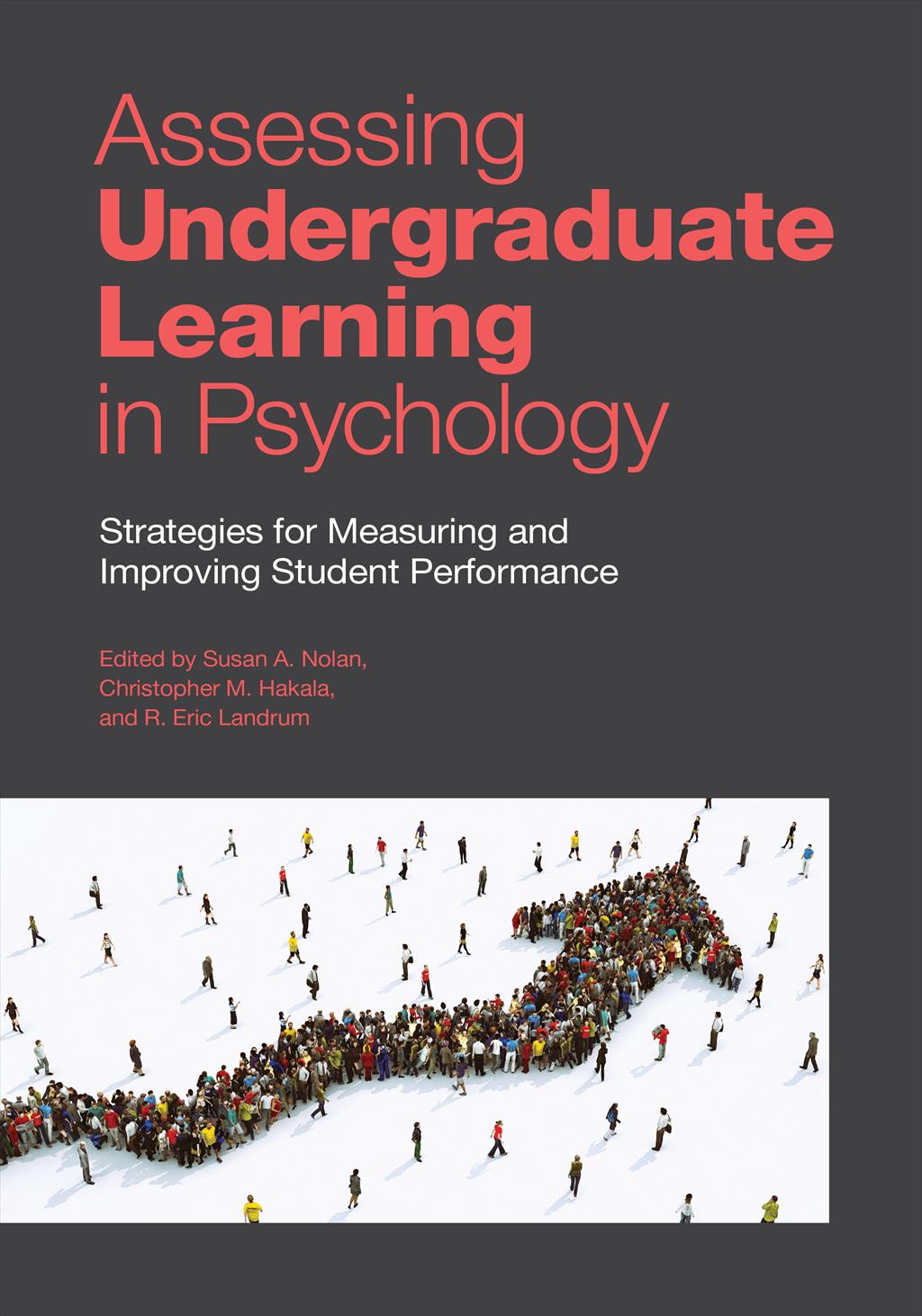
 Editors: Susan A. Nolan, Christopher M. Hakala, and R. Eric Landrum
Publisher: American Psychological Association
Copyright: 2021
ISBN: 978-1-4338-3227-7
Pages: 278
Price: $59.99 (members) $79.99 (nonmembers)
Assessing Undergraduate Learning in Psychology: Strategies for Measuring and Improving Student Performance (Nolan, Hakala, and Landrum, 2021) is a compilation of chapters on various aspects of assessment written by experienced educators from around the United States and the globe. The authors come from a wide variety of institutional types and educational organizations and are master teachers who have expertise in their specific area of assessment. The book is a useful volume since it is based on research as well as practical experience. The book focuses on assessment from the perspectives of the institution, the individual, and from the global perspective. Inclusion of the international perspective is enough to make this volume unique. However, the other two sections are relevant to anyone needing to assess their courses and their programs.
The editors begin with a discussion of the factors influencing the current state of assessment. They explain how assessment has changed from simply being grades in a course to a more comprehensive examination of what students are learning and how well programs educate their students. Assessment occurs at the course level, the departmental level, and the institutional level. Integrating and measuring student learning at all of these levels can be a complex undertaking that is often not readily accepted by all faculty. The editors admit that they hope this volume will spur academic discussions of assessment, not just complaining.
The first part of the book examines the institutional approach to assessment. In Chapter 1, “Scholarship of Teaching and Learning and Assessment,” Gurung presents an argument for using the scholarship of teaching and learning (SoTL) as the foundation for the scholarship of assessment. Having this research focus in Chapter 1 sets the tone for the volume. Assessment is not just something we do. It is something that can be studied scientifically and much of what is presented in this book is based on research. None of the chapters pretend to have all the answers or that their approaches to assessment are the only ones that work. I like this approach since the authors give the reader multiple ways to do assessment and they include specific examples that can be modified or copied. They also acknowledge that there are many ways to assess a program or a course. That said, they are firm about the need for, and the value of assessment at all levels. They are clear that assessment is now part of the education landscape and that it is not going away.
I was particularly interested in Chapter 3 by Jane Halonen and Dana Dunn on “The Sound and Fury of Academic Program Reviews.” They give a concise history of academic program reviews (APRs) as well as a description of the elements in most APRs. They have a clear explanation of challenges in accountability and how these can be addressed in an APR. Their chapter provides valuable information to anyone getting ready to undergo an APR. Often, departments are required to complete these studies but are given little direction. This chapter give a roadmap on how to do an APR and issues that are particularly salient.
Another chapter I found particularly relevant was Chapter 7, “Backward Design: The Science of Learning and the Assessment of Student Learning,” by Catherine E. Overson and Victor A. Benassi. This chapter delves into backward design and how the science of learning can be used to assess student learning. It includes specifics on ways to assess student learning and how such results can be used to improve course design and delivery. One strategy discussed was the use of online quizzes to improve student learning over the term. This chapter inspired me to revise my courses for Spring term. I am going to incorporate more self-scoring quizzes, with multiple attempts, and examine how final exam scores change.
Part Two reviews individual approaches to assessment. The authors examine assessment as pedagogical science, using data to improve teaching and learning, and evidence-based teaching and course design. Part Three concentrates on international approaches to assessment. These chapters examine the assessment of learning objectives, design decisions, and innovations in assessment. It is comforting to see that the challenge to better assess our work and our students is universal. I found the chapter on measuring generic skills (Chapter 14 by Doris Zahner, Dirk Van Damme, Roger Benjamin, and Jonathan Lehrfeld) especially interesting since my institution struggles to effectively measure our general education objectives.
This edited volume has relevance for all levels of teaching in psychology and for many other disciplines. It could be useful to a secondary school teacher as well as someone teaching at an R1 institution. It covers many aspects of assessment and the techniques discussed could be utilized in any course or at any institution. It is a useful volume for someone new to assessment since it covers the breadth of the field. It also is useful to someone already involved in assessment since it includes specific techniques. I found many chapters would be helpful if trying to convince an administrative committee to begin or change some aspect of assessment at an institution. The volume would be especially helpful for the graduate student who is planning to teach. The overview of assessment and the specifics would give them a good introduction to the field of assessment.
The book is easy to read while still being couched in research. It is a welcome addition to the literature on assessment.