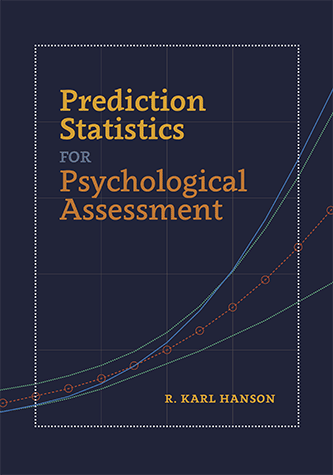
Prediction Statistics for Psychological Assessment
ISBN: 978-1-4338-3641-1Available formats
Also available from
At last, a comprehensive guide that meets psychologists and other social scientists’ growing need to master the tools of statistical prediction.
Prediction Statistics for Psychological Assessment, by R. Karl Hanson, is the first book to teach students and practitioners the nuts and bolts of prediction statistics, while illustrating the utility of prediction and prediction tools in applied psychological practice.
This valuable resource uses real-world examples, helpful explanations, and practice exercises to support the use of prediction tools in psychological assessment.
Actuarial risk assessment evaluators need to know how prediction tools work, how to evaluate them, and how to interpret their results in applied assessments.
Written in a clear and accessible manner, this user-friendly book helps readers understand how to evaluate and interpret different kinds of prediction tools, appreciate the numeric information used in risk communication, and utilize prediction tools to inform evidence-based decision-making.
Preface
Part I: Background and Overview
- Chapter 1: Introduction
- Chapter 2: The Nature of Probability
- Chapter 3: Overview of the Statistics Chapters
Part II: Statistics for Describing Likelihoods
- Chapter 4: Proportions
- Chapter 5: Discrete Time Survival Analysis
- Chapter 6: Kaplan-Meier Survival Analysis
Part III: Discrimination and Relative Risk
- Chapter 7: Dichotomous Predictors
- Chapter 8: Area Under the Curve
- Chapter 9: Cohen's d
- Chapter 10: Cox Regression
- Chapter 11: Logistic Regression
Part IV: Calibration
- Chapter 12: Chi-Square Goodness-of-Fit
- Chapter 13: The E/O Index
- Chapter 14: Meta-Analysis
- Chapter 15: Calibration Plots
Part V: Percentile Ranks
- Chapter 16: Percentiles
Part VI: Practice Considerations
- Chapter 17: Estimating the Quality of Prediction Tools
- Chapter 18: Standardizing Risk Communication
- Chapter 19: Going Even Further
References
Appendix A: Glossary
Appendix B: Useful Algebra and Notation
R. Karl Hanson, PhD is an adjunct research professor at Carleton University, Ottawa, Canada, and formerly a researcher with Public Safety Canada from 1991-2017. His research concerns risk assessment and rehabilitation for individuals in the criminal justice and forensic mental health systems, with a particular focus on sexual offenders. He has a strong interest in the statistical methods used to quantify risk and to evaluate change over time.
Follow Dr. Hanson on Twitteropens in new window or visit the Carleton University websiteopens in new window for more information.
Welcome to the supplemental materials for Prediction Statistics for Psychological Assessment. This webpage contains the syntax and datasets for those interested in completing the computer exercises located throughout the book. The datasets have been organized by chapter for your convenience. Please note these datasets are offered for your personal use. If you reuse or adapt them for publication, permission is required from the publisher. © 2022 American Psychological Association.
R Code (DOC, 39KB)opens in new window
SPSS Syntaxopens in new window (Contains SPSS syntax from multiple chapters)
Chapter 4 – Proportions
Chapter 5 – Discrete-Time Survival Analysis
Chapter 6 – Kaplan–Meier Survival Analysis
- Chap6_KM_example.csvopens in new window
- Chap6_KM_example.savopens in new window
- Chap6_KMoutdata.tableopens in new window
Chapter 7 – Dichotomous Predictors
Chapter 8 – Area Under the Curve
- Chap8_AUC_example.csvopens in new window
- Chap8_AUC_example.savopens in new window
- Chap8_AUC_exercise.savopens in new window
Chapter 9 – Cohen’s d
- Chap9_d_example.savopens in new window
- Chap9_example.tableopens in new window
- Chap9_no_relapse.csvopens in new window
- Chap9_relapse.csvopens in new window
Chapter 10 – Cox Regression
Chapter 11 – Logistic Regression
Chapter 12 – Chi-Square Goodness-of-Fit
Chapter 13 – The E/O Index
- Chap13_EO_example.savopens in new window
- Chap13_EO_KM_example.csvopens in new window
- Chap13_EO_KM_Question2.csvopens in new window
- Chap13_Table2.savopens in new window
Chapter 15 – Calibration Plots
- Chap15_Fig2.tableopens in new window
- Chap15_Fig3.tableopens in new window
- Chap15_Fig4.tableopens in new window
Chapter 16 – Percentiles