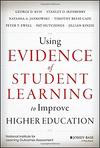
 Authors: George D. Kuh, Stanley O. Ikenberry, Natasha A. Jankowski, Timothy Reese Cain, Peter T. Ewell, Pat Hutchings, and Jillian Kinzie
Pages: 275
ISBN: ISBN 978-1-118-90339-1
Publication date: 2015 (San Francisco: Jossey-Bass)
Use It or Lose It
Assessment enthusiasts have some champions in the new text written by a team of scholars from the National Institute for Learning Outcomes Assessment headed up by George D. Kuh. "Using Evidence of Student Learning to Improve Higher Education" delivers what it promises — a major effective reframing of how to think about and implement strategies for student learning assessment.
The scholars involved in the project have impressively long histories of promoting high quality educational experience. Their scope of experience is expressed in chapters that fluidly combine and recombine their voices to make a compelling argument about what will be necessary to elevate the assessment conversation to fulfill its promise in higher education.
The text provides a comprehensive history of the assessment movement in higher education, including its intricate connections with various stakeholders, such as accrediting agencies and legislators. The authors collectively bemoan the fact that the mission of assessment — the improvement of learning — has not yet reached its potential. They propose what will be required is assessment programs that have real consequences if faculty are going to assert ownership of the activity. The authors offer practical advice about the essential components that will give assessment much-needed traction.
In the early days of the assessment movement, I used to state with some confidence that if faculty were doing a good job, they really had nothing to fear from assessment. I’m sorry to say that confidence has been shaken by years of experience in which good assessment reports can easily be ignored and bad assessment reports don’t inspire change from anyone involved in the process. The book represents a call to action to produce consequences that can create real change.
The primary argument in the book is on target. Assessment activities have become a central feature in the higher education landscape, but their effectiveness has been compromised. Institutions across the country have embarked on ambitious assessment plans in which data are collected on many dimensions regarding what happens in college classrooms and co-curricular contexts. However, it is clear that those activities appear to be driven by satisfying stakeholders rather than legitimately answering questions about ways to improve learning success for students. The authors collectively argue that this next era of assessment must move out of a compliance frame of mind to a new motivation that focuses on using the data to create real improvements in student learning.
What complicates the development of a true culture of evidence is that faculty differ in their responsiveness to assessment. As an assessment consultant, I’ve experienced the range of responses one might expect about this important driver of faculty activity. Out of that experience, I’ve developed a taxonomy to describe faculty receptivity (Halonen, 2016). Many faculty remain outright hostile to assessment initiatives of any kind; some express that they hope they can retire or even die before they get drawn in or have to contribute to a departmental assessment plan in any time-consuming fashion. Assessment resistant faculty reluctantly work on initiatives but harbor ill feelings about assessment as a distraction rather than a support for their important work. In the assessment neutral category, well, there is no one in that category.
Collectively, those three categories represent what I like to refer to as a “modern” sensibility about higher education. They tend to reflect fond reminiscence of a time when faculty life was less complicated, more private, and more supportive of faculty operating more individualistically.
The remaining categories in my taxonomy represent a “postmodern” orientation, meaning that the faculty understand that a different approach is needed in contemporary higher education. Postmodern faculty accept the complexity, recognize that much of what will transpire may have an absurd quality, and embrace the idea that it will be hard to manage within a culture of evidence alone. It is the postmodern faculty person who will find this book most useful. That group includes those who are assessment enthused, faculty who are at least willing to entertain that assessment may hold value for their professional decisions. Those who are energized by assessment see incorporating such activities as a natural fit for answering questions about their own effectiveness in the classroom. For this group, assessment is not an add-on, but a natural outgrowth of their own curiosity regarding the effectiveness of their colleagues and their own performance.
More recently, I’ve also seen the emergence of a sixth group — the assessment possessed — those for whom assessment activities may actually eclipse the importance of teaching and learning. The act of collecting data borders on the monomaniacal and, in fact, may not translate to meaningful change due to the energy draining activity of gathering every possible bit of performance data.
Therein lies the chief problem with the book. It will very much appeal to postmodern faculty, those who believe in assessment as a useful tool. But the individuals who would benefit most are unlikely to review the work without some kind of incentive that would make their teaching lives easier. I would have enjoyed an elaboration of strategies for helping to convert the naysayers. The concept of initiative fatigue does help to explain why faculty would choose to remain unengaged. They simply need to wait until the next new initiative is rolled out because perhaps the current one will fade. However, assessment is simply not going to fade, and to ignore it now generates risk both for unengaged faculty members and the programs that employ them.
Another useful addition to the volume would have been a more detailed discussion of the contemporary political landscape in higher education and the dynamic tensions that exist between performance metrics. For example, in my own state of Florida, the legislature appears to change the rules of what counts in performance funding metrics every year. Most of the metrics focus on things that are easy to count (e.g., retention and graduation statistics), but keeping up with changing requirement diverts attention and distracts us from the more serious and more challenging goal of improving high quality educational experience. Consequently, chasing moving targets may legitimately compromise or undermine even the most solid assessment initiatives.
However, these are relatively minor criticisms in contrast to the overall value of understanding what will be required for faculty to become and remain energized. The volume itself should be an important addition to the libraries of those charged with assessment responsibilities. The emphasis on selecting meaningful assessment strategies, communicating them effectively and engaging stakeholders provides some hope for assessment friendly faculty to help maintain their receptivity.
A final comment focuses on the particularly appealing feature in the structure of the book of tone-setting quotations used to start each chapter. Not only do the quotes aptly focus on the fundamental issue described in their respective chapters, but the range of experts cited includes, among others, W. Edwards Deming, Lao-Tsu, faculty curmudgeons, Henry Ford, C.S. Lewis, Sydney J. Harris, Yogi Berra and Laura Ingalls Wilder, among others. That mix is fitting and appropriately entices the reader to want to explore the chapter.
I remain hopeful that in the next era of assessment, we may be able to move away from compliance motivations to having the collectivist fun that comes from generating evidence of our own effectiveness and then using our findings to promote improvement. Our strategies need to allow some leeway and encouragement to face what needs to be changed with courage to implement necessary changes. I congratulate the authors (George D. Kuh, Stanley O. Ikenberry, Natasha A. Jankowski, Timothy Reese Cain, Peter T. Ewell, Pat Hutchings and Jillian Kinzie) for their exemplary contributions to that noble outcome.
Reference
Halonen, J.S. (2016, March 5). A little history goes a long way. Presentation at the annual meeting of the Eastern Psychological Association, New York.
This review was originally published by PsycCRITIQUES. Copyright © 2016 American Psychological Association.