

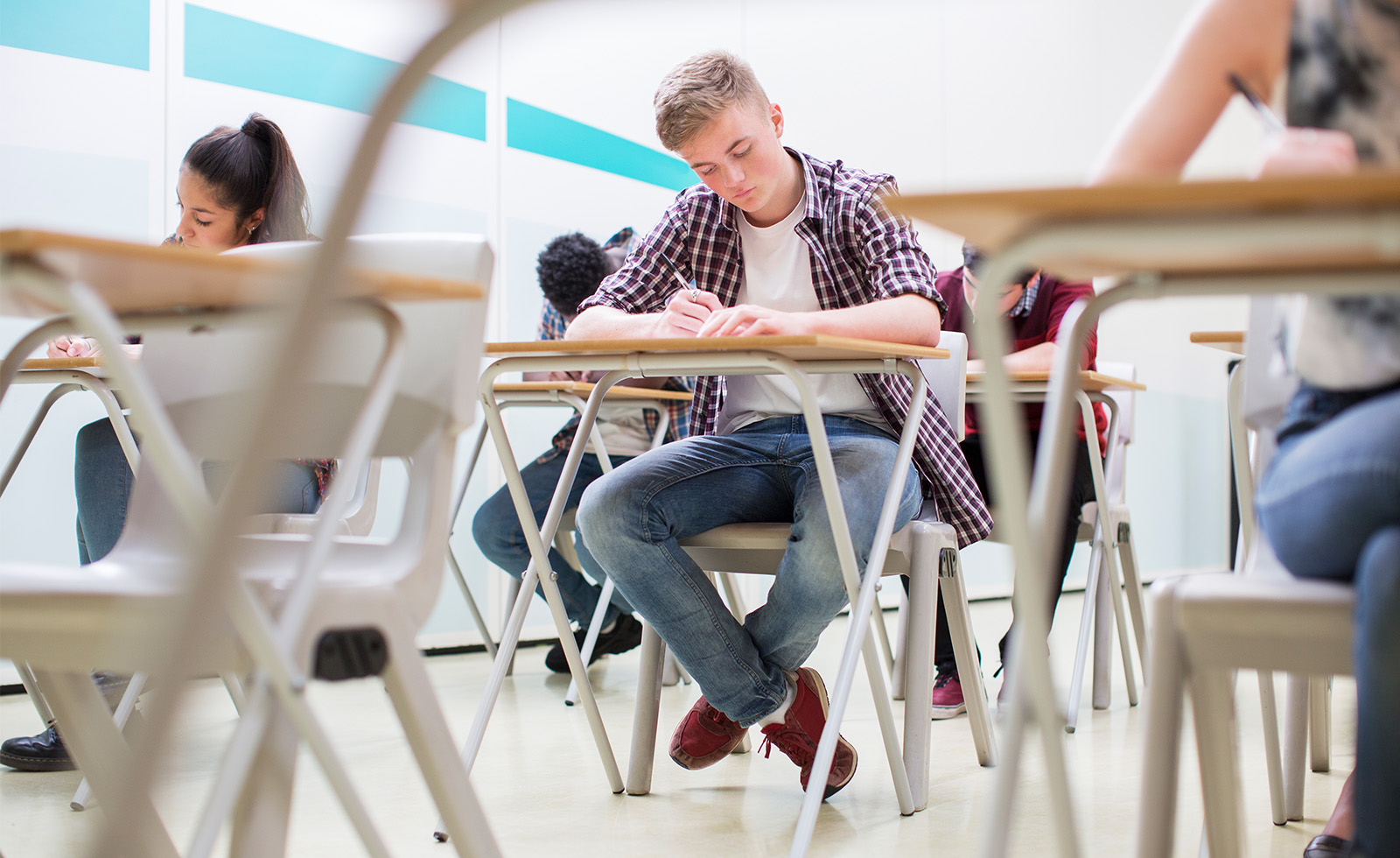
We now turn our attention to the high school psychology course. Psychology has been a part of the high school curriculum since the 1830s (Benjamin, 2001), and by the late 1950s psychology courses were being taught in 49 of 50 states (Thornton & Clover, 1967). The high school psychology course began as an examination of personal adjustment issues, rather than a course centered on a scientific approach to the study of behavior and mental processes (Benjamin, 2001; Keith, Hammer, Blair-Broeker, & Ernst, 2013). Indeed, the high school psychology course often ended up in social studies and social science departments rather than in science departments. Since the late 19th century there has been a slow but steady shift from the teaching of psychology as adjustment to the teaching of psychology as science, but there has not been a corresponding shift moving the course to the science department.

In 1992, the APA Teachers of Psychology in Secondary Schools (TOPSS) was founded. As the voice for high school psychology teachers at the APA, TOPSS’ primary mission is to promote the highest standards in teaching of psychology both as a science and discipline.
The Advanced Placement Psychology Examination was also first administered in 1992. Exam questions assess students’ understanding of central psychological concepts and the scientific methods linked to the various subfields in psychology (Keith et al., 2013).


By the year 2000, over a million students a year were taking high school psychology courses (Ernst & Petrossian, 1996).

In 2009, the most recent year of available data, the National Center for Education Statistics reported that 30 percent of graduating students earned credits in a psychology course during their four years in high school (U.S. Department of Education, 2011). These numbers were corroborated by The College Board, which reported that 32 percent of all graduating high school students in 2015 who took the Scholastic Aptitude Test (SAT) took a psychology course during high school (College Board Research & Development, 2015).

In 2018, over 313,000 students took the Advanced Placement (AP) Psychology exam, compared to about 4,000 in 1992. As of 2018, Psychology was the 6th largest AP exam. More students take the AP Psychology exam than take any of the AP Science courses (College Board, 2018).
Over 21,000 students took the International Baccalaureate (IB) Psychology Examination in 2018.
Although the number of students exposed to high school psychology continues to increase, there is an apparent inconsistency between the scientific nature of the field and its role in K-12 education. According to an APA survey conducted in 2016, approximately 80 percent of high school students who complete a psychology course earn social studies credit rather than natural science credit toward high school graduation because the course is taught in the social studies department (APA, 2016).
Teacher Training and Certification
Teacher training and certification also reflects the impact of the social studies department, where psychology teachers are placed 90 percent of the time (APA, 2016). As reported in an APA survey conducted in 2016, only one percent of the teachers teaching high school psychology report being certified to teach science. An additional 24 percent report specific certification in psychology. However, the requirements for this certification vary widely from state to state (Weaver, 2014). Many high school psychology teachers have worked hard to prepare themselves to teach the course, but there is a need to make sure that all teachers in the course have the preparation to do the job well. That does not appear to be the case at the present time, given the current credentialing status in the United States where 24 states have no psychology teaching credential and 14 states do not require the psychology teaching credential to teach the course (see Weaver et al., 2018, for additional information).
Instructors teaching natural science courses can consult the Next Generation Science Standards (NGSS) in designing curricula (NGSS Lead States, 2013). The National Research Council, in its Framework for K-12 Science Education: Practices, Cross-Cutting Concepts, and Core Ideas, acknowledges that psychology as a discipline, along with other social and behavioral sciences, is closely allied to the other sciences (National Research Council, 2012). This group did not develop specific standards for psychology due to a lack of psychology content in grades K-8 (the NGSS cover all of K-12) as well as the intended scope of the document. Groups such as TOPSS, the APA Summit on High School Psychology Education participants, and the Society for the Teaching of Psychology can provide leadership for the teaching of psychology as a science, focusing on the processes involved in studying behavior and cognition as an empirical discipline. Indeed, the current APA National Standards Working Group (2018-21) plans to align psychology to the cross-cutting concepts and science practices from the NGSS as it develops the next revision of the high school psychology standards by 2021.
Scientifically-based courses assist in educating the public about psychological science.
Positive Outcomes of Teaching Psychology as Science
Enhancing the scientific basis of high school psychology courses yields a number of benefits. Scientifically-based courses:
In this report
Information contained in this report does not represent the official policy of the American Psychological Association.