You could say the basis of William Chopik's flourishing career as a research psychologist is his love of a good story. He wants to find out who gets the girl, and why; whether the solider home from battle can find solace with his family; if the shallow young woman can learn to be a true friend; and why there's so much variation in how it all turns out in the end.
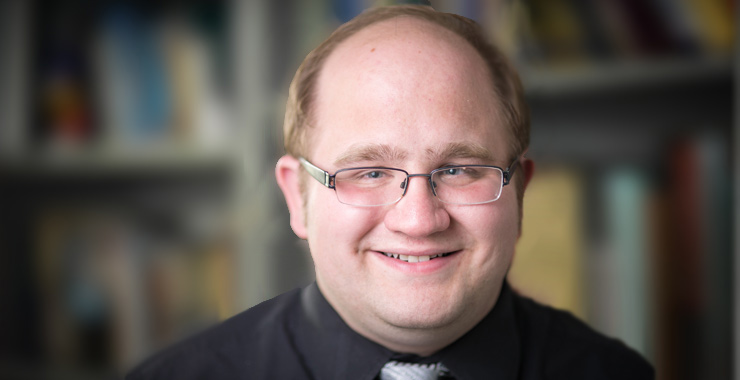
Chopik,opens in new window an assistant professor and director of the Close Relationships Labopens in new window at Michigan State University in East Lansing, studies relationships and, especially, how they change.
"The overall goal is to try to get people to have happier lives and relationships, but maybe there are different ways to go about that," he says.
Just 30 years old, Chopik is already a seasoned researcher. He has an ingenious approach that sometimes involves using data or investigating phenomena other scientists have overlooked.
For example, he used the massive, publicly available World Values Survey (WVS)opens in new window for a 2017 analysisopens in new window he did that produced the surprising insight that investing in friendships as we get older may be even better for our health than maintaining family ties. That may be true in part because, in contrast to family, we get to curate our friends and, to an extent, the experiences we share with them, he says.
Of the WVS, conducted since 1981 in nearly 100 countries with people of all ages, Chopik says its data is often used to assess political and cultural views, but to him, the survey was a treasure trove of material on attitudes toward human connection. That openness to looking at just about everything through the lens of relationships is one reason Chopik has become an influential figure in his field.
"I've had really good collaborations and supportive mentors," he says. "Part of it is luck. Part of it is having an intuition for what some important questions are, and how to test them, and having good data available."
Friendship has not been studied nearly as often as familial or romantic relationships, Chopik says, and he finds that "really kind of shocking. Part of the point of my research is to show that these things are worth thinking about. There's all sorts of friendships, but describing what they're like, how they benefit us, how they maybe harm us sometimes — I think that's worth doing."
Chopik has ranked countries in terms of how empathetic their citizens are — the United States was in the top ten, but is becoming more individualistic than it has been in the past, his team noted. Chopik also fears that the divisive political climate in our country right now may be throwing up serious barriers to making and maintaining relationships.
Finding love and friendship is hard enough as it is; whole industries have grown up to help. "It's something everyone wants and needs. It's amazing we still don't have an exact solution to this problem that plagues us all," Chopik says. He has a project in the works exploring romantic attraction, a topic that has been studied extensively, but he notes, "We don't really know what makes two people click."
Figuring out what makes humans actually happy is the "holy grail" in his field, he says, and relationships are definitely in the mix. "It looks like one of the largest predictors is what's called responsiveness — how responsive you are to your partner's needs." A study Chopik co-authoredopens in new window suggests that simply having a happy partner can contribute to a healthier life.
The thing Chopik likes best about studying relationships is how varied people are in their responses to absolutely everything, even though "we all want to have successful relationships." He's fascinated with the way relationships change over time, as do people themselves.
In general, he says, people seem to take stock of their lives and, as they get older, focus less on money and career success and more on their relationships and the things that make them feel satisfied. And there isn't really much difference between, say, baby boomers and millennials, when all is said and done.
"We're finding that there's something that happens over the course of an individual's life where they just kind of straighten out and become nice people." They become warmer; their relationships improve. Generational differences evaporate. "That's one cool thing you wouldn't see if you didn't follow people over time. It seems like there's this maturational thing that happens to everybody," he says.
Unlike some other researchers, Chopik thinks social media can be helpful in maintaining relationships. "Like most things, it depends on how you use it. If it's for mending a fence, or building a bridge with someone who doesn't live near you but who you really care about, then technology has powerful implications for relationships," he says.
Chopik is excited about a project he's working on with the U.S. Army that ranges somewhat away from relationships, investigating how military personnel adjust and change during and after their service. While post-traumatic stress disorder might be one outcome of deployment, the study will also be looking for "post-traumatic growth," in which some people may emerge from distressing experiences better or stronger than they were before, he says.
Chopik grew up on the south side of Chicago, in a family of "warm, considerate, socially responsible people," including his parents, who met in high school, and his three older brothers. He loved listening to their stories and those of neighbors and schoolmates and, later, the people he met at the bar and liquor store where he worked as a stock boy.
He tried to imagine an occupation that would allow him to spend his life helping people have happier lives. He considered becoming a religious brother like the ones who taught in his high school, or a stand-up comedian, or a therapist.
An early research project as an undergraduate at the University of Illinois in Champaign-Urbana set his course toward academic research; his master's degree and PhD are from the University of Michigan at Ann Arbor. That first experiment set up volunteers with flirtatious virtual dates to see how they would react. The project blew Chopik away, because all the subjects responded so differently.
"It was like, 'Wow! This is just fascinating,'" he says. "Here's a study of how people get into relationships, and I got interested in how people change once they're in relationships, and that's what I study today."