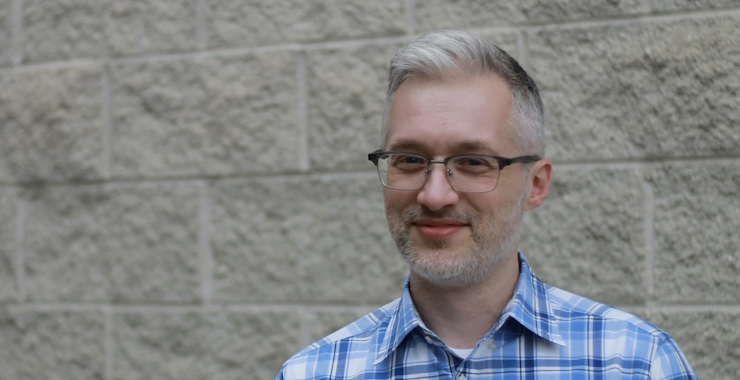
Photo credit: Courtesy Katie DeVries
O'Hara, D. (2023, June 1). David Rapp explores how best to combat misinformation. https://www.apa.org/members/content/combat-misinformation
David Rapp, PhDopens in new window, and his students at Northwestern University (NU) in Evanston, Illinois, hold down an especially lively corner of psychology, one that requires them to mix it up with scholars, scientists, and journalists on a regular basis. Rapp, professor of psychology and learning sciences, and head of NU’s Reading Comprehension Labopens in new window, has been a pioneer in the study of misinformation, a hot topic right now.
Rapp, himself an avid reader, got into the field following an early interest in how people make sense of what they read, see, and hear in conversation. Along the way, he says, he noticed that some of the information people take in is not accurate.
“I thought that might be an interesting place to start, to look at how people wrestle with information, how they try to decide whether they believe something,” he says. In 2004, when he started examining these questions, they were not receiving much attention.
They are now. The internet and especially social media have allowed for the unfettered spread of misinformation, defined as false or inaccurate material, and disinformation, which is deliberately intended to mislead. Falsehoods and conspiracy theories, and social and political groups that support them, have gained astonishing traction, disrupting elections, the public health establishment, education, communities, families—virtually every arena in public life, with the covid-19 pandemic serving as an intensifier in the past few years.
Interrogating the truth of information
Rapp’s lab focuses on memory and language to track what happens during comprehension experiences, and on how to help people interact more successfully with new information. The team works with high school students who struggle to read; helps create health information for older adults with low literacy; and assesses whether teaching tools convey concepts as intended. However, the urgency around getting a handle on misinformation has definitely pushed that segment of his work to the fore. Most of the lab’s researchopens in new window over the past decade has dealt with how people interact with, and are influenced by, misinformation.
While humans are very good at acquiring new information and retrieving it when the need arises, we’re less good at evaluating the truth of that information, Rapp says. His lab investigates why that is, and whether humans can be trained to be more discerning about information across the board. Such skills are essential in the digital age, when “there’s a ton of information coming at people” on the internet, he says.
Rapp’s team has foundopens in new window that any exposure to inaccurate information opens the door to confusion, doubt about information that actually is accurate, and the possibility that a person will come to rely on flawed understandings going forward.
Lessons from social psychology
The team has validated, and expanded on, some well-established practicesopens in new window for testing the accuracy of information, like “lateral reading,” or consulting a variety of sources to establish a convergence of evidence. In one studyopens in new window, for example, Rapp and his colleagues showed that simply giving people a heads-up about misinformation can make them more cautious about accepting the truth of what they hear or read in the future.
Rapp finds his work overlapping with new-to-him areas like social psychology, which is concerned with “how people reckon with aspects of their identity and their everyday experiences.” Rapp says, “Social psychologists are really good at understanding how identity formation occurs.”
The connection between misinformation and identity can be strong. A person’s belief that, say, climate change is an artifact of liberal-elite posturing, bogus science, and government overreach may be tangled up with “who they are as people,” Rapp says. “When I confront them and say they’re wrong, I’m not just confronting the idea, I’m confronting them.”
Not all arguments are equal
Climate changeopens in new window is a good example of a politically infused issue awash with disinformation easily accessed on the internet, and of the difficulties even professional communicators have with conveying accurate information when disinformation is rampant. Traditional journalistic practice is to include voices on both sides of an argument, so media accounts may present climate-science naysayers’ arguments on an equal footing with the actual science. Rapp says that approach can confuse people and lead them to conclude, wrongly, that scientists have not reached a consensus that climate change is real and must be urgently addressed.
Rapp’s team found in a recent studyopens in new window that “carefully worded introductions” indicating that most authentic evidence shows that climate change is real, and largely caused by human activity, can help people think about the issue in a more measured way. He adds that it’s nearly impossible to convince someone of the truth who is “wedded” to a particular piece of misinformation, but at least researchers are beginning to understand how to talk about politically charged topics.
And it’s never too early to arm people with antidotes to misinformation, Rapp says.
“Critical thinking probably should be part of formal schooling activities,” as early as kindergarten, or even earlier, he says. But critical thinking doesn’t mean “to rip something apart.” While disinformation needs to be clearly identified—and quelled—children need to learn to “interrogate ideas in a way that leaves open the possibility of discussing what’s potentially beneficial about a particular view,” he says.
Learning to ask good questions
Rapp grew up in a blue-collar household in Queens in New York City. He was an eager student and took classes in psychology and sociology at Queens College while still in high school, and thought, “Oh, this is awesome!” he says. The first person in his family to graduate from college, Rapp earned his master’s degree from New York University and his doctorate in experimental psychology from the State University of New York at Stony Brook.
He is joint-tenured at NU in psychology and education, and has won a number of teaching and research awards. His students and the lab’s research “all connect across areas to bridge deep theoretical, psychological understandings of the human condition, memory, and learning,” he says. And Rapp’s research is designed to have real-world applications, helping teachers to be more effective, say, or social media platforms to reduce the inaccuracies that crop up on their sites.
“I’m cautiously optimistic about being able to help people become more careful evaluators of information,” he says.
Going deeper to understand the stake a person or group might have in taking a particular stance, “why particular news gets presented and why people opt to share specific things, can also be instructive,” he says. “That, I think, is the most critical part of psychology and psychological work. If you can ask good questions, you’re halfway there.”