The Beating the Blues online course was developed by HealthPartners to help people manage their stress without giving up or breaking down.
Carter, K. (2019, February 26). How computer-assisted therapy helps patients and practitioners (part 2). American Psychological Association. https://www.apa.org/members/content/computer-assisted-therapy-stress
More and more mental health professionals are adding computer-assisted therapy, which uses computers to help therapists provide mental health services, to their practice. In part one of this series, we looked at virtual reality (VR) and artificial intelligence (AI) technology for the treatment of anxiety, fear, depression or trauma.
In part two, we look at computer programs that help people cope with stress. Instead of using VR or AI to interact with a patient or simulate a scary experience, these programs use instructional videos to guide people toward healthy ways of responding to stressors. These videos were developed by using the same approach that a practitioner would use with a client during a therapy session – teaching emotional resilience in response to stress.
Research shows that almost 60 percent of Americans feel stressed because of the recent increase in social divisiveness and the decline in civil discourse in the country, which can have negative effects on individuals’ emotional and physical health. To help people build emotional resilience skills and bring courtesy and kindness to the workplace, Karen Lloyd, PhD, senior director of Behavioral Health Strategy and Operations at HealthPartners, created the web-based application Choose Civility. “We are a country that is divided, and a lack of civility is going up. People from all walks of life are distressed about that,” she says.
At HealthPartners, a health insurance company and provider that helps patients deal with stress through online courses, Lloyd used research that showed that incivility can affect attitudes and behavior at workopens in new window, as well as survey data inquiring about people’s emotional wellnessopens in new window, stress levels and sense of sufferingopens in new window, to create a three-session course that helps them identify subtle uncivil actions and provides research on the effects of incivility.
After the sessions, users take an assessment to help them identify their own uncivil behaviors and complete homework assignments that encourage them to reflect on how to respond to incivility in emotionally healthy ways. This connects civility to emotional resilience, which is why Choose Civility was created, Lloyd says. Through computer-assisted therapy, “we want people to practice their emotional resilience skills,” Lloyd adds, by applying the fundamentals of cognitive behavioral therapy studies that psychologists have found over years of research.
HealthPartners also offers courses on other topics, including finding meaning and purpose through work, healthy communication and healthy thinking. “We are dedicated to helping people cope and adapt [to stress] in effective ways,” she says.
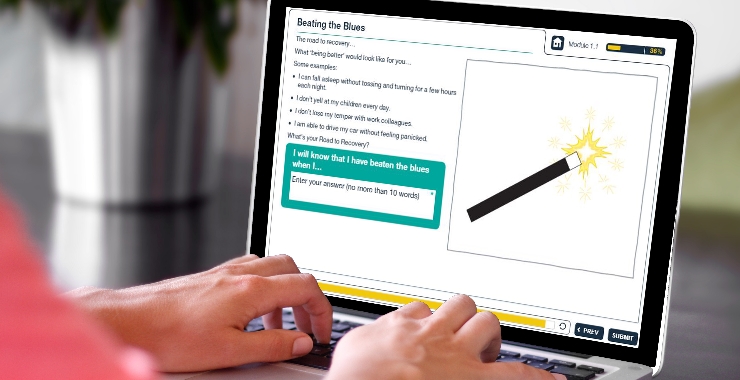
For example, HealthPartners offers the Beating the Blues online courseopens in new window, which is a “more intensive” opportunity to work on emotional resilience, says Lloyd. The creators of Beating the Blues developed it to help people manage their stress without giving up or breaking down, she adds.
The program has eight 30-minute interactive online sessions that are delivered similarly to the cognitive behavioral therapy approach to psychotherapy. The sessions teach concepts and support users in setting goals for changing their behavior, while users then measure the progress of those goals. The program has five characters for users to interact with. For example, one character is a school teacher who is experiencing feelings of failure and ineffectiveness at his job, and another is a mother who is suffering from panic attacks in the aftermath of a car crash involving her child. Users can watch how these characters handle their situations with emotional resilience and then walk away with examples of how to apply it to the stress in their own lives.
Over 8,000 people have participated in the program since it was created three years ago. “The majority of Beating the Blues users were not receiving behavioral health counseling or taking medication for their mental health issues,” explains Lloyd. “By making [the program] free and online, we think it is a good initiative to help people access skill building that can make a difference in their lives.” And there is research to support that statement. A survey conducted by HealthPartners’ market research team showed that 90 percent of Beating the Blues users found it easy to use, and 97 percent found it helpful in their personal lives.
Veronica, who took the course while she was feeling overwhelmed, says that Beating the Blues helped her identify the sources of her stressors. “It helped me pinpoint my frustrations and find ways to improve them,” she says. The program encouraged her to talk to people who are contributing to her high stress level about how to reduce it. “The program helped me communicate to other people what is stressing me...and get to a comfortable place where I can say what I need to not be stressed,” she says.
While Beating the Blues helps increase access for those not receiving in-person mental health therapy, “[therapists] are adding Beating the Blues to the treatment they provide face-to-face,” says Lloyd. Jesse Fladmark, a physician’s assistant at a Minnesota family clinic, often recommends Beating the Blues to patients who have anxiety and depression. “Beating the Blues helps people to be aware of their thinking,” he says. When he checks in with patients to see their progress on something they might be struggling with, like hearing bad news, they tell him they are more aware of their [negative] thoughts after taking the Beating the Blues classes and have learned ways to change them.
Fladmark says that people who might be afraid to see a therapist, or afraid to talk to anyone about their feelings, can use the program at home and still get the benefits of therapy. “I have gotten some good feedback from a few patients,” he says. “One patient told me that he learned more in 3 sessions of Beating the Blues than he has the entire time he was in therapy.”
Learn moreopens in new window about HealthPartners, Choose Civility, and Beating the Blues.
Technology, Mind & Society 2019
APA’s Technology, Mind & Societyopens in new window conference showcases the most important current research in psychology and other disciplines concerning the interactions of humans and technology — research that moves us toward the goal of ensuring that technology enhances the lives of all people.
Technology, Mind & Society Keynote Speakers
 Sara Czaja, PhD is a professor of gerontology and the director of the Center on Aging and Behavioral Research in the Division of Geriatrics and Palliative Medicine at Weill Cornell Medicine. Czaja’s research interests include aging and cognition, aging and healthcare access and service delivery, family caregiving, aging and technology, and functional assessment.
 Camille Nebeker, EdD, MS is an assistant professor of Behavioral Medicine in the Department of Family Medicine & Public Health, School of Medicine at UC San Diego. Nebeker’s research focuses on community research capacity building and the ethical dimensions (e.g., consent, privacy, data management) of emerging technologies (e.g., pervasive sensors, ubiquitous computing) used in health research.
 Albert “Skip” Rizzo, PhD is a clinical psychologist and director of Medical VR at the University of Southern California Institute for Creative Technologies. He is also a research professor with the USC dept. of psychiatry and school of gerontology. Rizzo has conducted research on the design, development and evaluation of Virtual Reality (VR) systems targeting the areas of clinical assessment, treatment, and rehabilitation across the domains of psychological, cognitive and motor functioning in both healthy and clinical populations.
 Valerie Shute, PhD is the Mack & Effie Campbell Tyner Endowed professor in education in the department of educational psychology and Learning Systems at Florida State University. Her current research involves using games with stealth assessment to support learning — of cognitive and non-cognitive knowledge, skills and dispositions. For more details on her research and publications, read her bioopens in new window on Florida State University's website.
 Kumar Garg is the senior director for technology and society at Schmidt Futures. His four core areas of work include: promoting the positive digital transformation of society by investing in data collaboratives that address concrete societal problems; expanding the number of people that are involved in discovery and innovation; investing in early stage risk-capital in nascent university research, high-potential people, and young organizations; and advancing public policy that sustains and leverages science and technology. He previously helped shape policy for the Obama Administration, serving in a variety of roles in the White House Office of Science and Technology Policy.