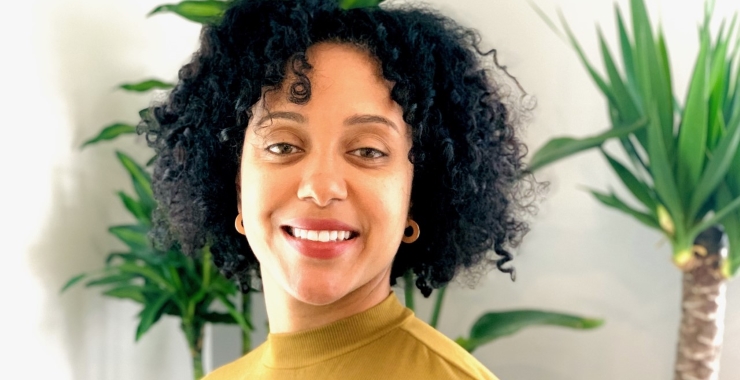
Rehabilitation psychologist Mana Ali Carteropens in new window, PhD, decided long ago that she would do what she could to make life better for African Americans. “It’s on my heart and on my spirit to do something for my community,” she says.
Ali Carter, a clinician and researcher at MedStar National Rehabilitation Hospital in Washington, DC, marvels at the way the past year, marked by the COVID-19 pandemic and the prominence of the Black Lives Matter social justice movement, has gathered up all her clinical and research interests and pitched them into the public discussion at once—the doctor-patient relationship, African American life and culture, health disparitiesopens in new window, psychosocial factors that affect health outcomes, and the role that the rehab institution plays in recovery for grievously injured patients.
The health-related concerns have come to the fore in part because of the unequal toll the pandemic has taken on Blacks and other minorities. Blacks are nearly four times as likely to be hospitalized with COVID-19 as Whites, and nearly three times as likely to die from the novel coronavirusopens in new window, according to the U.S. Centers for Disease Control and Prevention (CDC).
Even in normal times, Blacks are more likely to die at early ages from all causes, according to the CDC. One “silver lining in this horrible time,” Ali Carter says, is that attention is focusing on health disparitiesopens in new window and inequities as never before, and new researchopens in new window is being directed toward addressing themopens in new window.
Ali Carter, who is also the director of training for the Rehabilitation and Pain Psychology Postdoctoral Fellowship at MedStar, works with adults with debilitating medical conditions, some congenital and others caused by disorders like Guillain-Barré Syndromeopens in new window or traumas like sports injuries or gunshot wounds.
Profound loss is at the center of these experiences, Ali Carter says, but while she doesn’t gloss over her patients’ feelings, “people are resilient. Rehab is a strength-based discipline,” she says. “When people come in here, we say, ‘You’ve had a spinal cord injury and lost the use of your legs? Then we’re going to get your arms beefed up to be your legs. They’re going to do what your legs used to do for you. We’re going to focus on what’s working, what’s in your control.’”
COVID-19 has disrupted this can-do approach. “In normal times, a rehab setting is a very lively place,” Ali Carter says. “We’re having fun in groups, we’re moving people toward independence. It’s a bubbly environment with a lot of teamwork.”
COVID-19 has subdued rehab’s can-do spirit
Now, though, the rehab unit has become subdued, she says. Everyone is covered in masks and gowns, avoiding contact, staying as far apart as possible. Access to exercise areas is restricted. Inpatients can’t have visitors; they may be confined to their rooms. The cheerful engagement that plays a large part in recovery is missing.
“Everybody has had a hard time with this,” Ali Carter says.
For African Americans, the bleak COVID-19 version of rehab is even worse. For them, Ali Carter says, the environment that results from all those necessary adjustments “creates a brewing pot of medical mistrust and isolation that is horrible for recovery and engagement.”
Mistrust of the health care system already runs deep in the African American community. Individuals may know about the racist experiments and treatmentsopens in new window that have exploited and damaged African Americans over the centuries and into the present. One notorious episode was the Tuskegee Studyopens in new window, initiated by the U.S. Public Health Service in 1932. For decades, scientists withheld effective treatment from hundreds of Black men with syphilis in order to observe the devastating disease process, even to death.
Many Blacks have their own family stories and personal experiences with racism in health care that promote mistrust, which in turn contributes to health disparities by keeping people from getting the care they need, Ali Carter says.
She thinks a great deal about “the power imbalance” between health care providers and patients, she says, and she tries to level it out as much as she can. She doesn’t ordinarily wear a white coat to see patients; she believes just that one article of clothing can make her appear to be coming at the patient from on high.
“It says, ‘You’re the little one here.’ The work is on the provider to establish that rapport. A poor provider relationship is horrible for outcomes. If people don’t trust me, they won’t get better. If they feel intimidated, they won’t ask questions. They won’t speak up for their values,” she says.
Ali Carter has done research that shows that the patient-centered medical home (PCMHopens in new window) model, which includes a mental health componentopens in new window and team-based care, may help reduce disparities and improve outcomes. That approach, which is gaining momentum in health care, will also give more people easier access to, and normalize, mental health care.
Understanding patients’ culture is crucial in health care
Given that only 5% of psychologists are African American, and that the need is great in that community, White psychologists need to think about how to put their Black patients at ease, Ali Carter says. Making the effort to understand patients’ culture has to be an intrinsic part of any health care interaction, she says. She works to convey that message to the fellows she helps train at MedStar. She also co-chairs the hospital’s equity committee.
“I would like to see providers broaden their sense of who that person is in front of you, and why they are showing up in the state they are in,” especially if patients are upset or appear uncooperative, Ali Carter says. “We need to look past personality to explain health status. People want to be well. We need to connect with their circumstances and the challenges they encounter in the health care system.”
Ali Carter has spent her entire life in the Washington, DC, area. She grew up in a comfortable “bubble,” she says, in suburban Prince George’s County, Maryland. Though she comes from modest means, Prince George’s is one of the most affluent majority-Black counties in the United States.
Ali Carter attended the University of Maryland, where she studied psychology and criminal justice, and got her doctorate in clinical psychology from Howard Universityopens in new window, a Historically Black University in Washington, DC. She also completed a fellowship in rehabilitation psychology at Johns Hopkins University in Baltimore.
At Howard, Ali Carter was pleased to discover that diversity was “woven into every course. We were thinking about all people all the time,” she says.
For a researcher, one great benefit of the Howard program was that “African Americans trust Howard,” Ali Carter says. She worked on two studies during her fellowship there—one through Howard, and another study through the National Institutes of Health (NIH). It took four times as long to recruit people for the NIH study as for the Howard project, even though the NIH offered participants “way more money,” she says. Less time spent recruiting participants made the Howard project much easier—something for psychologists interested in working with African Americans to consider, she says.
“You’re doing your dissertation for as long as it takes to gather that data. If it takes two months, great!” Ali Carter says. “But if it takes five years to get the data, you’re still doing that dissertation.”
 Webinar: Resilience in Times of Uncertainty: A Conversation with Toastmasters and APA