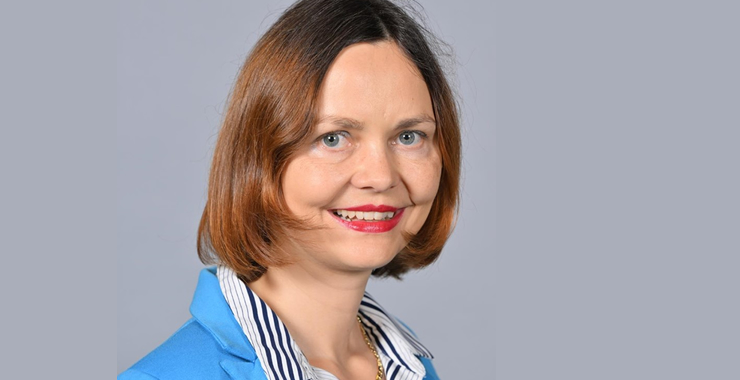
The Russian invasion of Ukraine this year has killed thousands and driven more than 14 million people from their homesopens in new window, including seven million who had fled the country at press time, the great majority of them women and children. They are at high risk for trafficking and exploitation, and signs of trafficking activity have been detectedopens in new window. Social psychologist Laura Dryjanskaopens in new window, PhD, has been watching the developments with some trepidation.
“The part that makes me most angry is that traffickers prey on the valid dreams people have, their hopes for a better life,” Dryjanska says.
Dryjanska is an associate professor of psychology at Biola Universityopens in new window in La Mirada, California. She works to stop the trafficking of human beings for sex, labor, and other exploitation, and is also interested in positive organizational psychology, migration, cultural values, and aging. Dryjanska is a Division 1 (The Society for General Psychology and Interdisciplinary Inquiry) fellow, the 2020 recipient of the Division 1 Citizen Psychologist Award, and a member of Division 9, the Society for the Psychological Study of Social Issues; Division 14, the Society for Industrial and Organizational Psychologyopens in new window (SIOP); and Division 52 (International Psychology). She is also a member of the APA’s Committee for Early Career Psychologists.
Dislocation puts refugees in danger
The stresses of dislocation are immense for all who undergo it, she notes. Forced migrants may not speak the language of a receiving country or be familiar with its customs. They must often rely on the kindness of strangers. And Dryjanska says that for every 10 good people who show up to meet refugees at an airport or train station offering to help, “one or two might take advantage” of these desperate and disoriented people. Opportunistic sexual abuse and other crimes sometimes occur, and refugees are susceptible to being trafficked into prostitution, or into forced work arrangements that may be little better than slavery.
The United Nationsopens in new window defines the crime of human trafficking as “the recruitment, transportation, transfer, harboring or receipt of people through force, fraud or deception, with the aim of exploiting them for profit,” and says it is practiced everywhere in the world. The United States Department of State estimatesopens in new window that 25 million people are trafficked worldwide at any given time. More than 10,000 people were reported traffickedopens in new window in the United States in 2020.
Increasing awareness of human trafficking, especially abuse of workers, is Dryjanska’s “niche.”
Indeed, abusive work practices are so ingrained in some countries that representatives from Western companies looking to take advantage of inexpensive labor may rationalize the practices, thinking, this is how things are done here, Dryjanska says.
For example, the so-called kafala systemopens in new window puts employers in charge of foreign workers’ employment and immigration status. Employers can require long hours, pay very low wages, hold workers’ passports, and restrict their movements; foreign workers typically do not benefit from laws that protect local workers. Some countries have made changes to the system, but critics charge that mistreatment of foreign workersopens in new window is still common.
Dryjanska is pleased that almost one-third of Fortune 500 companies are now discussing human trafficking on their websites, and she is proud that SIOP’s International Affairs Committee, which she chairs, published a paper called Be the Eyes: Training Employees to Recognize Industry-Relevant Indicators of Sex Traffickingopens in new window, by Maura Mills, PhD, Leanne Tortez, PhD, and Robert Blanton, PhD. According to that paper, employees in three industries — transportation, healthcare, and hospitality — are most likely to encounter trafficking. In fact, the paper reports that 75% of sex-trafficking cases in the United States touch a hotel or motel at some point, so it’s crucial that those employees, from the front desk to the housekeeping staff, know how to spot trafficking, and how to report it.
“There’s a lot more awareness now and a bit more screening of people who want to help,” Dryjanska says. But misinformation persists. The far-right conspiracy group QAnon has consistently promoted misinformation about trafficking, such as the baseless charge that prominent Democrats were operating a child-sex ring out of a pizza restaurant in Washington, DC. “Sadly, these conspiracy theories can linger for quite a while in people’s minds, and lead to less trust in organizations that do fight child trafficking, and thus less funding,” she says.
“Trafficking is everywhere”
Dryjanska grew up in Poland and speaks English, Spanish, and Italian fluently, in addition to Polish. She did her undergraduate work at Universidad Técnica Particular de Lojaopens in new window in Ecuador and obtained her doctorate in social representations and communications in social psychology from Sapienza University of Romeopens in new window, Italy, and did a post-doc there as well.
In 2017, she came to the Rosemead School of Psychologyopens in new window at Biola, a Christian institution. It took a year longer than she expected for her work visa to come through, “but they waited for me, which was pretty remarkable,” she says. “It’s a very friendly environment,” she says of Biola, and she has developed popular classes there on the psychology of human trafficking.
Dryjanska is also one of three editors of a planned book for the APA on the psychology of human trafficking, due out in August 2023.
She is currently working on a qualitative study of resilience in sex-trafficking survivors in California and Florida. “Though trafficking is everywhere,” she says, the top states in terms of numbers are California, Texas, and Florida.
Dryjanska has interviewed about one-quarter of the 30 women she hopes to talk with for the study, 15 each in Florida and California; her subjects tend to be “survivor leaders” who mentor others. Trafficking in the United States usually involves “grooming” rather than being taken by a stranger, she says; these American women may have tenuous trust relationships with their own families or other vulnerabilities the trafficker exploits. Once the woman breaks free, that vacuum has to be filled, Dryjanska says.
She is exploring how much these women, as they travel the road to resiliency, rely on self-agency, faith, faith communities, or other factors. So far, she has found that the support of faith communities has been more important to her subjects than religion or faith itself.
“It’s not as much about the personal spiritual experience. It’s more about building healthier relationships,” Dryjanska says.
As for traffickers or the people who have sex with trafficked women or who exploit people in other ways, she says she is not interested in their psychology. “As long as there is demand and an opportunity to make a lot of money, there is someone who will step in,” she says.
Dryjanska says that most people are not going to actively exploit vulnerable human beings, but we all may play a role. She says, “It happens because we’re pretty skilled at not seeing what is heartbreaking and unfair and unjust.”