Normalizing remote work
Businesses are navigating a shifting landscape of risk and decisions being made at multiple levels of government, with widely varying incidences and resources. Several major tech firmsopens in new window will support remote work for months, or even, in the case of San Francisco-based Twitteropens in new window, "forever."
IBM,opens in new window which had 95% of its global force working remotely this spring, plans to bring workers back in stages, to new cleaning protocols, reconfigured workspaces to allow for social distancing, traffic-control measures in elevators and restrooms and at entrances, fewer in-person meetings, and a limit on attendees when meetings do occur.
Across the workplace, there will likely be a range of solutions. "Some companies have more money than others," notes Sally Augustin, an authority on workplace design.
Kristen Shockley PhD, associate professor of psychology at the University of Georgia in Athens, who studies work–life balance, is gathering data now for a "rapid response" studyopens in new window funded by the National Science Foundation on how remote work is going during the lockdown for 450 people who have not done much of it in the past.
Shockley,opens in new window whose research focuses on the intersection of work and family, anticipat es that this "society-wide experiment" with remote work will normalize the practice as never before. It may even become a recruitment tool as prospective employees insist on having the option, she says.
"This may be wishful thinking, but I also see a little bit more understanding about family interference in work," Shockley says. "People tend to hide their family life, but they haven't been able to do that during the pandemic. It's been out in the open, and I think that will be a good thing. Managers have seen that people had a lot of family stuff going on but they still got their work done."
Judith Heerwagen, PhD, who has worked remotely for 10 years from Seattle, Washington, for the Office of Federal High Performance Green Buildings in Washington, DC, also sees a continuing role for remote work. She notes that just getting to the office is going to continue to be hazardous, especially if employees use public transit. Heerwagenopens in new window sees incorporating remote work into the business's overall plan, something the GSAopens in new window does already, as an essential option to give employees more of a feeling of control over their own safety and job performance. So then, what happens when workers do gather in the office? Organizations should be thinking strategically to optimize social interactions and other goals at such meetings.
"What should an office really be? That's the thing people come back to again and again. We miss the social dimensions of going to work, and there are lots of little things about people being together that may be far more important than we realize," Heerwagen says.
Staying flexible
Alexander Alonso, PhD, chief knowledge officer at the Society of Human Resource Management in Alexandria, Virginia, thinks the I/O psychologist's role will pivot substantially in the short term, as the faltering economy moves into a "talent-rich" hiring environment. I/O psychologists will need, and can create, new tools for assessing that talent, Alonsoopens in new window says. They can also help managers design offices, make evidence-based decisions to increase productivity, and set guidelinesopens in new window for bringing workers back safely to politically polarized environments.
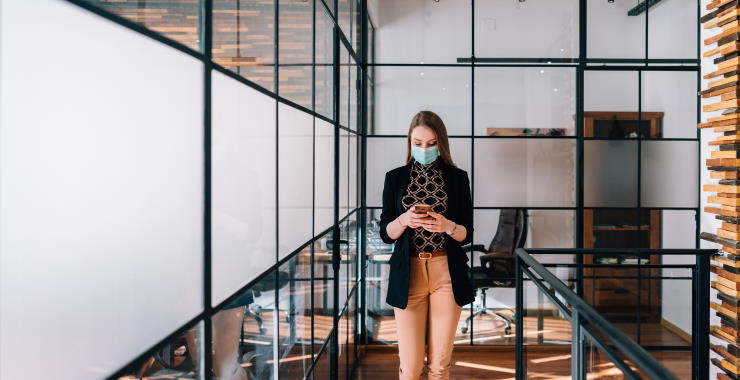
In terms of, say, wearing a mask at work, "it's okay to provide the space and opportunity for employees to work it out on their own, and it's okay when managers are involved, but the minute you get executives and HR (the Human Resources department) involved, that leads to high levels of polarization," says Alonso, who has studied workplace cultureopens in new window. "If an organization stays flexible, and says, 'It's incumbent on workers to act responsibly and meet certain guidelines, but we can't mandate everything,' that flexibility will buy a lot of good will."
Clair Reynolds Kueny, PhD, assistant professor at Missouri State Science & Technology University in Rolla, Missouri, agrees that organizations will need to think carefully about the messages they send employees coming back to the workplace in these uncertain times. Managers will want to signal that they value employees and their safety, and they'll need to allow employees to share their ideas and even their fears, and to vent negativity if they are feeling it. In fact, the whole workplace dynamic will probably take some time to shake out, she says. For example, even though employers generally value initiative, they are probably not going to want to open the floor to unbridled initiative for a while, given that so many unknown factors will be in play, she says.
Kueny,opens in new window who is investigating which employee behaviors are working best at a rural Missouri health care facility that is treating people with COVID-19, says, "Organizations need to be supportive, above all else. This is a really dynamic time. Everybody is already experiencing heightened emotional and cognitive stressors. You want your employees to feel like they're being heard."
Research can guide efforts
Sally Augustin, PhD, principal at Design With Science in La Grange Park, Illinois, thinks workers will likely be comforted to see their employers' efforts to keep them safe, but she is concerned about the unintended consequences of those efforts. Workers' freedom to move around the office may be impacted. They may be placed so far away from co-workers that "it could be weird from a personal-space perspective," she says. Standing meetings may not have all the people who used to attend. Workers could feel thwarted, or stressed. Continual cleaning might necessitate the exclusive use for furnishings of hard surfaces that don't nurture or comfort. Managers should keep in mind the copious research on the ability of certain colors, materials and natural elements like plants and sunlight to make people feel calmer and more creative, Augustinopens in new window says.
"The system can't be so onerous that people can't do their jobs," says Augustin. "They can't be so stressed that they can't contribute to getting the economy back on its feet."