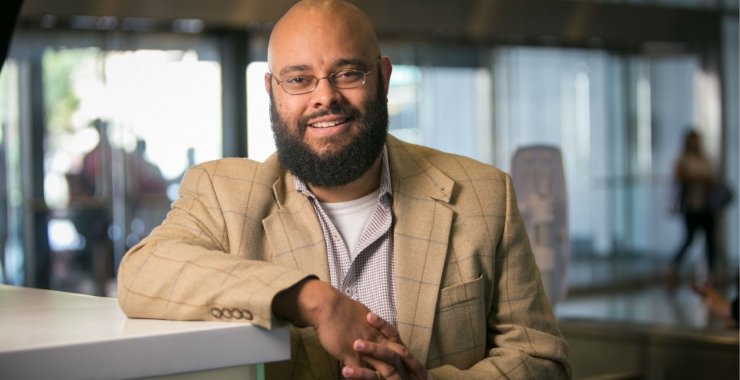
Photo credit: Arpi Pap Studios
Social psychologist Phillip Atiba Goff, PhDopens in new window, believes that science can fight racism, one of our society's most intractable problems. Specifically, Goff has been studying and gathering data on policing for more than a decade—research that in light of issues raised by Black Lives Matter—is more relevant than ever.
Goff wants to take “fundamental laboratory findings out into the world, particularly in the domain of public safety and policing,” to replace the systems we have “with better systems that have different intentions,” he says.
The Carl I. Hovland Professor of African American Studies and professor of psychology at Yale University in New Haven, Connecticut, Goff is an expert on racial bias. He co-founded and is chief executive officer of the Center for Policing Equityopens in new window (CPE), a national nonprofit organization that studies how public safety systems affect communities, how departments can improve, and what can replace policing.
Until about 2008, “there were no national data on police behavior,” he says. Reports of crime were tracked, “but not what police did to people in those communities,” he says.
CPE grew out of a 2007 conferenceopens in new window of social science researchers and law enforcement officials who were seeking guidance on how to hire for and sustain diverse, fair-minded, effective departments. Goff and Tracie Keeseeopens in new window, PhD, a 25-year veteran of the Denver Police Department and New York Police Department, co-founded CPE at the University of California at Los Angeles, where Goff was first tenured. He says CPE has the world's first and largest collection of data on policing behaviors. The organization has worked with more than 75 jurisdictions.
Blacks twice as likely to encounter force
One of CPE's core principles is a rigorous opposition to White supremacy, but racial bias can be unconscious. Goff's own workopens in new window has shown that people reflexively associate Black people with crime, and that they perceive Black children as being older than they areopens in new window, and less evocative of innocence.
Part of the dilemma of law enforcement in minority communities is that police officers now are first responders in situations that would more appropriately be addressed by mental health professionals and other social service providers, Goff says.
“We don't need to have punishment as the only public safety and public health response,” he says.
That framework is especially dangerous for Black people. While one in four adults in the United Statesopens in new window, about 62 million people, have contact with law enforcement in a year, only about 1.3 million of those people are dealt with with force. Goff told an audience at a 2019 TED talk that Blacks are more than twice as likely to be targeted for force than Whites.
Goff's early work at Stanford began to establish his stance and credentials on addressing racism at large, and in law enforcement. He won early career awards in 2009 from APA Division 9opens in new window and Division 48 and was named a 2011 Association for Psychological Science Rising Staropens in new window.
He is often interviewed and also writesopens in new window regularly in the media; he has testified in Congressopens in new window and before President Obama’s Task Force on 21st Century Policing.
George Floyd
The year 2020 was an intense time for Goff. He was living in Manhattan when COVID-19 hit. For weeks, Riverside Drive, which he could see from his home, was deserted, the city “ghostly silent except for the sound of ambulances,” he recalls.
Still, Goff was mindful of “the systems of inequality we already had” and concerned about the possible intensifying effects of the pandemic, he says. He started by advocating for personal protective equipment for law enforcement and getting incarcerated people released, if possible. But after George Floydopens in new window was killed by a Minneapolis police officer on May 25, 2020—or more precisely, after a shocking video of the murder surfaced—“there was a lot of demand for our services,” he says.
Floyd’s death was only one of several high-profile incidents of violence toward Black people that year, which contributed to what Goff calls “a sea changeopens in new window in public opinion,” with nearly 60% of Americans polledopens in new window saying they believed major changes were needed to improve public safety.
“I was always working on something that felt like the most important thing that we had ever done,” Goff says.
Many police departments have been eager to work with the CPE team; behaviors and policies are two variables over which police departments do have some control, Goff says. Even so, “experiments should have metrics and scientists involved,” he says. “That's what we're up to—and not just at CPE. That's what the country should be up to.”
By early this year, some of CPE’s activities were paying off with substantial change. Berkeley, California, implemented a package of reformsopens in new window designed to reduce racial disparities, based in part on a studyopens in new window Goff’s CPE did in 2018 that showed that Berkeley police were 6.5 times more likely to stop Black motorists than White ones, and 20 times more likely to search Blacks than Whites.
Changes went into effectopens in new window in Ithaca and Tompkins County, New York, too, one of which was the elimination of the “no-knock” search warrantopens in new window, which allows police to enter a home without warning. Goff's CPE was involvedopens in new window in those efforts.
Metrics and training can make a difference
There are 18,000 distinct law enforcement agencies (PDF, 1MB)opens in new window across the United States at the federal, state, county and local level, Goff notes. “Seventy-five percent of them are 25 officers or fewer, and there are a thousand that are just one dude,” he says.
“We know you are twice as likely to get shot in a rural area as you are in an urban area.” Citizens are safer in locales where rigorous training to address different situations is common. But it's also true that “it really matters what's happening in those small places,” Goff says.
Goff was born in Philadelphia and grew up in the suburbs there. He majored in Black studies at Harvard University in Cambridge, Massachusetts. He founded the Black Arts Festivalopens in new window there. If Goff weren't a social scientist, he says he might have been a performer or a storyteller, but he believes he chose “the work that needed doing most.”
He obtained his PhD in social psychology at Stanford University in Palo Alto, California. Goff's original plan was to stop at a master's degree in psychology; he recalls his first year in the program as a slog.
“I knew I wanted to be a professor and ask questions for a living. I thought I wanted to be in an interdisciplinary program,” he says.
Later on at Stanford, though, he worked with Claude Steeleopens in new window and Jennifer Eberhardtopens in new window, researchers who have done foundational work on race, unconscious bias, and stereotypes. He says he came to realize that social psychology could be a powerful tool for investigating racism.
“Racism is about behaviors, not feelings,” Goff told that 2019 TED audience. “When we change the definition of racism from attitudes to behaviors, we transform that problem from impossible to solvable, because you can measure behaviors...(and) hold yourself accountable to the metric. If every other organization measures success this way, why can't we do that in policing?”