skip to main content

School psychologists adapt to help students during COVID-19

School psychologists look back on how the pandemic upended their work, how they interact with students, and what’s ahead for the fall.
 
APA Style leaf logo Cite This Article in APA Style
Carter, K. (2020, July 14). School psychologists adapt to help students during COVID-19. American Psychological Association. https://www.apa.org/members/content/school-psychologists-covid-19

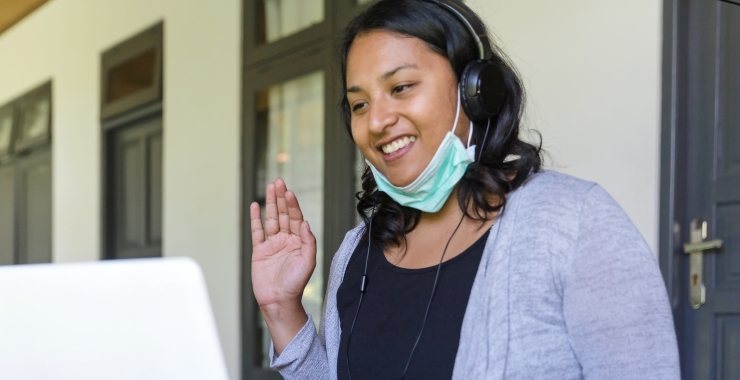
Female waves and smiles at her computer

When the coronavirus outbreak shuttered schools in almost every stateopens in new window, school psychologists moved quickly to provide their services remotely. Along with this change, they've experienced a significant shift from providing counseling to providing the technology children need to learn at home. “We have been trying to deploy iPads to families, and several districts have set up locations for virtual [internet] hot spots,” says Amy McDiarmid, PhD, field coordinator and a clinical assistant professor of school psychology at the University of Denver.

Byron McClure, EdD, was a school psychologist for years before he became assistant director of school redesign at Anacostia High School. Located in an area of Washington, D.C. with high rates of crime and poverty, many of his students come to school to have their basic needs met, like daily meals. His students, if they are able to connect with Wi-Fi, might have to share one device with an entire household. “Access to resources is certainly a challenge. We see inequities that have been exacerbated by the pandemic, primarily in the form of technology,” McClure says. Since COVID-19, his school has distributed meals and provided internet hot spots for families.

Ana Novelli, PsyD, a school psychologist in Colorado, used to spend most of her day doing consultations and providing behavior plan services. Once COVID-19 hit, her time shifted to calling families to determine their basic needs and connect them with food, internet access, and utilities.

Even with this added help, all of the school psychologists say working remotely has made it difficult to respond to the mental health needs of students because so many have connectivity difficulties.

“Pre COVID-19, if a student was having a difficult time in the classroom, you'd walk to that student's class, but if a student is having difficulty at home, and you can't even get in touch with that student, it changes things drastically,” McClure says.

Struggle to provide mental health assistance

Under normal circumstances there aren't always enough school psychologists to adequately address students' behavioral needs. Before COVID-19, “We were already feeling understaffed and unable to get to all students,” says Lisa Geissler, PsyD, a school psychologist in Denver. Because most school psychologists divide their time among multiple schools each day, they haven't been reaching out to new students because they've been busy with existing caseloads, says Rachel Stein, PhD, clinical assistant professor of school psychology at the University of Colorado Denver. “And if we didn't have a relationship with the student already, it was next to impossible to connect with them,” Geissler adds.

Geissler explains that students often don't respond to remind texts or emails. “We would try through parents but sometimes they also didn't respond.  Even if you could reach them, it felt very futile,” she says. “We offered ideas and ways for them to take care of themselves but we didn't hear back or get a follow-up communication to know if they did any of those things or if they were helpful.”

Preparing for a new normal

Stein says that although school psychologists in many districts are still uncertain as to whether schools will physically reopen in the fall or what they might look like if they do, it is especially important to consider students' social-emotional needs and assess learning progress in conversations about reopening.

“We know we will have to increase our level of service for when students return, and we need to focus on how to support their transition back into the school building,” McDiarmid says.

The kids who were already struggling or had previous trauma, who were the most marginalized and impacted to begin with, are going to return to school with more intensive needs, says Franci Crepeau-Hobson, PhD, associate professor and director of clinical training at the University of Colorado Denver. Novelli agrees. “Students living in poverty, students of color, and students with disabilities [are] going to be disproportionately impacted by this crisis,” she says. She fears that without a plan to help these students, they will experience the effects of the pandemic for years to come.

Geissler says it might be difficult to respond to the need for an increase in services when schools reopen. Her district was already experiencing a budget shortfall. Novelli anticipates difficulties as well. “We will be short-staffed, underfunded, and overwhelmed,” she says. McClure points out that schools must adequately meet the The National Association of School Psychologists (NASP)opens in new window recommended ratio of one school psychologist for every 500–700 children in schools to decrease the staffing issues they face upon reopening.

“As districts begin to make more concrete plans, school psychologists will be better able to prepare to support students when schools do reopen,” Geissler says. But even with the guidance from APA and NASP that school psychologists have been given on how to help families provide school psychology work at home, some schools and families don't have the resources. For example, in Geissler's district, “we are being told there isn't money, per se, for new platforms such as those used for telehealth,” she says. But when school reopens, she plans on using free services like schoolologyopens in new window to continue to reach out to help students and families.

McClure predicts students will need more academic interventions and supports on reopening. “Students will come back with some deficits,” he says. “Some will be referred to special education classes because they will be perceived to have learning issues, but that is not the case.” He points out that these students don't have learning disabilities; rather, they are experiencing shortages such as exposure to violence, poverty, little access to healthy food, and minimal access to health care. “This pandemic has amplified the inequities in resources available in some communities and families,” says John Kelly, PhD, past-president of NASP. He points out that the students who have experienced a lack of resources are the ones who will come to school most negatively impacted by the pandemic academically and emotionally, and that this is a major thing that school psychologists will need to address when schools reopen.

Novelli works in a high-needs school with a majority Hispanic population, where most of her students are struggling to engage in remote learning. She has had to change her focus to helping parents understand remote learning apps and how to access their child's educational tools, and will likely need to continue to do so in the fall.

Stein says some students simply do not show up for remote learning or mental health services. In districts like these, students will lose not only their academic progress, but also the emotional work they achieved prior to closing. Come fall, they'll be facing shortfalls.

To address both issues, school psychologists should consider psychoeducation, Stein suggests. McClure agrees, stressing that addressing academics is equally as important as social and emotional learning (SEL). SEL must be also part of any plan for schools to reopenopens in new window, he stresses. Incorporating SEL elements like journaling and deep breathing for both staff and students will be vital for a healthy transition back to school.


A positive perspective

Despite the hardships of the past few months, "This pandemic has created an opportunity for school psychologists to stretch their muscles,” says Devadrita Talapatra, PhD, assistant professor of school psychology at the University of Denver. She is pleased that it has presented an opportunity to reach out to parents to show them what school psychologists do. Novelli says connecting not only to parents but also to the whole community has also been a positive outcome of this difficult time. “I have been astounded at the way our community has come together to support each other. This experience has shown me the true love that our teachers and staff have for our students,” she says. “One mother was having difficulty with Google Classroom toward the beginning of the pandemic. She worked until 8 p.m. so she could not usually answer when the paraprofessional called to help. So, they called well after their day was over, after 8 p.m. After spending about an hour working with her, they were able to get everything sorted out, the child was able to access and excel in remote learning. If this teacher and paraprofessional had not been willing to go above and beyond, this student would have missed out on a majority of the learning,” Novelli says.

McClure says that school psychologists have a “unique opportunity to ensure that students' voices are heard, so we can re-imagine what school looks like, and have their voice included in this conversation,” so their needs are met when they return to school.

Some parents have said being out of school has resulted in lighter academic demands on students, removing some of the daily social stress and resulting in improvements with their children, says Geissler. “We may see some students come back more resilient, with family relationships much improved. We may also see the opposite. This is a huge social experiment right now.”

For more information and resources for school psychologists, visit APA's Div. 16.

Recommended Reading

APA Member Benefits

Member Benefits

Connecting with peers

APA Community


Find Your Perfect Gym

Active&Fit Directopens in new window


New products available

APA Merch Storeopens in new window


Competitive low rates

Student Loan Refinancing