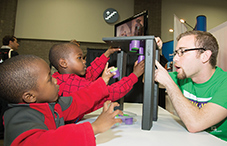

Thousands of children and adults heard the message that it is possible to study human thought and behavior scientifically at an exhibit at the biannual USA Science & Engineering Festival Expo in Washington, D.C., April 25–27.
The "The Science of Kids: Ask, Play, Learn!"exhibit, sponsored by APA and the Living Laboratoryopens in new window of the Museum of Science, Bostonopens in new window, was one of more than 700 aiming to promote interest in STEM (science, technology, engineering and mathematics) among the public, especially children. An estimated 320,000 people, including families and school groups, attended this year's Expo, visiting and participating in exhibits sponsored by academic institutions, government agencies, professional societies, publishers, community groups and corporations.
"Our participation in the Expo is an important part of APA's efforts to enhance public understanding of psychology as a STEM discipline," says Steven Breckler, PhD, APA's executive director for science. "It's a delight to see children, teens and adults get excited about both the methods and the findings of psychological science."
The APA/Museum exhibit featured interactive tasks used in cognitive development experiments, such as those that study exploratory learning, inferential thinking and categorization in young children. Graduate students from universities in the Washington area and science educators from the Maryland Science Center staffed the exhibit, engaging visitors of all ages in the tasks and answering their questions about psychological research. An accompanying video provided further background about the experiments.
"Kids had a great time and the adult visitors were very interested in watching their children's behavior on the tasks and in talking with the graduate students about the research," says Marta Biarnes of the Living Laboratory. "I was also pleased to see how many high school and college students stopped by to learn more about careers in psychology."
The Living Laboratory is a program at the Museum of Science in which Boston-area child development researchers conduct studies and discuss their work with the public. Through an initiative supported by the National Science Foundation, the Living Laboratory model has been implemented at other museums, including the Maryland Science Center, the Madison Children's Museum in Wisconsin and the Oregon Museum of Science and Industry.