APA's Center for Workforce Studies collects demographic and salary data for faculty in U.S. departments that award master's and doctoral degrees in psychology. 1, 2
Results from the center's latest Faculty Salaries in Graduate Departments of Psychology Survey reveal that the percentage of female faculty that make up U.S. graduate departments of psychology has been steadily rising:
- In 1985, women made up only 22 percent of U.S. graduate psychology faculty.3 By 2013, the percentage of female psychology faculty had increased to 46 percent.4
- In 2013, female faculty were more evenly distributed across the ranks of full (30 percent), associate (31 percent) and assistant professor (31 percent) than male faculty.4
With more women entering the academic workforce, the proportion of women who are promoted to full professor positions has been increasing.
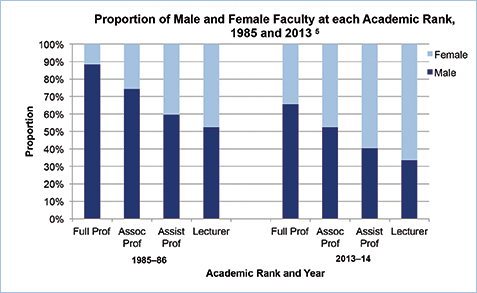
Between 1985 and 2013, the percentage of male full professors decreased from 88 percent to 66 percent. In contrast, the percentage of women occupying full professor positions nearly tripled between 1985 (12 percent) and 2013 (34 percent). 3, 4
— Peggy Christidis, PhD, Marlene Wicherski, Auntre' Hamp, MEd, MPH, Karen Stamm, PhD, Andrew Nigrinis, PhD
For more information, contact APA's Center for Workforce Studies.
1. The Faculty Salaries Survey has been conducted since the mid 1960s. Prior to 1978, the survey was overseen by the Council of Graduate Departments of Psychology (COGDOP), and after 1978 by APA in conjunction with COGDOP. Although the Faculty Salaries Survey collects data for both U.S. and Canadian graduate departments that award master's and/or doctoral degrees in psychology, only the U.S. institutions are represented here.
2. Comparisons of respondents with non-respondents indicated few marked differences in terms of the geographic distribution or National Research Council quality ranking for U.S. graduate departments. However, the response rate was lower for master's departments, private institutions, and educational psychology departments and professional schools of psychology.
3. American Psychological Association (1986). 1985-1986: Faculty salaries in graduate departments of psychology [Unpublished analysis]. Washington, DC: Author.
4. Wicherski, M., Hamp, A., Christidis, P., & Stamm, K. (2014). 2013-2014: Faculty salaries in graduate departments of psychology. Retrieved from www.apa.org/workforce/publications/13-fac-sal
5. Figure includes full-time U.S. faculty employed in departments that award the master's and/or doctoral degree (e.g., psychology departments, educational psychology departments and professional schools of psychology). Figure excludes faculty whose gender and/or academic rank were not reported.
Source: Faculty Salaries in Graduate Departments of Psychology Survey (selected years), APA Center for Workforce Studies