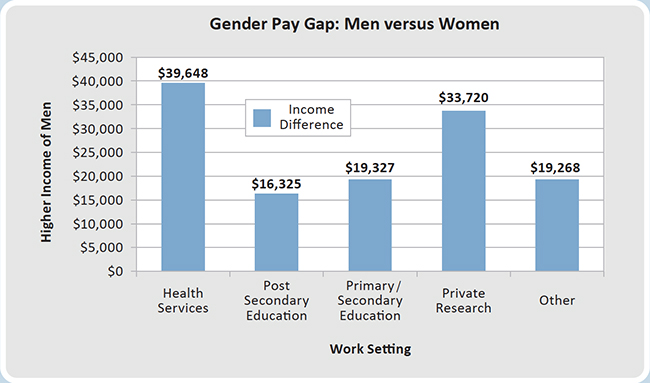
In the United States, men often earn more than women who occupy similar jobs. Among psychologists, the magnitude of this gender pay gap varies by primary work setting.1
The largest pay gap for psychology doctorates occurs in health services,2 where men earn an average of $39,648 more than women. This work setting employs the largest number of psychologists.
The lowest pay gap is in education, where government is the main employer. Women also earn less than men employed in post-secondary education (80 percent), elementary and secondary education (77 percent), private sector research3 (69 percent) and other settings.4,5
— Andrew Nigrinis, PhD, Auntré Hamp, MEd, MPH, Karen Stamm, PhD, Peggy Christidis, PhD
For more information, contact APA's Center for Workforce Studies.
1. All data come from the U.S. Census Bureau's American Community Survey (2010), which divides psychologists into five broad work setting categories: health services, post-secondary education, primary/secondary education, private research and other. The income data can be split between wages/salary income and self-employment income (which includes business and professional practice income).
2. "Health Services" refers to psychologists working in industries coded as medical offices, medical outpatient, health care services, hospitals, nursing care facilities, community and religious institutions.
3. "Private sector research" refers to psychologists working in pharmaceuticals and medicine, management, scientific and technical consulting services, scientific research and development services, and other professional, scientific, and technical services.
4. All "other" refers to psychologists that cannot be categorized in the above categories, which is a small fraction of the data.
5. This analysis does not include controls for age, number of hours worked or other factors. Future reports and analyses from APA's Center for Workforce Studies will address these issues.