Whether you think the ever-increasing use of technology in education is a panacea or a threat, relax, Sue Frantz told participants at APA's Education Leadership Conference.
While technology allows educators and students to do things faster and reach more people, they're typically using it for the same things they've always done, said Frantz, a psychology instructor at Highline College in Des Moines, Washington.
Teachers outraged by students using cellphones in the classroom may be forgetting that students in the past passed notes or worked on assignments for other classes, for example. Massive open online courses — the controversial educational format known as MOOCs — are just the latest version of the public libraries Andrew Carnegie opened in the late 1800s with the idea of creating a "people's university" and promoting the diffusion of knowledge. When it comes to technology in education, said Frantz, "it's not all rainbows and unicorns, nor is the sky falling."
Frantz was one of almost 150 psychology educators, members of APA governance groups and others who gathered in Washington, D.C., Sept. 13–16 to discuss "Learning in a Digital World." Participants explored ways of using technology to improve teaching and learning in traditional and online classrooms. One major theme was the use of data to identify students at risk, enhance multimedia presentations and online courses, and improve programs. Participants also visited elected officials and staff on Capitol Hill to push for APA's education advocacy goals.
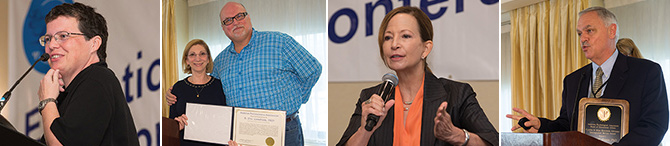
{L to R): Sue Frantz; APA President Dr. Nadine J. Kaslow awards Dr. R. Eric Landrum with a presidential citation; Dr. Cathy Sandeen; Dr. Joseph Evans (credit: Nick Crettier)
While many psychology educators have been quick to adopt technology, all educators should keep in mind that technology is just a tool that must be used carefully to enhance learning, said Catherine Grus, PhD, APA's deputy executive director for education.
"Technology is only as good as we understand the evidence behind it and prepare ourselves to use it effectively," Grus said.
Used properly, technology in the hands of psychology professors and other educators has the potential to make the American educational system more competitive, said Cathy Sandeen, PhD, vice president for education attainment and innovation at the American Council on Education.
Just 43 percent of Americans age 25 to 34 have earned at least a two-year degree, she pointed out. Yet The Center on Education and the Workforce at Georgetown University predicts that 65 percent of U.S. jobs will require at least some postsecondary education by 2020.
Technology can help fill that gap, said Sandeen, especially since only 25 percent of college and university students in the United States are traditional full-time students. A software program called Degree Compass, for example, helps students choose optimal course schedules based on their major's requirements, past performance, course availability and other factors. Schools that have put the system in place have seen students earn better grades, degree completion rates go up and withdrawals go down, said Sandeen.
"With the smart use of data and technology, we can help our students learn, persist and complete their degrees," said Sandeen.
Harnessing the power of data
Some educators are taking that challenge to heart.
Psychology professor Victor Benassi, PhD, faculty director of the Center for Excellence in Teaching and Learning at the University of New Hampshire, has been experimenting with ways to use data analytics to make technology more effective in the classroom.
In one study, Benassi proved to professors that PowerPoint presentations with animation, colorful backgrounds and unrelated photographs can direct students' attention away from the lesson content.
To show the impact presentation design can have on student learning, Benassi conducted a study in which he asked volunteers to submit their slides to him. He then redesigned half the slides in professors' presentations to conform to good multimedia design principles by deleting anything extraneous, breaking material into smaller segments and adding graphic elements to illustrate text. The result? The percentage of correct responses on quizzes at the end of each class was 14 percent higher for questions about material presented in the redesigned slides compared with those about material presented in unmodified slides. The changes improved students' long-term retention, too, with mid-term exams showing a 10-point difference between questions based on material presented in modified versus original slides.
Using data to assess learning, improve teaching and enhance program offerings is especially important as education faces calls for greater accountability for student success, said Linda Baer, PhD, founder of a higher education consulting firm called i4 Solutions.
When professors and administrators collect and analyze data regularly, they can determine which students are at risk for failure, which classes are duds, even what the implications could be for a student considering a change in majors, said Baer.
Of course, the real issue is what to do with the information you find, she said, emphasizing the need for early intervention. "The problem is many times we look [at the data] after the fact — at the end of the term, we look at how everybody did — instead of systematically looking throughout the term and understanding how things are going early enough to do something about it," she said.
No matter what level you apply analytics to, said Baer, the goal should be "actionable intelligence." Take one program, where students often dropped out when they hit the required anatomy and physiology class. Analysis revealed the problem wasn't how difficult the class was for these nontraditional students, but the 3 p.m. time slot when it was offered. "What happens at 3:00? Kids get out of school," said Baer. "People weren't completing the program because the gateway course was offered at a time that wasn't easy for them to get to."
Using data to see who's making steady progress toward graduation and who's in trouble can be as simple as tracking attendance and calling students who don't show up, said Baer. Learning and course management systems can help professors track attendance and student engagement, said Baer. Yet faculty aren't using such tools systematically, she said, citing a 2012 case study in Educational Technology & Society that found that at least 70 percent of the professors at a large research-intensive university profiled weren't using them.

(L to R): Dr. Anastasia Salter; APA President Dr. Nadine J. Kaslow recognizes Kelly Brown; Dr. A. Jordan Wright; Dr. Victor Benassi (credit: Nick Crettier)
Better teaching online
Online classes are an increasingly important part of higher education, said Ladonna Lewis, PhD, a psychology professor at Glendale Community College in Arizona. But online courses aren't a silver bullet, she warned.
Online courses were once viewed the way MOOCs are viewed today, said Lewis. "They were going to save all this money … and education would be free and open," she said. But well-done online classes take effort, money and time, she said, citing the need to build in opportunities for students to interact with instructors.
While online classes improve access to education, said Lewis, they have limitations. When she examined data from her own program, where most classes are face-to-face, she found that online students in an introductory psychology class were more likely to drop out and didn't perform as well as face-to-face students. While more than 90 percent of face-to-face students completed the class and 76 percent earned a C or better, just 74 percent of the online students finished and only 65 percent earned at least a C.
"What worries me in the community college setting is that we're setting students up for failure; we're cutting budgets, then throwing online classes at students," said Lewis. "The students who need support the most are getting the least." Students often take online classes because they have jobs, children or other obligations that prevent them from taking classes in person, she pointed out.
To help such students thrive, Lewis suggested limiting online class size to facilitate interaction with the instructor, encouraging students to connect with each other and making sure online students know about such resources as writing and math tutors, which are often available online as well as on campus. Instructors can also boost students' motivation and time management skills by urging them to treat online courses like in-person courses and devote specific times in their schedules to online work.
It's also important to teach instructors the special skills needed to teach successful online courses, said A. Jordan Wright, PhD, who heads the human development department at Empire State College of the State University of New York.
Consider course development, for example. "You can't just shove a course online," said Wright, warning against simply videotaping lessons and using the same assignments and evaluations used in the lecture hall. Research on online learning suggests that students learn best with smaller, more frequent assignments; discussions that promote higher-level learning; and opportunities to interact with the instructor and each other. Instructors also shouldn't fall prey to what Wright calls "course and a half syndrome," being proactively defensive against people who think online courses aren't rigorous enough by trying to do way too much.
More research is needed on how best to teach professors the skills they need for online teaching, said Wright. In the meantime, he said, "people who are going to teach online should take an online class and learn about online learning in an online platform."
Playing games
Putting an in-person class online without modifications doesn't work, and neither does making pencil-and-paper games digital, said Anastasia Salter, PhD, an assistant professor of digital media at the University of South Florida.
In traditional educational games, she said, nothing happens differently than if it happened on paper. "The technology is getting more sophisticated and more powerful, but we're often not using it better," she said. Classroom Jeopardy is just a quiz in disguise, for example. Math Blaster, which encourages kids to shoot correct answers, is nothing more than a glorified drill sheet. "You could probably get kids to play this for a while and think they were having fun, but after a while they'll figure out that you've handed them what we in educational games like to call chocolate-covered broccoli," said Salter.
Done right, however, games can offer something new. In contrast to traditional classroom learning, where passivity reigns, digital games give students exciting opportunities to explore ideas in simulated realities, said Salter. Students can take on roles, face challenges and opportunities to develop their characters and discover that problems are best solved through cooperation.
Other digital games let students inhabit the interior worlds of others. A game called Spent makes users aware of what it's like to live on minimum wage, while Trading Races is a role-playing game. Depression Quest simulates life as a person with depression.
Games, said Salter, are a way to represent ideas, worlds and experiences that would otherwise be difficult to bring into the classroom. The key, she said, is to use well-designed games, integrate them meaningfully into classes and brief students about what they're supposed to get out of the experience and how they might transfer that learning into another space.
Rebecca A. Clay is a journalist in Washington, D.C.