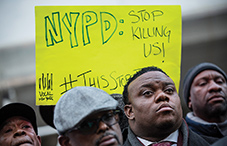

Psychologists and their research are central to two federal efforts to improve relationships between police and the communities they serve. A new, $4.75-million Department of Justice (DOJ) initiative aims to combat distrust and hostility between police and citizens, while a White House task force will focus on improving 21st century policing. Both measures include psychologists' research and insight.
Research on what works
The DOJ's new three-year program, the National Initiative for Building Community Trust and Justice, is being led by a consortium featuring psychologists and social science researchers from the University of California, Los Angeles; Yale Law School; the John Jay College of Criminal Justice; and the Urban Institute.
Although the new initiative was announced in September 2014 — a month after the shooting of Michael Brown in Ferguson, Missouri — it had been underway long before that incident, says Yale professor and social psychologist Tom Tyler, PhD, a member of the consortium. "It's a response by the DOJ to their sense that there were problems of trust and confidence in the police in America, but of course it was accelerated by everything that happened," he says.
The initiative brings together three groups of researchers — including two led by psychologists:
- Tyler and other researchers at The Justice Collaboratory at Yale Law School will focus on what causes people to view police and the criminal justice system as legitimate and therefore to comply with police orders. They will base their work on psychological research into legitimacy and procedural justice as it applies to police-citizen encounters.
- Researchers at UCLA's Center for Policing Equity, co-directed by social psychologist Philip Atiba Goff, PhD, will explore ways to reduce implicit racial bias.
- David Kennedy, director of the National Network for Safe Communities at John Jay College, will concentrate on facilitating racial reconciliation.
The researchers will develop and study interventions based on existing research, and adapt these to the needs found in five yet-to-be-determined pilot sites, says Tyler. In addition to addressing general police-community issues at each pilot site, the researchers will work with a specific group or area of concern, such as race relations, anti-gang initiatives, or lesbian, gay, bisexual or transgender communities. "We're going to target particular populations in communities where those populations are especially an issue," says Tyler. Sites were expected to be named on March 1.
Tyler's interventions, for example, will focus primarily on the types of policies and practices his work has shown can be effective. These include having officers walk beats, making sure citizens get follow-up calls after they contact police to find out whether problems were resolved, and keeping the public informed through regular communication, such as newsletters.
Jennifer Eberhardt, PhD, is a social psychologist at Stanford who specializes in the study of racial bias and policing, and is a consultant to the DOJ initiative. Eberhardt has researched racial bias with Goff at the Center for Policing Equity and is a recent MacArthur "genius" grant award winner for this work. She also presented her research to the DOJ last fall and plans to speak there again this summer (see November Monitor).
In a project likely to inform her work with the DOJ initiative, Eberhardt has been hired by the Oakland Police Department to analyze whether its stops and searches are influenced by race. She also is analyzing the department's body-camera footage — hundreds of thousands of hours of video taken during police-citizen interactions over the past four years. "We're … trying to understand the triggers for interactions going awry [and] what officers can do to de-escalate conflict and feed that back into training," she says.
A team of about eight researchers in Eberhardt's SPARQ (Social and Psychological Answers to Real World Questions) center at Stanford will be looking at everything from body language to tone of voice as they analyze the interactions.
"Having the body camera footage allows us to actually see the incident unfolding in real time, so that's the thing that we're excited about that we've never been able to see before," says Eberhardt.
She sees the raw video as a gold mine that can quantify what's actually happening on the streets. The video analysis also can help train officers by showing which words, tones of voice, body language and other factors are effective and which are not.
Enhancing policing
President Obama's Task Force on 21st Century Policing will also explore ways to strengthen public trust and improve relationships between law enforcement officers and the communities they serve, as well as combat crime more effectively. The task force will seek input from experts through a series of "listening sessions" before coming up with recommendations, due in March.
Among those named to the 11-member panel last December was Cedric Alexander, PsyD, deputy chief operating officer for public safety for DeKalb County, Georgia, where he oversees the police, fire, emergency management and other departments. Alexander, who heads the National Organization of Black Law Enforcement Executives, earned his doctorate in clinical psychology in 1997. (Read a profile of Alexander in the November Monitor.)
"The role of the task force is to give recommendations to President Obama as to how we enhance policing in America," says Alexander. "How do we advance the criminal justice system to create an environment where everyone feels like they are part of it and don't feel so separated?"
Alexander — who visited Ferguson at the request of the city's police chief following Michael Brown's death — says that the lack of trust between police and communities can be addressed by applying "the basic skills we learned as psychologists," such as how to listen, to understand others, to interact more meaningfully and to communicate more effectively.
"Psychology can play such a significant role just by being at the table and being able to deliver a sense of calm to an environment where there's a whole lot of noise going on and people don't know how to deal with it, how to respond to it," Alexander says.
While working as police chief in Rochester, New York, Alexander developed basic psychology training for officers to allow them to better identify mental health issues and help citizens with such conditions. Alexander says the training led to a significant decrease in violence in the city. "People who may have been having a crisis were less likely to be violent to police and vice versa."
He would like to see such training become a regular part of policing, since so many calls for police help have a mental health component and police often don't have the training to respond to them.
"As a psychologist, that's going to certainly be one of my mantras at the table, to bring more awareness of this," says Alexander.
Lorna Collier is a journalist in Chicago.