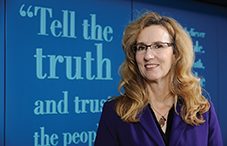

What do you do at the Pew Research Center?
I foster the development of research related to science and society. I focus on survey research, which involves designing questionnaires that reveal what and how people think about different issues related to science. Public opinion has an important role in democracy, and our research explores how well governmental policies line up with public views and what influences public opinion.
For example, we did a survey recently to learn about the public's views on things such as genetically modified food, childhood vaccines, climate change and genetic modification of babies to decrease the risk of serious illness. We also looked at factors underlying opinions, such as religion, education, gender, age and political views. After analyzing the data, we found that opinions about the issues we surveyed were sometimes divided along party or religious or other lines, but no single pattern explained the answers people selected across all 22 science-related issues.
How do you use your psychology training in your job?
My training in statistical and research methods helps me evaluate which research designs to use and analyze the findings. It also brings perspectives on how people think and the kinds of factors that influence attitudes and behaviors.
We use a collaborative process to design questionnaires, and part of what I do as a psychologist is listen to how people on the team are interpreting the phrases. I can then help guide us toward a meaning that people hold in common. For instance, we had to decide which term to use on the survey, "genetically modified food" or "genetically modified crops" or "genetically engineered food." The terms are intended to convey the same concept, but they hold different connotations for many people.
Where did you get the training and experience for this job?
I studied psychology as an undergraduate, and my first job after college was working for CBS News on pre-election surveys that looked into public opinion about political issues and campaigns. I was always interested in people, their attitudes and how they think about issues, which prompted me to enroll in a social psychology doctoral program at the University of California, Los Angeles. After that, I worked in academia teaching survey research, but I was not designing surveys for a number of years. I realized I needed to supplement my psychology training with real-world survey experience. While I was a faculty member at Virginia Commonwealth University, I started directing the VCU Life Sciences Survey, which was a new series of nationally representative surveys focused on public attitudes related to science and biotechnology.
How did you learn about the job?
A colleague let me know there was an opening at the Pew Research Center. I was well-established in my career at that point, and the Pew Research Center had known of my work surveying the public about their understanding on a variety of topics, including science.
What do you enjoy most about it?
I really enjoy the fact that I work in an unbelievably collaborative research group where we come together and share ideas. By working collectively, I think we develop better research projects. Getting data back is also endlessly fascinating because we get a window into what people think, and to me that is always interesting.
It's also important to me to have a hand in all the phases of research, and the team is involved from the beginning to the end of a project. I've had jobs in which I only focused on the design phase or the analysis phase, and I love seeing something from beginning to end.
What's difficult about your job?
Our aspiration is to do more research on more topics, so "our eyes are bigger than our stomachs," so to speak. As an organization, the Pew Research Center is nonpolitical and nonpartisan, and sometimes it can be challenging to study topics that are controversial. We always work to take every perspective into account when designing a survey, but when we comment on our findings, we can only speak to our data. When a topic is particularly divisive, such as climate change or the relationship between religion and science, people may find it hard to hear information that does not align with their views.
What else can you tell readers about this job?
This is not the path I planned to take. I allowed my path to evolve over time and I'm glad I did. When I went to graduate school, I thought I would be a professor for my entire career, but instead I did a blend. I kept one foot in traditional academia and one foot in applied research by doing surveys for the university. Eventually, it all came together with my job at the Pew Research Center.
It's also surprising to me how versatile my training has been. People in the public are increasingly aware of the principles and concepts of behavioral science, such as cognitive dissonance and the fundamental attribution error. I think that speaks to the value and relevance of this training in any job setting.
— Heather Stringer