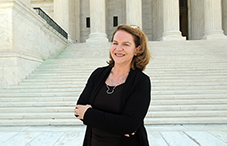

Under the direction of General Counsel Nathalie Gilfoyle, APA has filed 90 amicus briefs on such critical topics as same-sex marriage and the death penalty for juveniles and people with intellectual disabilities. Those efforts have shaped some of the most significant legal decisions in the past two decades and enhanced the association's reputation as an authoritative source of scientific guidance for the courts. In a survey of former U.S. Supreme Court clerks published in the Journal of Law & Politics, a significant percentage of clerks cited APA's briefs as "consistently trustworthy."
"Thanks to her insistence upon even-handed, scientific amicus briefs, APA's influence on the Supreme Court has been strong and positive for many years," says Joel Dvoskin, PhD, an expert on correctional mental health systems who has worked with Gilfoyle. "I can't imagine a more significant or lasting testament to the career of an attorney than to have influenced the Supreme Court in so many cases of profound significance to our country."
Gilfoyle, who retires from APA in June, submitted amicus briefs only in cases where psychological science could have a powerful effect. APA's briefs have been cited in numerous state and federal court decisions, including the recent U.S. Supreme Court decisions in Perry v. New Hampshire (on the unreliability of eyewitness testimony) and Hall v. Florida (exploring why a death-row inmate may be ineligible for execution due to intellectual disability).
In a major recent decision, Obergefell v. Hodges, the Supreme Court cited APA's amicus brief in ruling that the constitution prohibits states from denying marriage licenses to same-sex couples. APA presented key scientific evidence that gay men and lesbians form just as stable, committed relationships as heterosexual couples, and are as capable of raising psychologically healthy children.
Of course, in addition to her amicus brief work, Gilfoyle worked on the full range of legal-risk management issues inherent to a large nonprofit enterprise that publishes books and journals, engages in accrediting doctoral psychology programs, develops practice guidelines, owns two buildings and has more than 500 employees.
The prospect of furthering psychological science through the law is what drew Gilfoyle to the job in 1996, when she came to APA as deputy general counsel before taking over as general counsel in 2001. Gilfoyle developed an interest in the intersection of law and psychology as a research assistant at her alma mater, the University of Virginia School of Law. Her legal career included a stint with Legal Aid, and a partnership in the international law firm McDermott Will & Emory.
Providing legal counsel to a scientific organization has provided a wealth of intellectual challenges, Gilfoyle says. "I am a firm believer in lifelong learning and a day has not gone by at APA when I have not learned something new," she says. "Now it's time to turn my interest in learning to all the other non-legal interests I never had time to pursue."
APA Interim CEO Cynthia Belar, PhD, adds, "Nathalie's work has enabled psychology to make significant contributions to public policy during her tenure here. I have been privileged to work with her."
— Jamie Chamberlin