
This article is the second in the Monitor series "Lab Work," which illuminates the work psychologists are doing in research labs nationwide.
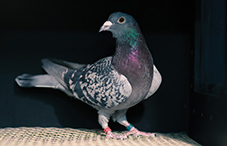
Pigeons have a storied history in psychology. Famed behaviorist B.F. Skinner, PhD, used pigeons to demonstrate his theory of operant conditioning. In the 1960s and 1970s, Harvard psychologist Richard Herrnstein, PhD, devised a classic set of experiments to show that pigeons could classify objects into categories, such as trees or people.
While that latter work was groundbreaking at the time, something about it bothered Edward Wasserman, PhD, a professor of experimental psychology at the University of Iowa. "We don't form categories like 'people versus non-people' or 'flower versus non-flower.' That's not how we carve up the world," he says. "As clever as his work was, it didn't capture what categorization is all about."
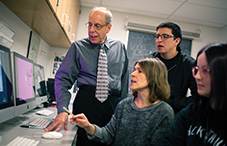 So, Wasserman decided to take Herrnstein's work further. He finished his PhD at Indiana University in 1972. After eight months as a postdoctoral fellow at the University of Sussex, he accepted a position at the University of Iowa and set up his Comparative Cognition Laboratory. He's housed pigeons there ever since. In addition to categorization, he and his team have explored a range of other cognitive processes, including memory, judgment, task switching and visual processing, in pigeons, people and many other species. Pigeons, Wasserman has shown, can do a lot of what humans can do, including learning many new object categories simultaneously, selectively ignoring irrelevant information and learning to recognize human emotional expressions, even on unfamiliar faces (Journal of Vision, 2011).
Wasserman's team currently includes a PhD research scientist, a part-time lab technician, two graduate students, five undergraduates and a rotating pool of collaborators all over the world. It's a busy and productive group, says former student Fabian Soto, PhD, now an assistant professor of psychology at Florida International University (and recipient of the 2016 APA Award for Distinguished Scientific Early Career Contributions to Psychology). "We were running experiments day and night, and the range of topics was amazing," he says.
Those topics have come a long way from the early days of animal research. "My theoretical inspirations are Pavlov and Skinner, but we want to know a good deal more about the basic mechanisms and principles" that control behavior and learning, Wasserman says. He was a physics major before pursuing psychology, so precise methodology comes naturally to him, he says. "What we're doing isn't rocket science — it's way harder because we deal with living beings."
Word learning and x-ray vision
While the pigeon is a cornerstone of Wasserman's work, he thinks of Columba livia as just one system by which to understand the basic building blocks of cognition. Raising many different species in one lab is impractical, however. In order to take a truly comparative approach, he's collaborated with scientists around the world to incorporate research on bonobos, baboons, crows, parrots, dogs and more.
"I started off following the lone wolf model of scholarship. As I've gone deeper into the field, I've found we need teams of people working together to do really exciting work," he says.
Those partnerships aren't always easy. "It's like dating. Some work out and some don't. Some are flirtations that don't amount to much. Long-distance relationships can be challenging," he says. "But when they do work, they're quite exciting."
In 2016, Wasserman embarked on a major new collaboration when he and a team of investigators from the University of Iowa, the Ohio State University and University College, London, secured a five-year $5.77 million grant from the National Institute of Child Health and Human Development to study the development and neurobiology of categorization. The scientists will be exploring the processes that pigeons, rats and children of differing abilities use to categorize objects in their world. While Wasserman's team will focus on the pigeon piece, his collaborators in London will undertake comparative work exploring the neural mechanisms of category learning in humans.
Leyre Castro, PhD, is helping to coordinate that project. Castro arrived from her native Spain for a one-year postdoc in Wasserman's lab in 2004. When he offered her a permanent research scientist position, she stayed.
While Castro says the pigeons are a lot of fun, her motivations — like Wasserman's — go deeper. "My main interest is in the pigeons as a model for learning more about cognition," she says.
Psychologists who study human subjects don't always fully appreciate how much can be learned from animal research, she adds. "We don't do this because it's cute or just for curiosity. The essence of how organisms learn and behave is the same. Things that seem really sophisticated, we see in the pigeon and we realize the mechanisms are much more basic than we may think."
In one example, Wasserman and Castro presented pigeons with touchscreens featuring sets of images, such as stars and spirals. They showed that when learning to distinguish one set from another (as indicated by patterns of pecks on the screens), the birds — like humans — apply selective attention, essentially tuning out the irrelevant visual information. What's more, the birds didn't learn which pieces of information were relevant and then acquire the appropriate way to respond. Instead they seemed to learn which pieces of information were relevant simultaneously and steadily improved their ability to respond accurately, just as humans do (Journal of Experimental Psychology: Animal Learning and Cognition, 2014).
In another study, Wasserman and his colleagues showed that pigeons could learn to categorize objects into 16 human language categories simultaneously, as opposed to one category at a time. These results parallel findings of studies on word learning by human infants, suggesting pigeons use a process similar to the one that human babies employ as they acquire language. The results hint that human word learning might rely on more basic associative learning mechanisms than previously thought (Cognition, 2015). Such work could lead to improved methods of teaching words or other concepts to people, he says.
Other projects also angle toward applications outside the lab. For example, Wasserman, current PhD student Victor Navarro, and collaborators showed that pigeons could be trained to distinguish between healthy and cancerous tissues in X-rays. After around two weeks of training, the pigeons correctly identified signs of breast cancer 85 percent of the time, a level on par with that of human pathologists (PLOS ONE, 2015).
Wasserman suggests pigeons (or other animals) might be trained to serve as initial screeners before a person makes a final diagnosis, especially in developing countries where trained experts are in short supply. As far-fetched as that may sound, Wasserman has already heard from a group in South Africa who wondered if they might use pigeons to screen chest X-rays for tuberculosis. Perhaps more practically, the birds could be used to test image-enhancement techniques that could help human pathologists make more accurate diagnoses.
Living the dream
Despite the potential for downstream applications, animal cognition research in general doesn't always command the respect it deserves, says Soto. "Funding for animal research is going down," he says. That can make it hard to find jobs in the field after leaving the lab, unless graduates are willing to move into a different line of research. "You might have to reinvent yourself during your postdoc to be fundable," he says.
Still, many lab graduates have continued in animal research, while others have moved into human cognition or other fields, such as neuroscience modeling in Soto's case. "People come out of this lab and end up in really different places," he says. Yet wherever they end up, their meticulous training in animal cognition provides a valuable foundation, he adds. "Working with animals you learn to study complex cognitive processes with a rigorous methodology that is not always possible in a human cognition lab."
Soto also notes that there's a great balance of enthusiasm and attention to detail in the lab. "Ed has the same excitement that young people have for science and for data, and that's really contagious," he says. And even after many decades of research, he remains open to new ideas, Soto adds. "He lets things go in the direction in which the data are telling you. He doesn't have this five-year plan in which everything has to work in the way he thinks it should work. As long as the experiment makes sense, he supports you."
Castro, whose role as research scientist involves a mix of helping with Wasserman's larger projects and pursuing projects of her own, is similarly enthusiastic about the lab's approach to science. "We live in this world where we have to publish, so you have to have some topics that are relatively safe," she notes. "But he allows us to go beyond that, and try something that sounds crazy, or that we may not know exactly how it will work."
Sometimes it can be hard to keep up with the sheer number and diversity of projects happening in the lab, says Navarro, a third-year PhD student. While that's challenging, it's also exciting to be in the midst of so much science. Wasserman has a knack for tackling intricate cognitive phenomena by dissecting them into manageable parts, says Navarro. "He has great experimental finesse and intuition."
It's a talent Wasserman has polished over decades of doing hands-on science. "When I started as a grad student, I was told to do a project and given an empty room. The wood shop was the first place I went," he says.
"Now we have a beautifully equipped lab with touchscreen computers for every bird. We are able to ask questions we couldn't even think of before," he adds. After nearly half a century of his science, Wasserman says, there's nowhere else he'd rather be. "I'm living the dream."
Research foci
The Comparative Cognition Laboratory is exploring:
1. Categorization
2. Conceptual behavior
3. Visual pattern recognition
4. Short-term memory
5. Causal perception