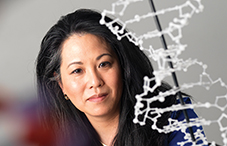

Vivian Ota Wang's early career as a genetic counselor opened her eyes to the ethical and racial issues involved in the field of genetics. She saw, for example, how Asian and Latino infants were often flagged for Down syndrome testing because their normal eye shape was mistaken as "dysmorphic." Experiences like that fueled her desire to pursue a doctorate in counseling psychology, enabling her to study how considerations of race and racial identity influence genomics, genetic counseling and public health.
Ota Wang went on to become a manager at the National Institutes of Health, where she is program director of data access and sharing at the National Human Genome Research Institute. Her work centers on issues such as human subject protections in research and the ethics of genomics and neuroscience.
What does your work at the institute entail?
I help develop and implement policy related to sharing genomic and phenotype (observable characteristics) research data. These data are generated by researchers worldwide who are searching for new trends and mechanisms for understanding the genomic, environmental and behavioral interactions that cause diseases.
For example, they may be exploring how cardiovascular disease is connected to genomics, environmental factors like where people live and work, and behavioral factors such as diet, exercise and smoking. By sharing data with one another, researchers can explore a wider range of questions, validate research results and increase statistical power. Much of my work involves deciding what, where and when those data should be shared, who should have access to it and what can be done with it.
I also use my clinical skills when working with administrators and researchers, who are sometimes impatient with the pace of policy development and may want to advance the science faster than the ethical and legal issues allow.
What got you interested in genetics research?
It started in high school. I was eager to learn more about science careers, so I joined a program offered through the Boy Scouts. We visited a surgical oncology lab where scientists were studying cancer cytogenetics. I started volunteering there and continued working in that lab during and after my college years. Over time, I realized I was more interested in working with people than mice and cell cultures, so I eventually pursued the budding profession of genetic counseling to combine my science, ethics and clinical interests. My frustration with the Down syndrome testing for Asian and Latino infants, coupled with the monocultural lens of genetic counseling, motivated me to refocus my work on multicultural competence and issues of race and genomics. After earning a PhD in counseling psychology, I worked in academia for about 10 years. I was then recruited by NIH for my multidisciplinary expertise in psychology, ethics, genetics and genetic counseling.
How have you used your expertise in racial identity and genetics to make a difference?
My passion is human rights and protections in research, particularly for vulnerable populations. The research enterprise is riddled with examples of ethical dilemmas, such as the Havasupai First Nation studies in the 1990s in which the research participants didn't realize their DNA samples were being used to study schizophrenia. My policy work has focused on making sure people understand the concept of informed consent when they are participating in a research study. For example, I met with groups of self-identified Han Chinese in China and the United States to explain how their DNA would be used for the next generation human genome project known as the International Hap Map Project. The project aims to develop shortcuts to identifying genomic causes of diseases. I addressed concerns among the Han Chinese about increased discrimination and group stigma if a "bad gene" was discovered in their samples. I explained that diseases are complicated and influenced by a combination of factors, including genes, the environment and behaviors.
What is the most challenging part of your job?
For me, it is weighing scientific, ethical and political factors when creating and implementing policy. You can have uncertain science, unclear ethics and policy aspirations that compete against each other. These competing interests were at play when I was on an FDA drug panel that was deciding whether to approve Bidil, the first race-based drug that would be marketed specifically for congestive heart failure to self-identified African-Americans. I cast a minority dissenting vote because the science didn't support the race-specific labeling for the drug, but the drug was approved anyway.
What do you enjoy most?
I love working with curious and innovative people who aren't afraid of disrupting the status quo—it challenges me to be creative. I worked on the White House's National Nanotechnology Initiative, which gave me insight into the scientific excitement and ethical uncertainties of nanotechnology, which can be used for everything from tissue engineering and regeneration to enhancing color quality and energy efficiency for televisions. Yet the environmental and personal risks of using engineered nanoscale materials—which have increased mobility and reactivity—are unknown and raise ethical issues about their use. We also face interesting questions related to dual use. Should the nanotechnology used for rehabilitation and medical treatments be available for performance enhancements in athletics and cognitive functioning? Or would this create unfair advantages?
What have you learned at NIH that psychologists should know?
Generally speaking, psychology researchers are reluctant to participate in data sharing. If we don't share data as a profession, we are at risk of being left behind in cutting-edge multidisciplinary science, and our expertise may be replaced by nonpsychology researchers who are involved in data sharing. I'm eager to have more psychologists embrace data sharing to make new and unimagined discoveries.