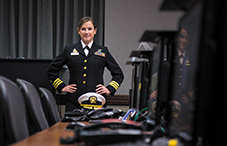

Commander Jill Breitbach, PsyD, had an unusually busy fall. A former Army psychologist, Breitbach is now a member of the U.S. Public Health Service (PHS), the Commissioned Corps of the U.S. Department of Health and Human Services (HHS). She works as a liaison officer between HHS and NORTHCOM, the Department of Defense's Northern Command, which is responsible for the United States, its territories of Puerto Rico and the U.S. Virgin Islands, as well as Canada, Mexico and the Bahamas.
During disasters on U.S. soil—such as the 2017 hurricanes Harvey, Irma and Maria that devastated areas of Texas, Florida, Puerto Rico and the U.S. Virgin Islands—Breitbach helps coordinate the federal government's public health response. She joins the resources of HHS and the military to make sure that, for example, hospital patients continue to receive medical care through power outages, flooding and other disruptions.
Tell me about what you do in response to natural disasters.
When there's a disaster, the U.S. Department of Health and Human Services can bring in federal assistance, such as Public Health Service officers and supplies like cots and pharmaceuticals. Frequently, we ask the Department of Defense to assist, because HHS lacks the resources that the DOD has for a sustained response. For example, shortly after Hurricane Maria, we were notified that we needed to evacuate a hospital in St. Croix. HHS doesn't have airplanes or helicopters to move patients across a large body of water, so we asked DOD to move patients to other locations for care.
To give you an idea of the scale of the challenge in Puerto Rico, when the storm hit, it knocked out power to the island's 69 hospitals. We track how many are back on grid power, how many have generators and what people or equipment shortages they may have. Our focus is making sure the infrastructure is running as well as it can be, that the hospitals have food, water, power and supplies.
What else does your job involve?
The other part of my job is global health engagement, specifically reaching out to and collaborating with the governments of Mexico and the Bahamas. For example, we've trained first responders how to provide psychological first aid and helped to build community resilience in several cities in Mexico, along with the Mexican disaster-relief agencies that are equivalent to HHS, FEMA or the Red Cross. After the recent earthquake in September, we heard from our colleagues there that they used our materials to provide "just in time" training for an additional 1,500 responders in Mexico City. "I'm very proud of that particular project. We've also trained people who work with children and families after disasters, and with the special needs community. And we did trainings for clinicians who work with first responders themselves."
I also coordinate other global health projects not related to behavioral health, such as projects on food safety and novel diseases, as well as medical equipment donation. So, my role is not only in behavioral health; it has a much broader scope.
How did you get the training to do your job, and how does your psychology background influence your work?
While I was in the Army, I did a fellowship in neuropsychology and completed a master's degree in psychopharmacology. So, I'm a prescribing clinical neuropsychologist when I'm doing clinical work—it's very analytical. When I joined the Public Health Service, I completed additional training in public health and disaster response. In addition, I've received training in global health through the Uniformed Services University of the Health Sciences.
In general, psychology is relevant to my job because at a basic level, all psychologists take in a great deal of information, analyze the information and then identify immediate, midterm and long-term goals and strategies for helping the organism or the organization. And that is essentially what I do here. I take in a ton of information every day and analyze what parts of it are relevant to both sides—both for HHS and for DOD. So that ultimately helps coordinate an efficient and effective response for those who are in the middle of a disaster and desperately need it.
What prompted you to join the military?
My family has a long history of military service. Both of my grandfathers were in the service—one was in the Army and one in the Navy. So, I'd always considered it, but enlisting or being a traditional non-medical officer wasn't for me. Instead I went to graduate school in clinical psychology at Pacific University in Oregon. One of my instructors there was Paula Truax, who had served in the Air Force and had great things to say about the experience. She was phenomenal. When I thought about the kind of psychologist I wanted to be, she was it.
The reason I went into the Army specifically was that I met the man who would be my husband, and he was in the Army, and it was easier for us to get stationed together if we were both in the Army. So I applied for my internship at Eisenhower Army Medical Center in Georgia. Over the years, I've worked at Fort Bragg, North Carolina, at Fort Carson, Colorado, and at Tripler Army Medical Center in Hawaii. I've also been deployed to Iraq.
Why did you transition to the Public Health Service and how did you get your current job there?
Ultimately, what made the decision was that I had my kids, and one of their parents needed to be home consistently. I can still deploy as a PHS officer, but it's a domestic deployment in most instances. Public Health Service officers generally serve in health-related jobs for different federal, state and local entities where there is an underserved population. We also partner with federal agencies, such as the DOD, where there is a benefit to both organizations to have liaisons embedded.
My first position was working for a special forces group at Fort Carson, Colorado. I oversaw clinical services for an initiative called Preservation of the Force and Families that serves the unique needs of special operation soldiers and their families, who are usually away more than they are home.
I happened to know the psychologist in charge of setting this program up at Fort Carson and worked with him to create a job and shape it so it could be a PHS job. I was there for three years, and I've been here at NORTHCOM for over three years now. This month, I'll be moving into a new position with the Veterans Health Administration as a program manager.
For more information about applying to become a U.S. Public Health Service officer, visit www.usphs.govopens in new window. Psychologists interested in participating in federal disaster response in other ways can contact the National Disaster Medical System, whose members serve as intermittent federal employees, and the Department of Health and Human Services' volunteer Medical Reserve Corps.