skip to main content

Datapoint

APA Style leaf logo Cite This Article in APA Style
Lin, L., Ghaness, A., Stamm, K., Christidis, P., & Conroy, J. (2018, October 1). Datapoint: Do psychology degree holders work in psychology jobs? Monitor on Psychology, 49(9). https://www.apa.org/monitor/2018/10/datapoint

  • In 2015, about 64 percent of the 1.3 million people in the U.S. workforce who held a psychology bachelor's degree as their highest degree reported that their jobs were related to that degree.1,2 That's less than the percentage in science and engineering fields overall (74 percent).3
  • About 87 percent of the 604,200 people who held a psychology master's degree as their highest degree reported that their jobs were related to that degree. That's nearly the same as those who held a master's in science and engineering fields overall (88 percent).
  • About 96 percent of the 207,100 people with a psychology doctorate or professional degree reported that their jobs were related to their highest degree. That's the same level as those with doctorates in science and engineering fields overall.
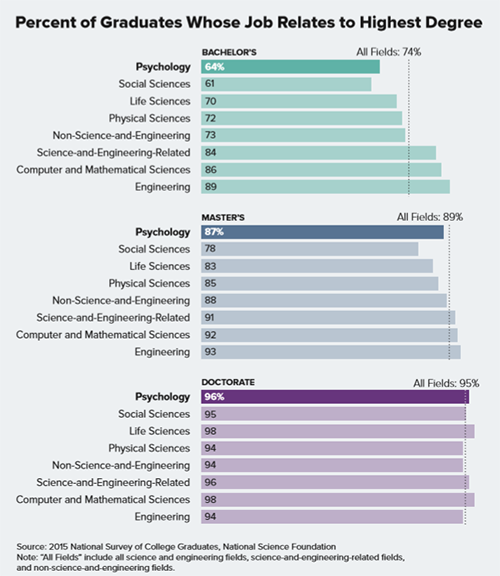
Datapoint Oct. 2018 For an interactive version of this "Datapoint," including occupations for psychology bachelor's, master's, doctoral and professional degree holders, visit the APA Center for Workforce Studies data tool. For more information, contact cws@apa.org.


Footnotes

1National Science Foundation (NSF), National Center for Science and Engineering Statistics. (2015). National Survey of College Graduates Public Use Microdata File and Codebook. Retrieved from https://ncses.nsf.gov/explore-data/microdata/national-survey-college-graduatesopens in new window. Field of bachelor's degree was based on respondents' first major field of first bachelor's degree. Examples of professional degrees include PsyD, JD, MD, DDS and DVM. The use of NSF data does not imply NSF endorsement of the research, research methods or conclusions contained in this report.

2Respondents were asked to what extent was their work on their principal job (job spent most hours in a typical week) related to their highest degree: closely related, somewhat related or not related. Those who reported "closely related" or "somewhat related" were coded as working in a job related to their highest degree.

3Science and engineering fields include computer and mathematical sciences, life sciences, physical sciences, social sciences, psychology and engineering fields. Science-and-engineering-related fields (not included in "science and engineering fields") include health, science and mathematics teacher education, technology and technical fields, etc. ­­­Non-science-and-engineering fields include management and administration fields, education, social service, sales and marketing, art and humanities, etc.

Recommended Reading

Letters to the Editor