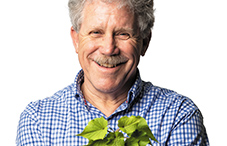

Using principles of psychology, design and behavioral economics, Michael A. "Mick" Smyer, PhD, is leading an effort to move older adults from environmental anxiety to earth-friendly action through his hour-long "Your Climate Journey" workshops. The project is part of his Graying Greenopens in new window initiative, which also includes consultation to public and private organizations on how to engage their older members, retirees and near retirees in sustainability efforts. The project is outlined in a 2017 article in Public Policy & Aging Report (Vol. 27, No. 1) and has been featured on NPR, PBS and other media outlets.
Older adults are an important target for several reasons, says Smyer, a professor and geropsychology researcher at Bucknell University in Lewisburg, Pennsylvania, who studies how context affects people’s experience of aging. "Developmentally, older adults—say 60 and older—are primed to be thinking about their legacy and how they will be remembered," he says.
In addition, older adults vote at higher rates than people in other age groups, which is key to making changes at the regulatory and legislative level. They also have the experience needed to foster change. "If you want to know how to get things done in a local community, look to people who have lived in that community, who have been on the committees and commissions and held offices. If you activate them, next thing you know, their community is composting."
And perhaps most important, the size of this group is massive: Nearly 1 billion people worldwide are age 60 or older, and that number is expected to reach 2 billion by 2050. "To leave them on the sidelines while the world is trying to come to grips with climate issues," says Smyer, 67, "makes no sense at all."
The Monitor talked to Smyer about his Graying Green project.
How do you structure your workshops?
They have three parts, which combine psychology, human-centered design and behavioral economics. The first part asks people to think about a place that has special meaning to them, and then to picture what that place would be like if it were affected by extreme weather or climate change. I also ask them to picture something they can do to keep that change from occurring. In each case, they write and draw their answers—a deliberate tactic, since research shows that two-thirds of our sensory neurons are wired to process visual information either directly or indirectly.
The second part is a card-sorting task—a series of 30 individual actions a person can take toward a more sustainable world. People sort these cards into three piles: things I already do, things I could do and "no way"—things I either cannot or will not do. We do several exercises with those cards, but the task helps people to see that they are already doing something positive, to understand the carbon footprint of their various choices and to choose one thing to move from the "things I could do" pile to the "things I do" pile.
The third part of the workshop is based on strategies from behavioral economics. I give people what I call a climate commitment form and ask them to write down the one thing that they’ve chosen to do in the previous exercise.
How does that work?
Let’s say they’ve decided to get an energy audit—that’s a popular one. They write that down, and then I ask them to list one person they are going to tell about this. We know from research that just telling one other person—having an accountability buddy—increases the odds that they’ll carry through.
I then ask them to picture an individual or an organization whose mission, values and goals they do not agree with, and to write down how much money they’ll give that organization or individual if they don’t carry out their commitment. That’s straight behavioral economics because you’re tapping into what motivates people. The task usually produces nervous laughter, but it’s very effective in engaging people very quickly.
How is the project evolving?
We are building in follow-up activities so that it’s not just a "one and done." One strategy is linking this program to already existing groups—sustainability groups in senior centers, churches and environmental organizations, for example. I also love it when people take what I’m doing and adapt it to their own circumstances. That happened last spring, when city officials in Fort Collins, Colorado, attended one of my workshops. They took the materials, and when I spoke with them several months later, they had made them part of the orientation for all new city employees.
My goal is to get people to move beyond climate avoidance to realize, "There are things I can do."
You have long studied issues of aging, but what got you interested in the environmental aspect of this work?
I came to the environmental issues pretty late. My own climate journey started in 2005 when Hurricane Katrina hit my hometown of New Orleans. While I wasn’t living there at the time, it was like a punch in the gut to watch my hometown devastated. It made me much more aware of extreme weather events. My journey accelerated three years ago, when our twin grandsons were born. Now I can really envision what their world will be like when they’re my age in 65 years.
To learn more about the Graying Green project, listen to the APA "Speaking of Psychology" podcast at www.apa.org/research/action/speaking-of-psychology/graying-green . To contact Dr. Smyer, email him at grayinggreen01@gmail.com .